Mont-Saint-Michel, France Travel & Photography Guide: Best Photo Spots, Things to Do & Hidden Gems
The first time I went to Mont Saint-Michel, I was probably seven or eight years old. I was there with my mother and my uncle, and on that visit, we watched a car float as the water rose around the Abbey.
The tides at Mont Saint-Michel are among the most dramatic in the world. In those days, visitors could drive their cars directly onto the sand around the abbey. The water would come in fast, faster than most people expected, and that day, a car was left too long, and the tide took it.
I went back as a photographer, and the abbey is still exactly as extraordinary as it was the first time. The 2015 bridge that replaced the former causeway means you can no longer drive onto the sand, which is correct and sensible and also a little sad in the specific way all childhood things become a little sad when they are correctly and sensibly removed. Now a shuttle bus brings visitors from the parking lots every fifteen minutes. The photographs are different. The experience of the place is the same.
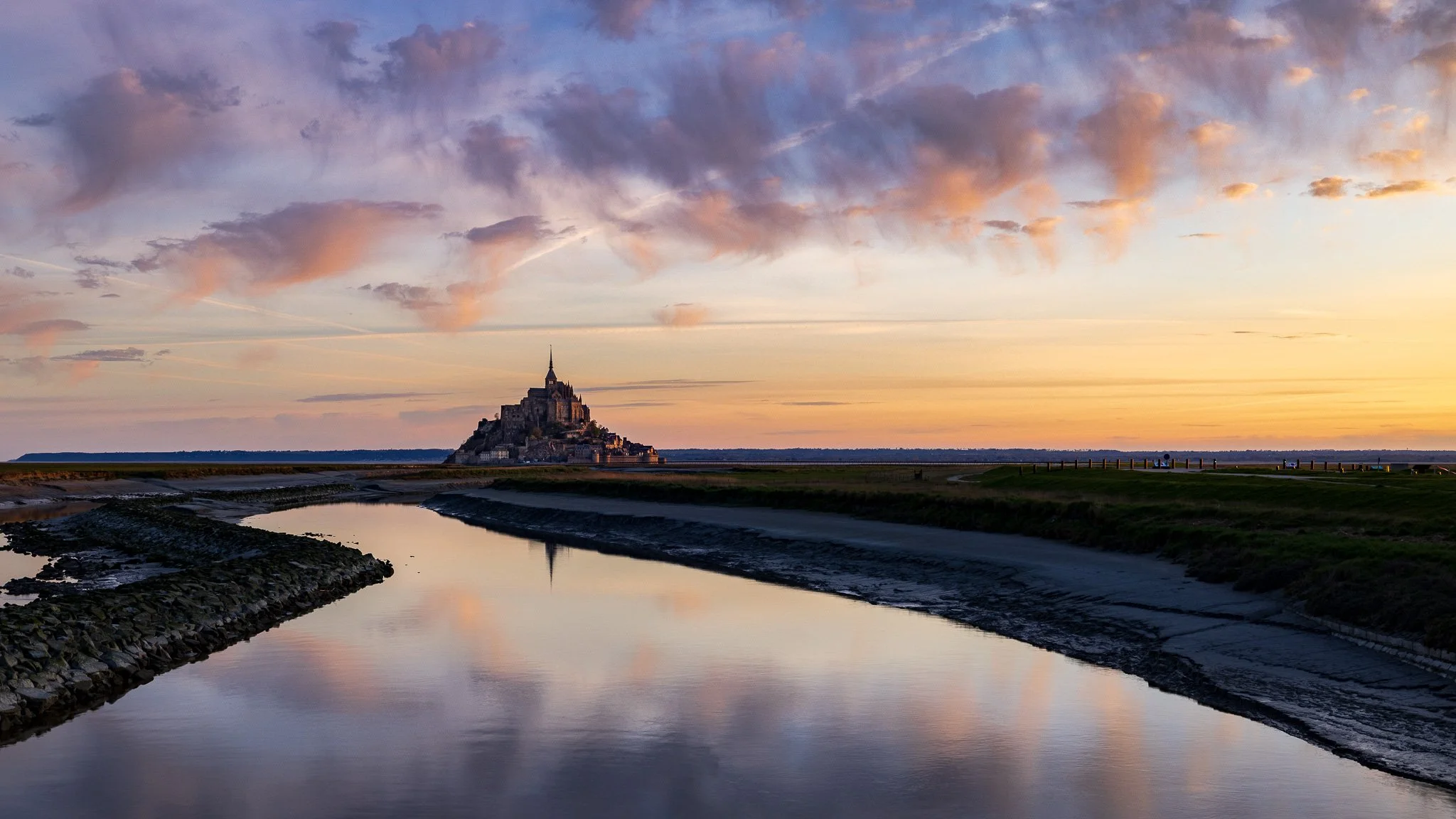
Mont Saint Michel rising above the tidal flats of Normandy, one of France’s most extraordinary photography locations.
Mont Saint-Michel dates to the 8th century and is one of the most visited monuments in France. It has been a Benedictine abbey, a pilgrimage destination second only to Santiago de Compostela in Spain, a prison during the French Revolution, and a UNESCO World Heritage Site since 1979. The tidal island rises from the bay with a completeness that feels impossible: granite rock, medieval walls, the abbey at the summit, and the water circling everything twice a day.
Seeing it at sunrise or sunset, with the light changing across the granite and the sky turning from orange to deep blue, is one of the finest photography experiences in France. There is almost no way to prepare yourself for that first time. Photographs help, and photographs do not help. You have to be there.
In this Photography Guide to Mont Saint-Michel, I share the places and experiences that continue to draw me back. You will find my favorite photography locations, guidance on when and where to shoot, practical travel tips, and gear recommendations, along with cultural insights to help you explore and photograph Mont Saint-Michel with confidence, respect, and ease.

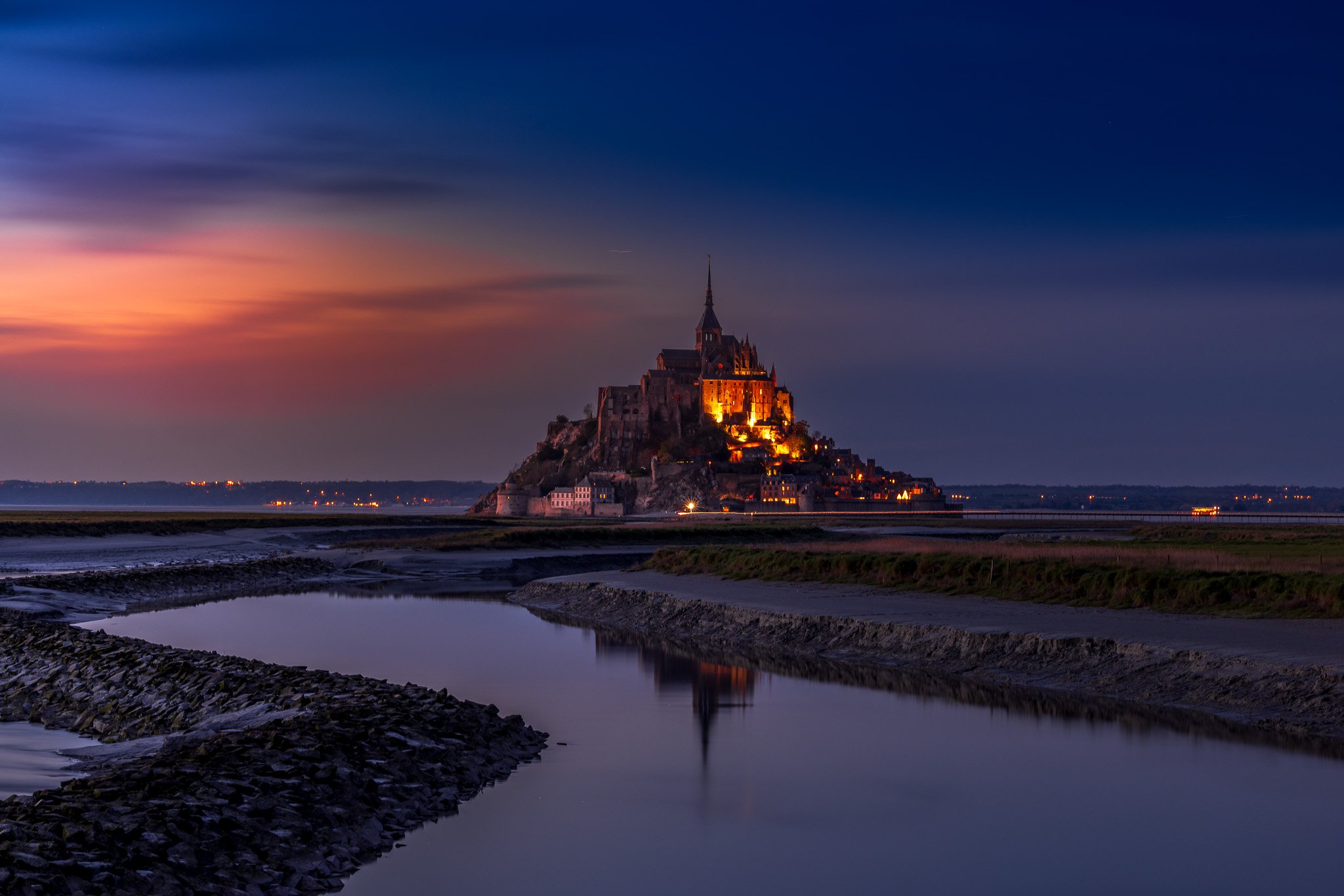
Mont Saint Michel glowing in the warm light of sunset above the surrounding bay.
Photographer's Notes
Before you go, here are my own takeaways.
Favorite Season: Spring
Favorite Location: The Dam
Favorite Restaurant: La Mère Poulard
Favorite Hotel: Mercure Hotel
Favorite Lens: 70-200mm
Would I Return? Absolutely.
How to Get to Mont-Saint-Michel
The simplest way to get to Mont Saint-Michel is by car. From Paris, it is about a 4-hour drive. This is the best way to visit MSM. The advantage of having a car is that you can drive to other areas, such as Saint-Malo. The drive is straightforward, and there are plenty of places to stop for gas or to use bathrooms.
You can also get to Mont Saint-Michel by train from Paris. Here is a link that provides different options on how to get there.

Colorful yellow fields of the Normandy countryside as you approach the island.
Best Time to Visit Mont-Saint-Michel
Mont Saint-Michel is worth visiting year-round, with one exception: avoid mid-winter if you can. January and February bring heavy rain, short grey days, and limited photographic opportunities.
Spring (April and May) is my strong recommendation. I was there in April and found single-digit crowds in the early mornings. The light is soft and directional, the rapeseed fields in the surrounding countryside are beginning to turn yellow, and the weather is cool enough to be comfortable while walking around. Spring also brings some of the more dramatic tidal swings of the year, which means better reflections and a more dynamic landscape.
Summer (June through August) brings the best weather and the longest days, but also enormous crowds. The island sees millions of visitors annually, and peak season is relentless. Golden hour works in your favor here because the light lasts until very late, but you need to be in position by 5am to shoot the dam and causeway before people arrive. If you visit in summer, this is non-negotiable.
Autumn (September and October) is the second-best window. Crowds thin considerably after the summer holiday period ends, the low-angle autumn light creates long, warm shadows on the granite, and the bay takes on a moody, atmospheric quality that suits long exposures well. This is genuinely underrated as a photography season here.
Winter (November through March) offers maximum solitude and dramatic weather, which can produce extraordinary images, but rain is frequent and light hours are short. If you accept the risk and pack accordingly, you can have the place almost entirely to yourself.
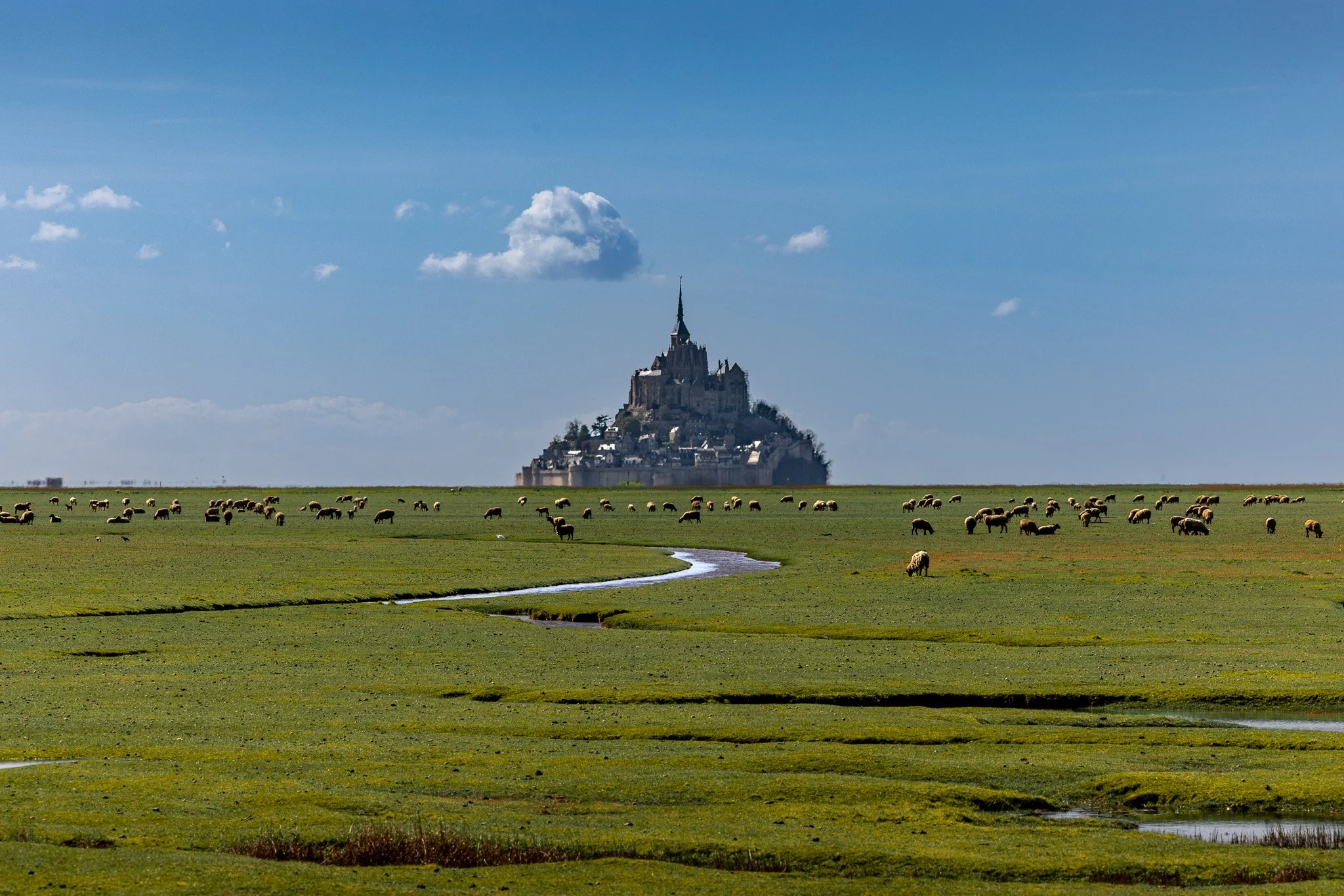
The first view of Mont Saint Michel appearing above the Normandy countryside as you approach the island.
Where to Stay in Mont-Saint-Michel
Where you stay at Mont Saint-Michel is not a minor decision. It is probably the single most important logistical choice of the entire trip, and it will determine what your photography looks like.
My advice is simple: stay within the gated area, near the dam and the Couesnon River. If you stay outside, you are looking at a 40-minute walk to reach the abbey or a dependency on the shuttle bus, which does not run in the early morning hours when the best light exists. The Dam is one of the top photography locations, and from the right hotel, it is a five-minute walk from your front door. That matters enormously at 5 am.
Luxury in Mont-Saint-Michel
Auberge de la Mère Poulard is the most storied address at Mont Saint-Michel, built into the island itself, with the legendary restaurant on the ground floor. Rooms here are historic, atmospheric, and genuinely beautiful. The location inside the walls means you are surrounded by crowds during the day, but at night, when the day-trippers leave, you have the cobblestones almost entirely to yourself. For photographers, this is a unique advantage.
Les Terrasses Poulard is closely related to the Mère Poulard and sits within the island walls with views over the bay. The terrace views are exceptional at golden hour. It is a mid-to-upper range property with a quieter, more residential feel than the main hotel.
Hôtel Le Relais Saint-Michel sits just outside the island, facing the bay with private terraces on each room. The view from your terrace at sunrise is the classic Mont Saint-Michel frame, and the property is well-positioned for early morning walks to the dam. This is the hotel I would look at if the Mercure is full.
Mid-Range in Mont-Saint-Michel
Mercure Mont Saint-Michel is where I stayed in April 2022, and it was exactly what a photographer needs: large, clean rooms, a comfortable bed, breakfast included, and the shuttle drop-off and pick-up directly in front of the entrance. Most importantly, the dam is less than a five-minute walk. I cannot recommend this more strongly for anyone prioritizing photography access.
Hôtel Vert is a solid, well-reviewed mid-range option situated about 1.2 miles from the tidal island. It is clean, consistently well-rated, and offers easy shuttle access. A good fallback if the Mercure is fully booked.
Hôtel Gabriel sits about a mile from the abbey and offers comfortable, modern rooms with shuttle access nearby. The staff tends to be genuinely helpful about tide schedules and photography, which matters more than it sounds.

Changing light and weather transform Mont Saint Michel throughout the year, making every visit feel different.
Getting Around Mont-Saint-Michel
By Car is the best way to visit Mont Saint-Michel if you have flexibility in your itinerary. From Paris, the drive is approximately four hours on the A13 and then the A84. Having a car means you can stop at the Normandy beaches, Saint-Malo, and the surrounding countryside on the same trip. The drive is straightforward, and road signage throughout Normandy is excellent.
By Train from Paris, take the TGV or intercity train to Rennes or Pontorson, then connect to local buses. The train option is perfectly workable but adds time and requires more planning around tidal schedules and shuttle timing. Check the SNCF website for current routes.
Once You Arrive, park in the main parking lot complex, which is well-organized and has clear signage. The shuttle bus runs approximately every 15 minutes and drops you at the base of the causeway leading to the island. The shuttle does not operate during the very early morning hours, which is another reason to stay in the gated area near the dam rather than parking and riding each day.
Walking is the dominant mode of transport once you are on the island. The causeway from the dam to the abbey is about 2 kilometers and takes 10 to 15 minutes at a relaxed pace. The island itself is small, and all of the streets inside the walls are pedestrian only.
Taxis and rideshares are available in the area around Pontorson. Uber does not operate reliably in this region, so if you need a taxi, ask your hotel to arrange one.
The pedestrian causeway leading toward Mont Saint Michel across the tidal bay.
How Many Days Should I Visit Mont-Saint-Michel
Two nights is the practical minimum, and three nights gives you more insurance against the weather.
A single night is too risky for photographers. Mont Saint-Michel is an outdoor, weather-dependent destination. If you get rain on one evening, the trip is compromised. With two nights, you have four shooting windows: two sunrises and two sunsets. With three nights, you have the luxury of revisiting a location that did not deliver what you hoped for the first time.
A Two-Night Photographer's Outline
Day 1: Arrive in the afternoon. Check in and orient yourself. Walk to the dam and scout your positions before the light becomes interesting. Stay for sunset. This is your first real shooting window.
Day 2: Rise early and be at the dam before sunrise. Spend the morning shooting the causeway and the meanders before crowds arrive. Afternoon rest and editing. Return for sunset from the west side of the island.
Day 3: If you have a third night, use the extra morning for any shots you missed or a day trip to Saint-Malo or the Normandy coast.
I am excited to introduce Voyagefox, a fellow travel creator known for inspiring photography, beautiful destinations, and practical travel ideas from around the world. She has a terrific blog about Mont Saint Michel that is worth checking out for more ideas on what to do there. Here is the link to Voyagerfox
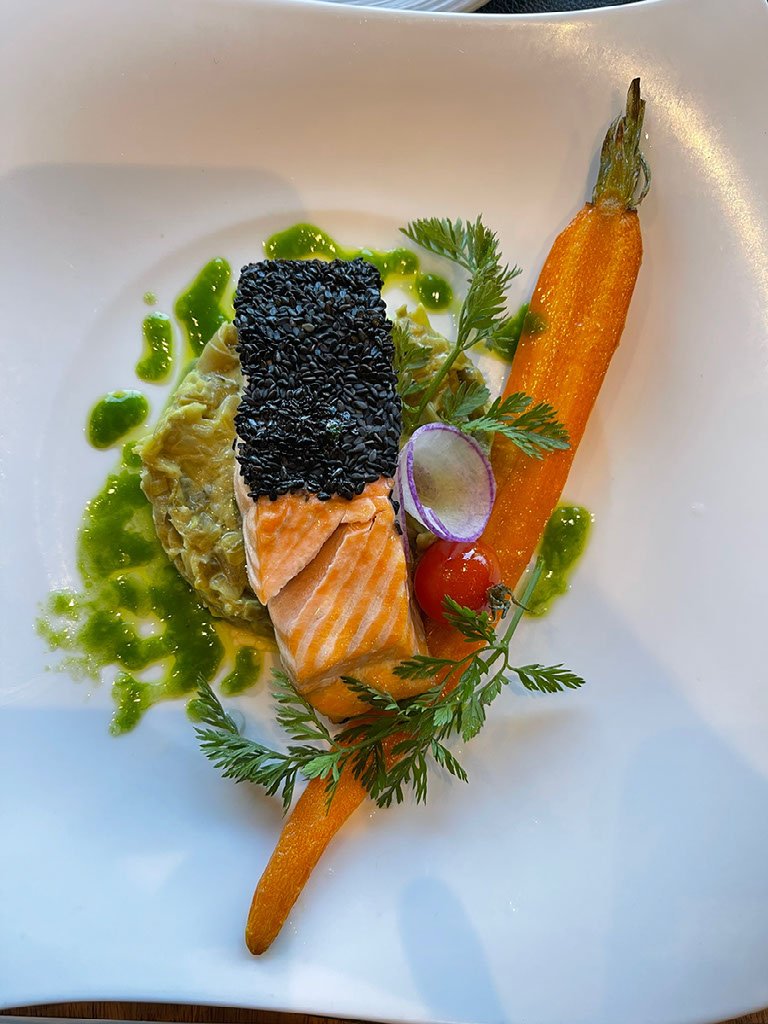
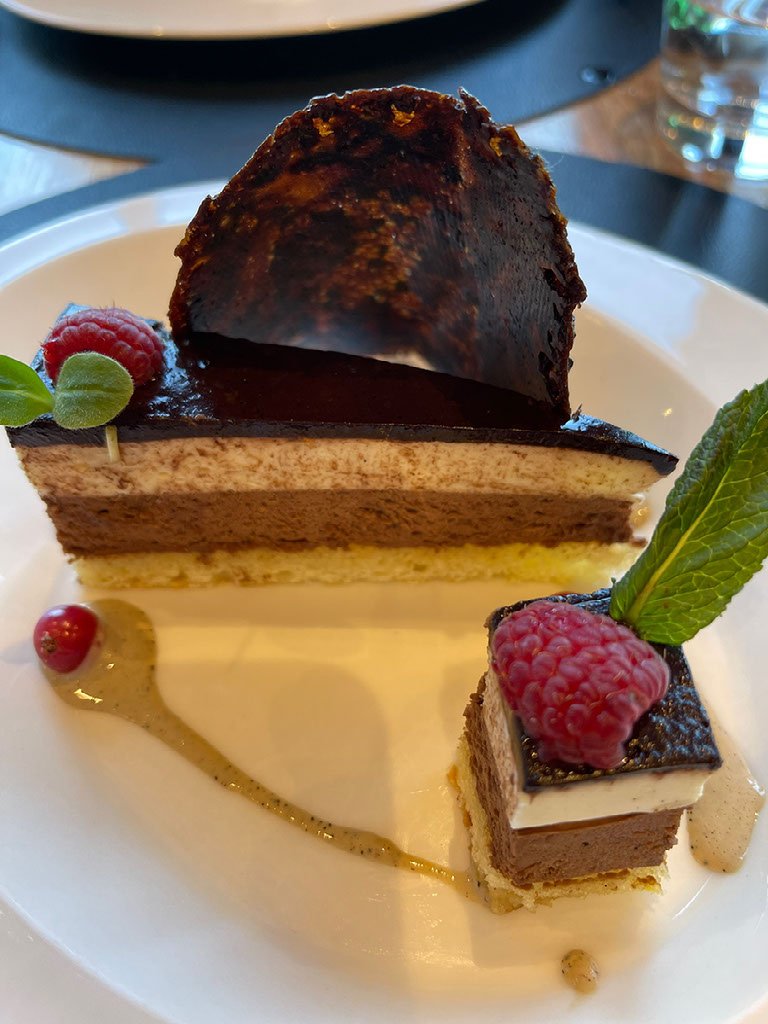
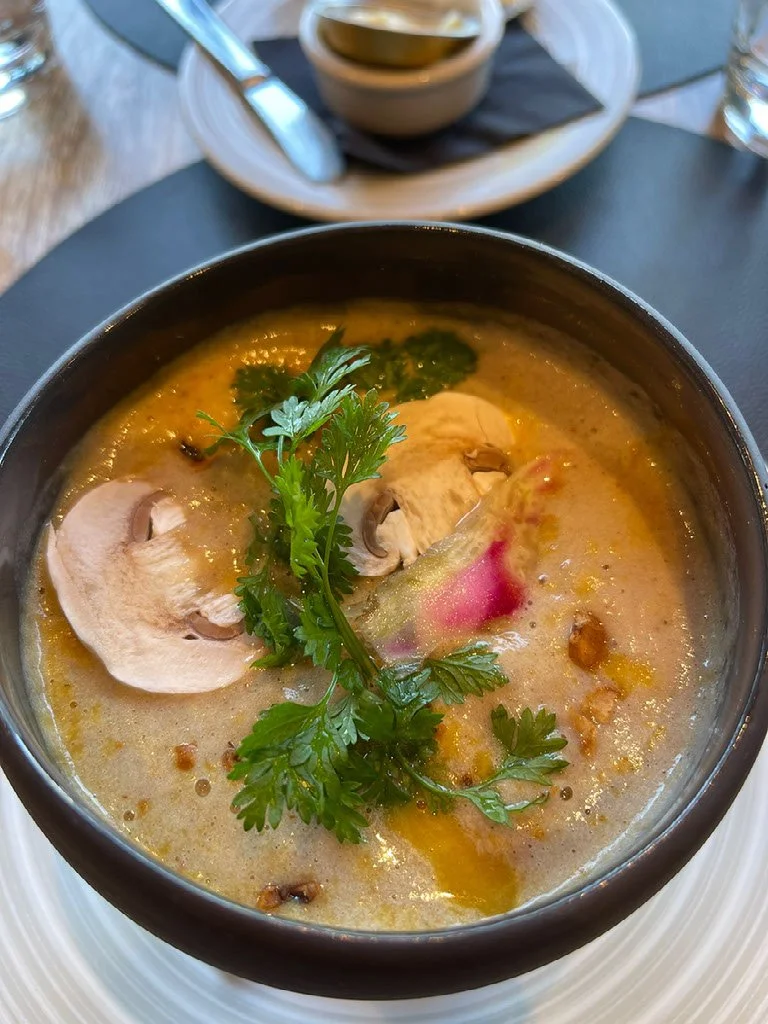
Where to Eat in Mont-Saint-Michel
The restaurants inside the abbey walls and along the main tourist street are expensive and designed for throughput. The food is generally unremarkable for what you pay. There is one exception, and it is worth knowing about.
La Mère Poulard is the most famous restaurant at Mont Saint-Michel and one of the most storied in all of Normandy, having operated since 1888. The restaurant is known for its omelets, whisked with long copper whisks over a wood fire in copper pans, a technique that has been performed here for over a century. They are expensive, theatrical, and genuinely good. Eating here is part of the Mont Saint-Michel experience rather than simply a meal. Go at least once for the omelet and for the spectacle of the kitchen.
Restaurant La Jacotière is a short drive from the abbey in the village of Ardevon. This Norman farmhouse restaurant serves traditional regional cuisine in a warm, unhurried atmosphere. After a full day of shooting and carrying gear, a long dinner at a table that is in no hurry to turn you over is exactly what you want. Far better value than anything inside the walls.
Les Terrasses Poulard Restaurant is connected to the hotel of the same name and offers a properly prepared Norman menu with bay views. More formal than La Jacotière and priced accordingly, but the location earns its premium.
Saint-Malo (30 minutes by car) is worth a half-day drive if you want exceptional seafood. The restaurants along the waterfront in the old walled city serve the freshest Breton fish in the region. Make a day trip of it.
For everyday meals and simple Norman food, eat at the restaurants near your hotel around the dam area rather than inside the tourist corridor. The moules marinières, galettes with local butter, the cheeses of Normandy, and the apple cider of the surrounding orchards are all available at much better value outside the island.
Coffee in Mont-Saint-Michel
The hotel restaurants near the dam all serve reliable coffee, and this is your best bet for early mornings when you need caffeine before a sunrise shoot. Inside the island, the cafés that line the main street are fine for a mid-morning break but are priced as tourist stops. Ask your hotel staff for their local recommendation, particularly if you are staying near the dam.
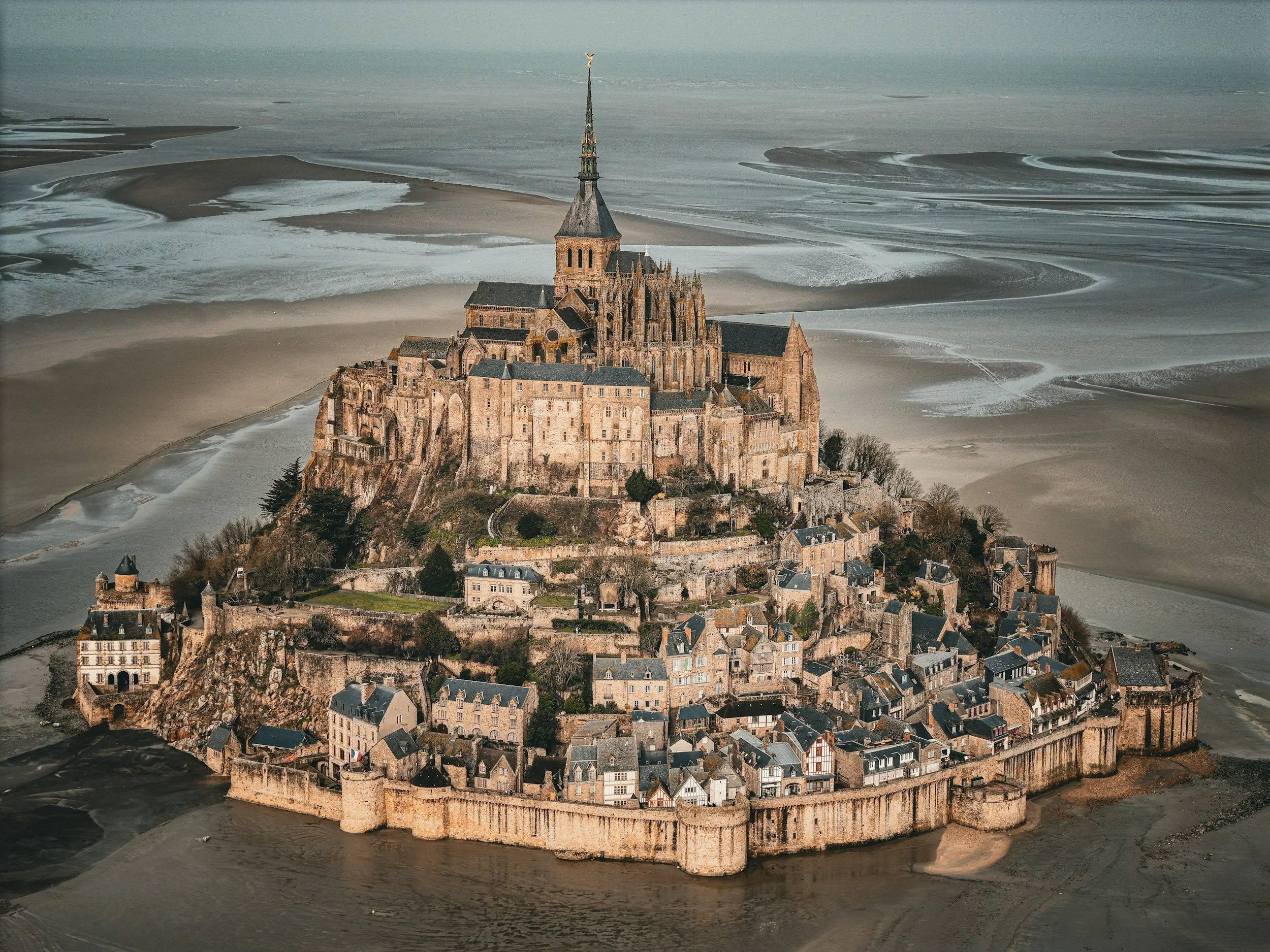
Mont Saint Michel from above with a Drone
Photography Gear to Bring for Mont-Saint-Michel
Mont Saint-Michel is a telephoto destination more than a wide-angle one. Keep that in mind as you pack.
DSLR and Mirrorless Kit
Any current full-frame mirrorless body handles this destination well. I used my Canon EOS R5 Mark II, which performs exceptionally in the low-contrast morning light common in Normandy. The Sony A7R V and Nikon Z8 are equally strong choices. The high resolution of any of these bodies is useful here because you are often shooting at distance and may want to crop.
Lenses: Your 70-200mm f/2.8 will do the majority of the work at Mont Saint-Michel. You are almost always photographing from a distance, whether from the dam, along the causeway, or from the meanders. A wide-angle lens (15-35mm or 16-35mm) is worth bringing for the causeway walk and for interior shots inside the abbey, but it should be the secondary lens, not the primary one. A 24-105mm zoom is too limiting on the long end for the main shots here.
Tripod: Essential. Blue hour and long exposures in low light require a stable platform. I use a Gitzo, but any quality carbon fiber tripod works. Be aware that the dam vibrates slightly when people walk nearby, so wait for a clear moment before triggering.
ND Filters: Bring your full set. Kase ND filters in 3, 6, and 10 stops, plus a circular polarizer for managing reflections on the water. Long exposures during high tide can smooth the water beautifully.
Extra batteries and at least two memory cards. Normandy spring mornings are cold, and batteries drain faster in cold conditions.
Drone: Do Not Fly Here. Mont Saint-Michel is a designated no-fly zone. The entire area is off-limits for recreational drone use as a UNESCO World Heritage Site, and the gendarmerie actively patrols. French pilots have been fined for illegal flights here. Leave the drone at home for this one.
iPhone Photography Tips Mont-Saint-Michel
The iPhone performs well at Mont Saint-Michel, particularly for the wide establishing shots along the causeway.
Use your ultrawide lens for the causeway walk, placing the bridge as a strong leading line into the frame with the abbey in the background. Early morning is your best window before foot traffic breaks the composition.
For sunrise and sunset shots from the dam, switch to Night Mode when the light drops below the horizon. The iPhone handles the long blue-hour exposure automatically and will produce smooth water with a stationary subject. Place the phone on a small travel tripod or prop it on a flat surface for maximum sharpness.
Use your standard lens (approximately 24mm equivalent) for the abbey itself once you reach the base. The ultrawide will distort the architecture when you are that close. Step back, zoom in slightly, and let the geometry work.
In the ProRAW or Apple ProRAW setting, shoot in the highest resolution available. The file sizes are larger but give you far more flexibility in Lightroom Mobile during the editing session.
Best Photography Locations at Mont Saint Michel
The best shots of Mont Saint Michel are from a distance, where you get the water reflections, sheep, and rapeseed fields that create the perfect foreground. I walked around the area quite a bit, and here are my suggestions.
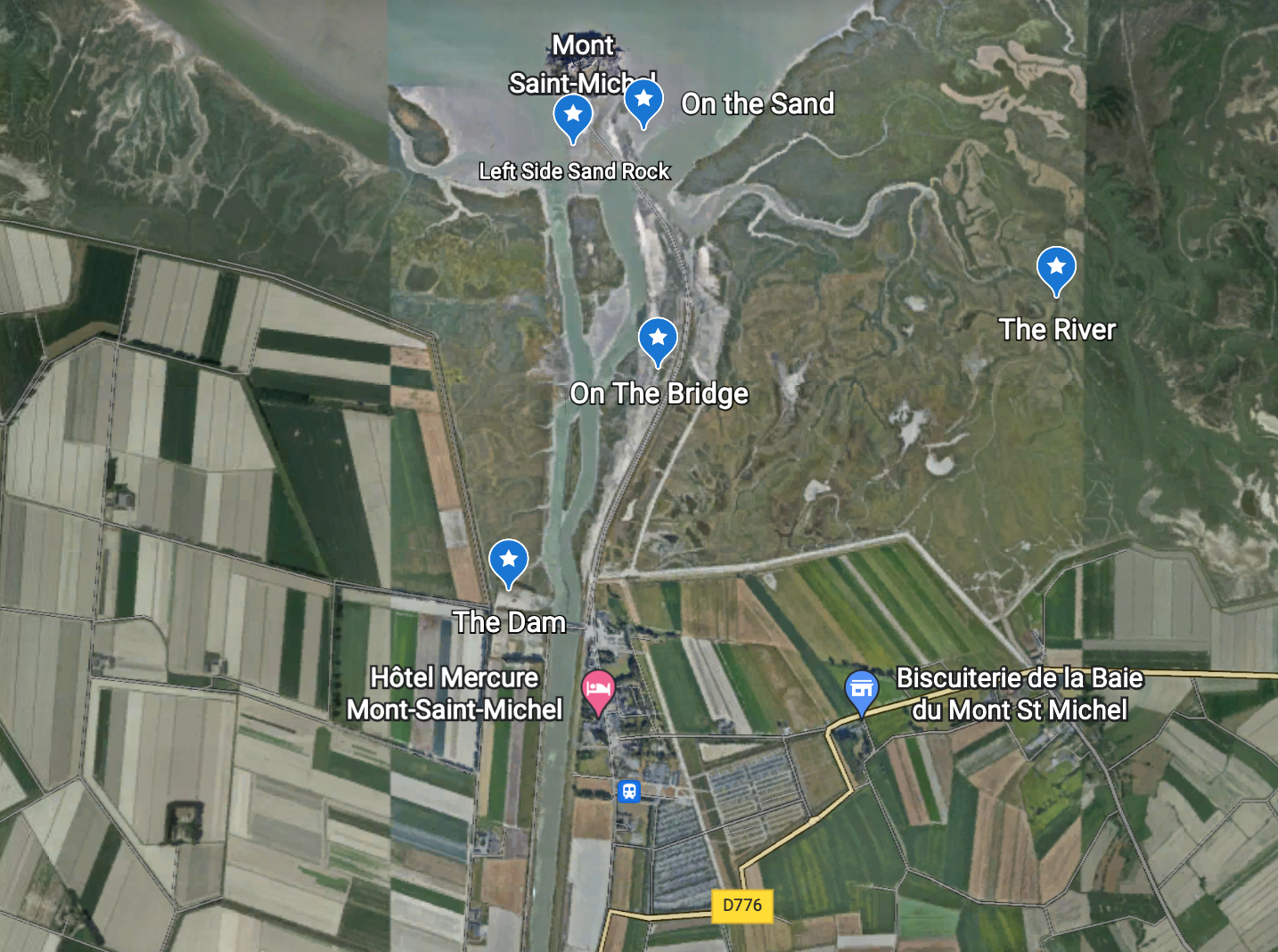
A Map of the Photography Locations in Mont Saint Michel
The Dam (Barrage de la Sélune)
The dam is the starting point for almost every serious photographer at Mont Saint-Michel, and for good reason. The Couesnon River creates a natural leading line that draws your eye directly to the abbey rising on the horizon. It is the most accessible shot, the most reliable shot, and in the right conditions, with golden light reflecting off the water and the abbey glowing above, it is one of the finest landscape compositions in all of France.
The dam sits at the beginning of the causeway, just to the left of the shuttle bus barrier. From your hotel near the dam, it is a five-minute walk. You will know the spot immediately.
📷 Pro Tip: Position yourself on the left bank of the Couesnon, keeping the river as a leading line running toward the abbey. Shoot with your 70-200mm at around 100-150mm to compress the distance and bring the abbey into a more powerful relationship with the foreground water. The best light is at sunrise, shooting in a northern direction, when the low sun catches the granite of the abbey. Bring a tripod; the dam surface has slight vibration when other photographers walk nearby, so wait for a still moment. At high tide, the water fills in around the base and the reflections become extraordinary. Check the tide schedule before you arrive and plan your sunrise shoots around the tidal cycle.
Best time: Sunrise and sunset. Access: Free, public. Walk left from the Mercure Hotel along the main road toward the causeway.

Mont Saint Michel photographed from the dam, with the Couesnon River creating a natural leading line toward the abbey.
The Causeway (Pont Passerelle)
The 2-kilometer elevated bridge that replaced the former causeway in 2015 is both a piece of modern engineering and a strong photographic subject. Walk it at sunrise before the shuttle buses begin running and you have a clean, graphic composition: the bridge as a straight leading line, the sky reflected in the tidal flats on either side, and the abbey pulling you forward through the frame.
The causeway walk takes 10 to 15 minutes at a relaxed pace. Almost any point along it offers a usable composition, but the middle section, roughly halfway between the dam and the abbey, is where the proportions work best.
📷 Pro Tip: For the classic causeway shot, shoot from low to the railing with a wide-angle lens (15-35mm) and let the bridge geometry converge toward the abbey. Early morning before crowds arrive is essential for clean people-free compositions. At golden hour, the light catches the tidal sand on either side and turns the entire scene warm. If there is a high tide, the water extends under the elevated bridge, and the reflection almost doubles the visual impact. Avoid this location on summer afternoons when shuttle bus traffic and pedestrian crowds make clean shots nearly impossible.
Best time: Sunrise, or the first 30 minutes after. Access: Free, public.

The elevated causeway creates a strong leading line toward Mont Saint Michel across the tidal flats.
A few other shots from this location

A couple on bikes on the Way to Mont Saint Michel
One other image of the causeway
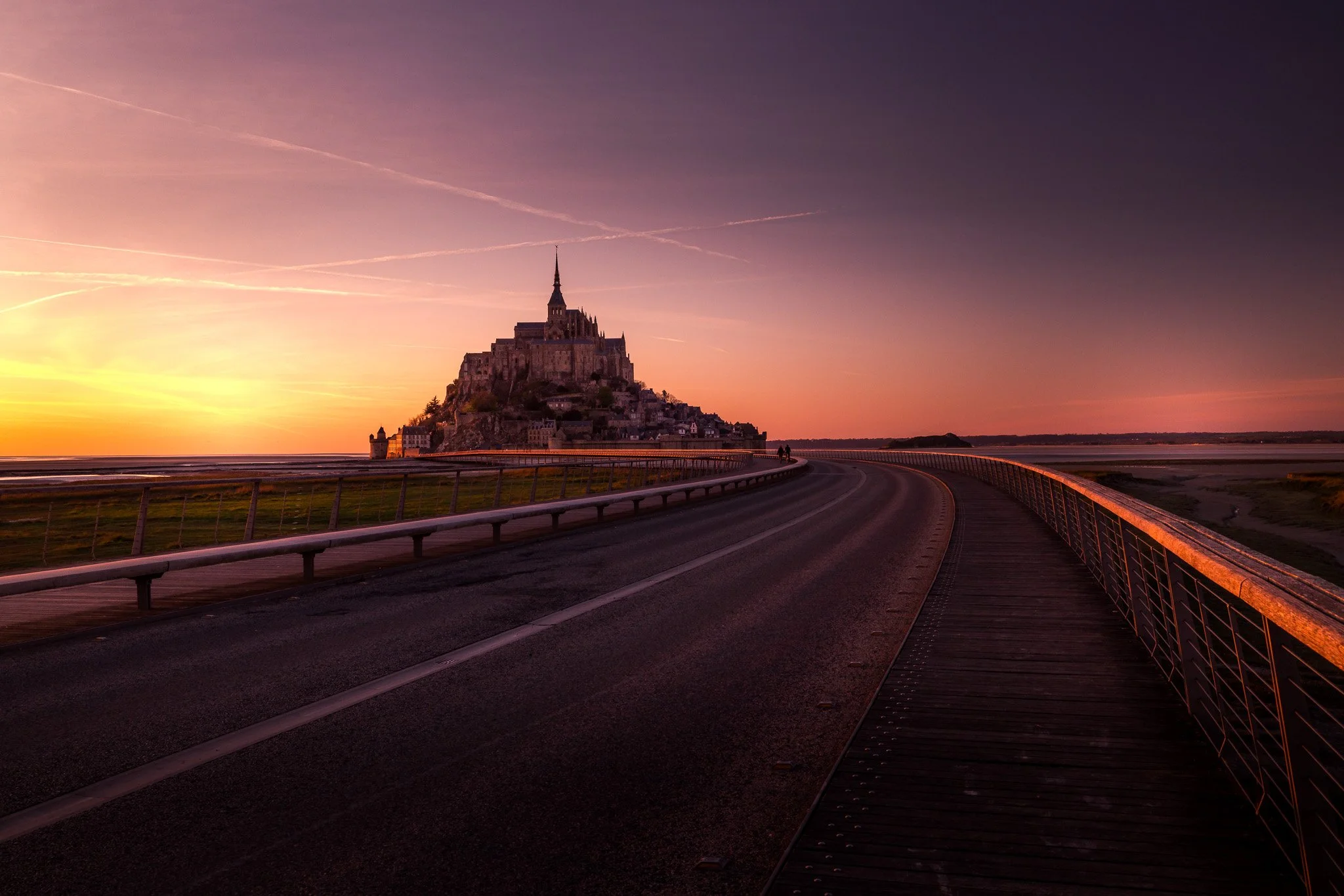
A different perspective along the causeway, using the bridge geometry to draw the eye toward the abbey.
Left and Right of the Abbey (Tidal Flats)
Once you reach the base of the abbey, walk off the bridge to the left or the right and down onto the tidal flats. You are now shooting the abbey from directly below, with foreground texture from the exposed sand, rocks, and tidal pools. The perspective changes completely from the long-lens distance shots from the dam.
The left side has rocks and shallow water puddles that work well for reflections. The right side offers clean white sand with a simpler foreground. Both work at sunset when the light hits the west face of the abbey.
📷 Pro Tip: For the left side, look for tidal puddles that reflect the upper sections of the abbey and position yourself low, close to the water surface, with a wide-angle lens. The 15-35mm gives you foreground texture and scale. For the right side, the clean sand makes a strong minimalist composition with a telephoto at sunset, isolating the abbey against the sky. Watch the tide schedule carefully here. Incoming tides at Mont Saint-Michel move faster than walking speed in some conditions. Stay aware of your exit route and do not linger when the tide is coming in.
Best time: Sunset. Access: Free. Walk off the bridge to either side and descend to the sand level.
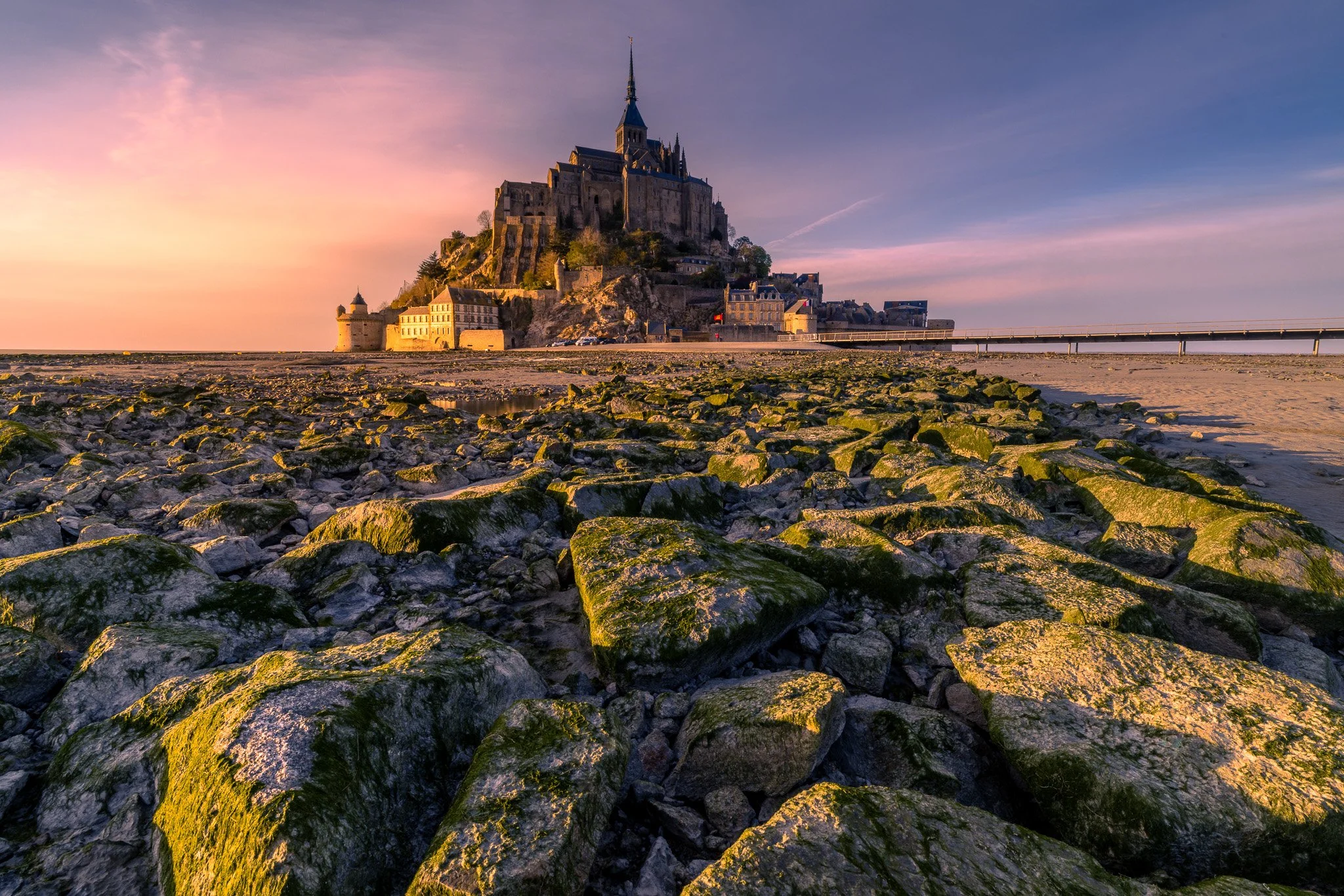
Mont Saint Michel reflected in shallow tidal pools at sunset from the edge of the bay.
Another angle at sunset
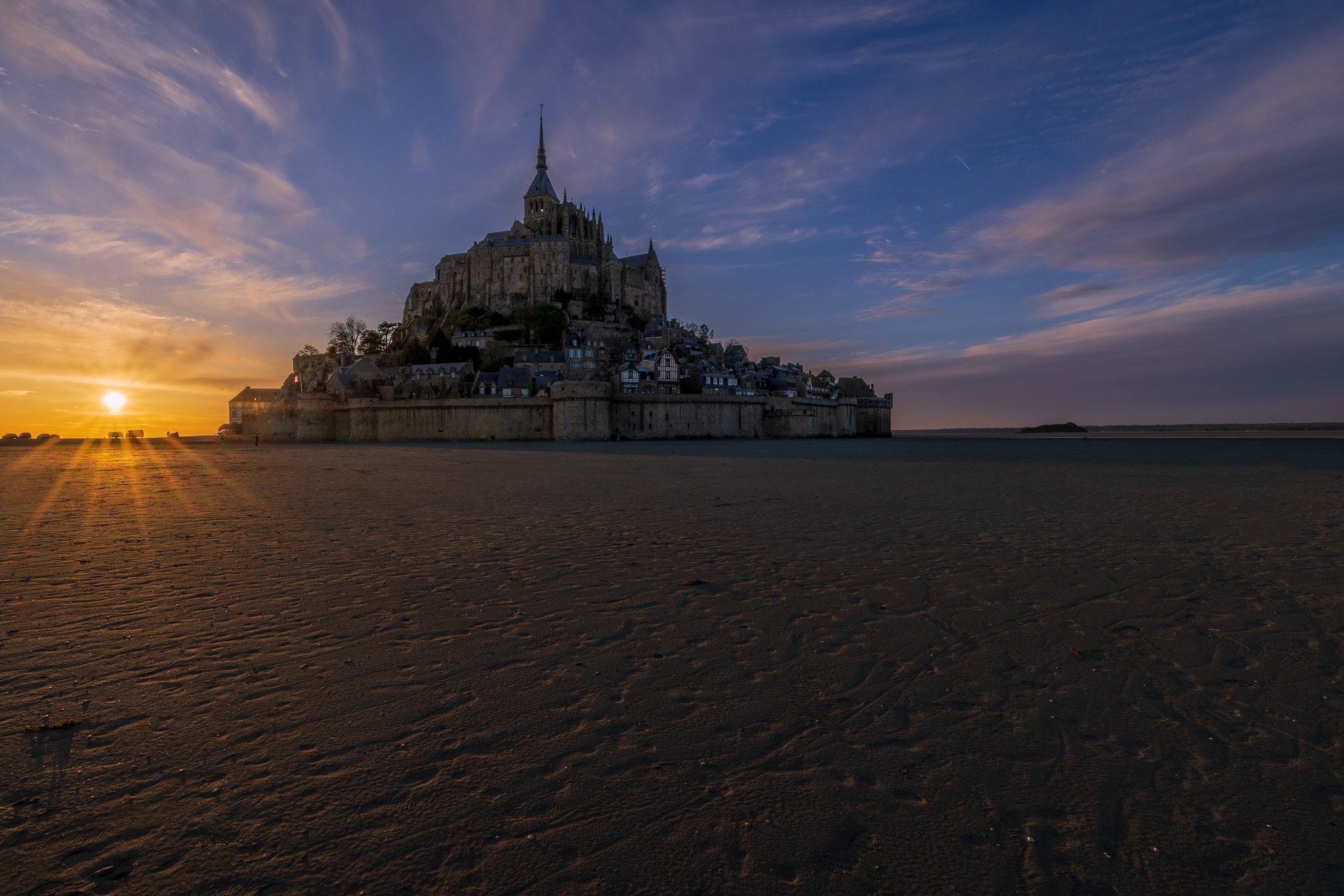
Warm evening light across the exposed sand and tidal flats beside Mont Saint Michel.
Les Méandres (The River Meanders)
This is the hardest location to find and the most rewarding when conditions are right. As you walk toward Mont Saint-Michel from the dam, look for a fenced area on the right side of the road. Despite appearances, you are permitted to walk past the fence. Continue for at least 15 minutes into the wetlands, heading toward the river bends. You will likely see one or two other photographers if you are there at sunrise. The morning I finally found this spot, I was surprised to find no one else there, and the location was further than I expected.
The meanders offer a completely different angle on the abbey: the winding river in the foreground, the marsh grasses, and the abbey floating on the horizon. With water in the river after rain, the reflections can be extraordinary.
📷 Pro Tip: Arrive before sunrise and walk the 15-plus minutes from the road to get in position before the light starts. Bring a telephoto and compress the river bends into the frame with the abbey behind them. The 70-200mm at 150-200mm collapses the distance effectively and makes the abbey feel present rather than distant. This is a sunrise location. Wet conditions after rain fill the meanders and dramatically improve the reflection quality. Wear waterproof footwear; the ground is marshy and soft in places.
Best time: Sunrise. Access: Free. Walk past the fence on the right side of the road approaching the abbey; continue 15 minutes into the wetlands.
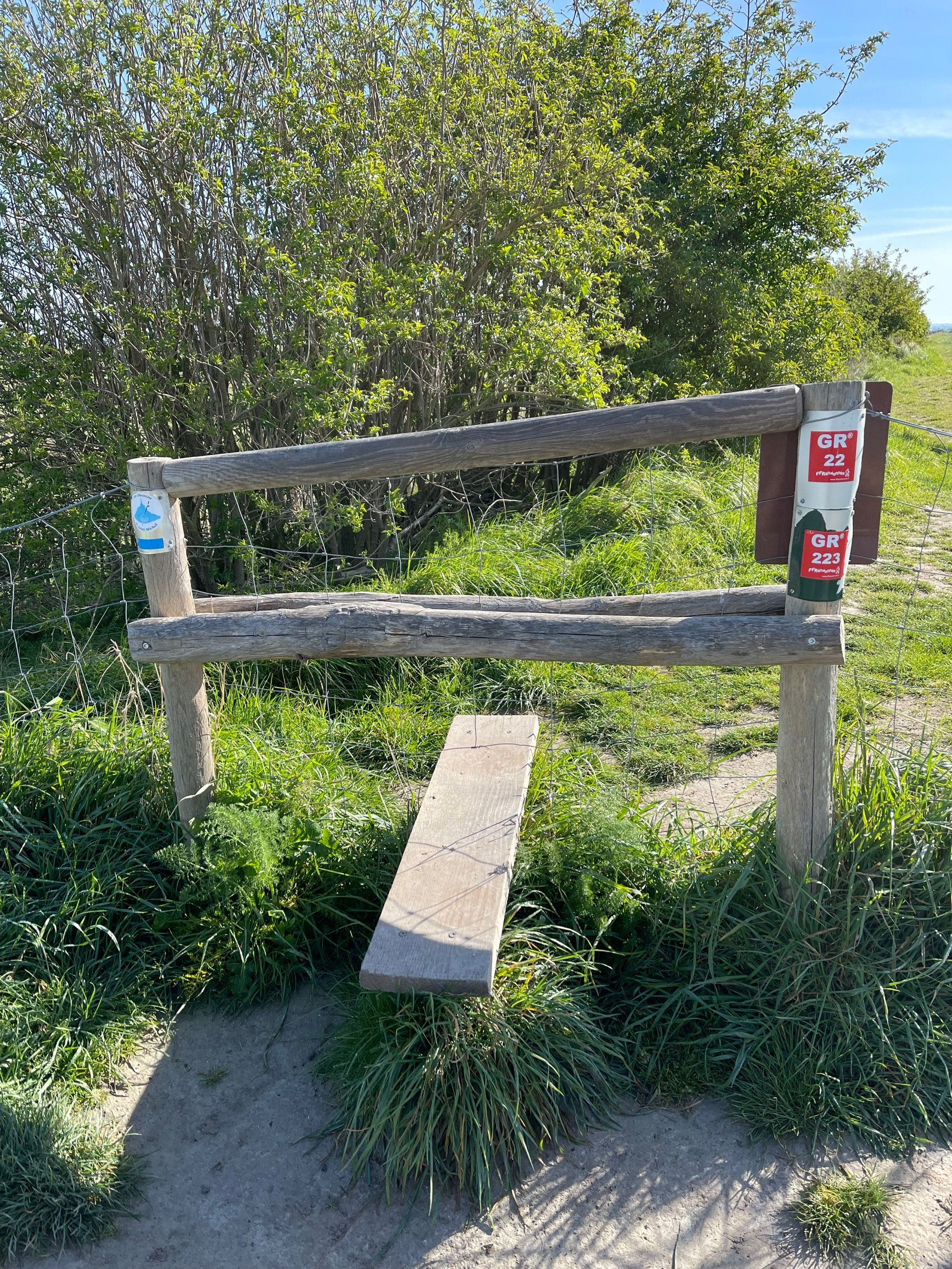
The path to the Meandres
You will need to walk for at least 15 minutes, and most likely, you will see a few photographers in the location. The morning that I finally found it, I was surprised that not only were there no photographers, but it was further than I expected. I think this would be a great spot with water in the river. It is also a Sunrise location.

The winding river meanders create a natural foreground leading toward Mont Saint Michel in the distance.
Festivals & Events
Summer Night Shows at the Abbey (July through August) are one of the more unusual photography experiences at Mont Saint-Michel. During the summer months, the abbey opens at dusk for evening visits, with light projections, sound effects, and video installations that bring the monastic buildings to life after dark. The exterior of the abbey is illuminated, and the internal spaces are dramatically lit in ways that are impossible during daylight visits. For photographers, this is a window into the abbey at night with far fewer people than the daytime. Bring your tripod and check the current season's show schedule on the abbey's official site.
Festival Grandes Marées (July, Bay of Mont Saint-Michel) is the regional music festival, held in the bay area between Granville and Avranches. Previously known as Jazz en Baie, it shifted its name but not its format: several days of outdoor concerts across multiple stages, with the bay as the backdrop. The festival itself is not a photography destination, but the crowds it draws to the region and the festive atmosphere in the surrounding towns are worth knowing about if you are timing your visit.
Christmas at Mont Saint-Michel (December) transforms the island in a way that most visitors never see. Nearly seven kilometers of lights are strung along the walls and ramparts of the abbey, the main street fills with decorated trees, and the crowds thin considerably compared to peak summer. The combination of illuminated medieval architecture, cold clear skies, and low winter light creates genuinely exceptional photography conditions. This is one of the more underrated times to visit.
The Bay Marathon (Spring) is an annual race that brings approximately 5,000 runners through the bay area, with Mont Saint-Michel as the backdrop for parts of the course. For photographers, the combination of athletes in motion, the tidal landscape, and the abbey is a strong editorial subject. The race energy and the crowd make for excellent people photography as well.
Saint-Michel Feast Day (September 29) is the feast day of the archangel Michael, and Mont Saint-Michel marks it with religious ceremonies in the abbey, a pilgrims' procession, and a sense of occasion that the rest of the calendar year rarely matches. The procession of pilgrims approaching the island across the bay is a photograph that carries genuine historical resonance. Attend the morning ceremony if you are in the region.
Frequently Asked Questions About Visiting Mont Saint-Michel
Do the tides really affect a visit to Mont Saint-Michel?
Yes, significantly, this bay has the largest tidal range in Europe. The 2015 bridge means you're no longer stranded the way visitors once were driving onto the sand, but the water still transforms the landscape twice a day, and it's worth checking tide schedules before you plan any shooting sessions on the sand itself.
Is it safe to walk out into the bay alone?
No, not without a guide. The mixture of water and fine sand created by the rising tide can become dangerous quicksand-like ground, and the tide moves in faster than most people expect. Stick to the marked paths, the dam, and the causeway unless you're with a licensed guide.
How long do you need at Mont Saint-Michel?
Most day-trippers spend three to five hours, enough to see the abbey and walk the main street. For photographers, I'd recommend two nights minimum, that gives you two sunrises and two sunsets, and one bad-weather night doesn't ruin the whole trip.
When should you visit to avoid the crowds?
Outside summer, ideally. May, June, September, and October see far fewer visitors than July and August. Within any season, arrive early morning or come in the late afternoon after the day-trip buses have left.
What are the best photo spots at Mont Saint-Michel?
The Dam for the classic reflection shot, the causeway for a leading-line composition, and the sand to either side of the abbey at sunset are three I return to constantly. The full list with Pro Tips is above.
What surprised you most about photographing Mont Saint-Michel?
The beauty of the abbey at sunrise when there's no one around. Most people picture Mont Saint-Michel packed with tourists, because by mid-morning, it often is, but arrive before 7am and you'll have long stretches of the dam and causeway almost entirely to yourself.
Should you stay inside the gated area or outside it?
Inside, if photography is a priority. Staying near the dam puts you five minutes from your best shooting locations. Staying outside means a 40-minute walk or a shuttle ride each way, which costs you the flexibility to chase changing light.
Is it worth eating at La Mère Poulard even though it's expensive?
Yes, at least once. It's touristy and pricey, but the century-old omelet tradition, whisked in copper pans over a wood fire, is genuinely part of the experience, not just a meal.
Final Thoughts
I have been to Mont Saint-Michel at least a half dozen times, as a child watching a car float in the Channel, and as a photographer standing at a tripod at 5 am with the abbey lit in golden light above the Couesnon River. Both experiences stayed with me. That tells you something.
The abbey has held its power for over a thousand years. Monet painted here. Pilgrims walked for weeks to reach this place. You will understand why the moment you stand at the dam and watch the light change. It does not matter how many photographs of Mont Saint-Michel you have seen before. The real thing is different.
Go in the spring if you can. Stay near the dam. Shoot the morning. Stay for the evening. Come back the next morning and shoot it again.
Want to improve your photography while exploring some incredible destinations? Join me on one of my photography workshops! You can find all the details, including upcoming destinations and dates, through the links below.
Let's Stay Connected!
If you enjoyed this guide, you might also find these useful for building out a larger Normandy or France itinerary:
My Photography & Travel Guide to Étretat, France is a two-hour drive up the Normandy coast from Mont Saint-Michel. The chalk sea cliffs and natural arches are among the most dramatically photogenic landscapes in northern France, and the two destinations pair beautifully on a single Normandy road trip.
My Photography & Travel Guide to Paris, France is the logical bookend to any Normandy trip. Mont Saint-Michel is about four hours southwest of Paris by car, and a few days in the capital before or after your time in Normandy makes the trip feel complete.
My Photography & Travel Guide to Colmar, France sits in Alsace, in the northeast, and is a different France entirely: half-timbered houses, flower boxes, and the Rhine plain at golden hour. If you are building a broader France itinerary, Colmar and Normandy together tell a rich story of the country's range.
✈️ Travel Photography Planning Sessions
One-on-One Trip Planning with a Professional Travel Photographer
Don’t miss the shot. Let me help you plan for it.
Overview
Planning a photography-focused trip can be overwhelming. From figuring out the best places to shoot, to when the light is just right, to knowing which lens to pack — there are a lot of decisions to make.
This one-on-one Zoom session is your chance to get personalized travel photography advice from someone who’s spent the past 25 years exploring cities, coastlines, and wild places around the world — camera in hand.
Whether you're headed to Paris, Patagonia, Tokyo, or Tuscany, I’ll help you make sure your photography trip is well-planned and creatively inspired, so you come home with the images you dreamed of (and then some).
What’s Included
✅ Photography Location Planning
I’ll help you create a customized itinerary of the best photo spots, including off-the-beaten-path gems and iconic views.
✅ Best Times to Shoot
Get expert advice on lighting, golden hour, blue hour, and seasonal conditions for each location.
✅ Gear Recommendations
Not sure whether to bring the telephoto or the prime? We’ll walk through your gear and make sure you’re bringing the right tools for your destination and style.
✅ Hotel and Base Recommendations
Stay where it’s convenient for sunrise shoots and late-night strolls with your camera. I’ll recommend hotels that are photographer-friendly and well-located.
✅ Custom Travel Tips
From sunrise entry times to tripod rules at major landmarks, you’ll get insider tips to save time, avoid tourist traps, and make the most of your trip.
Who It’s For
This service is for anyone who:
Is planning a trip and wants to prioritize photography
Wants expert insight on the best places to shoot and how to get there
Is tired of missing the shot because of poor planning or bad timing
Is a beginner, enthusiast, or professional photographer looking for guidance before a trip
How It Works
Book a Session
Choose a time that works for you and tell me where you're headed.Share Your Plans
You’ll fill out a quick questionnaire so I know your travel dates, interests, and photography style.One-on-One Zoom Call (60 minutes)
We’ll meet via Zoom and walk through your trip together — from location ideas to gear and timing. You'll leave with a custom PDF full of notes and suggestions.Follow-Up Support
Get one round of email Q&A after your session to clarify anything as your plans evolve.
Why Work With Me?
I’ve spent the last 25 years photographing the world — from major cities to remote islands. I know what it’s like to travel and shoot under pressure, and I love helping people get the most out of their trips. This is not just about hitting “popular spots” — it’s about crafting a creative and efficient plan tailored to your trip, your gear, and your goals.
Pricing
$125 / Session
Includes:
60-minute Zoom call
Custom PDF summary with photography spots, gear tips, and travel recommendations
One follow-up email with additional Q&A
Introductory rate available through September 2025
Ready to Plan Your Trip?
Let’s make sure you’re ready — so when the light is perfect, you’re in the right place with the right gear.
Questions?
Please email me at vito@chasinghippoz.com if you're not sure whether this is right for you. I'm happy to chat.
Finally—a beginner-friendly photography guide that makes sense.
If you've ever picked up a camera and thought, "Now what?" this is the book for you.
Photography Made Simple is written for adults who are just starting out and want a clear, encouraging, real-world approach to learning photography. Whether you're using a DSLR, mirrorless, or just your smartphone, this guide walks you through the basics—without the jargon or tech overwhelm.
Inside, you'll learn:
The only camera settings you really need to know to get started
How to shoot sharper, more intentional photos using light and composition
Simple tips for portraits, landscapes, travel, and everyday life
What gear you do (and don’t) need
How to create better photos without upgrading your camera
You’ll also get practical exercises, cheat sheets, and tips for organizing and editing your images—plus the confidence to shoot off Auto Mode for good.
This is not a textbook. It’s a friendly guide to seeing the world with fresh eyes—and finally capturing what you see the way you imagine it.
📸 Format: PDF download
Pages: 100+
Perfect for: Beginners, hobbyists, and anyone ready to take better photos without the stress