Étretat, France Travel & Photography Guide: Best Photo Spots, Things to Do & Hidden Gems
When I first saw photos of Étretat, I thought I was looking at the white cliffs of Ireland. That alone was enough to put it on my list. Then I started watching the French Netflix series Arsène Lupin and realized the show was partially set here, in this dramatic little town on the Normandy coast. My interest was fully captured. What kind of place draws a fictional thief, two of France's greatest painters, and thousands of photographers every year?
As it turns out, a remarkable one. Both Monet and Manet painted here. Monet spent February of 1883 in Étretat and produced twenty views of the beach and the three extraordinary rock formations: the Porte d'Aval, the Porte d'Amont, and the Manneporte. When painters of that caliber keep returning to the same place, you pay attention. I did, and I am glad I did.
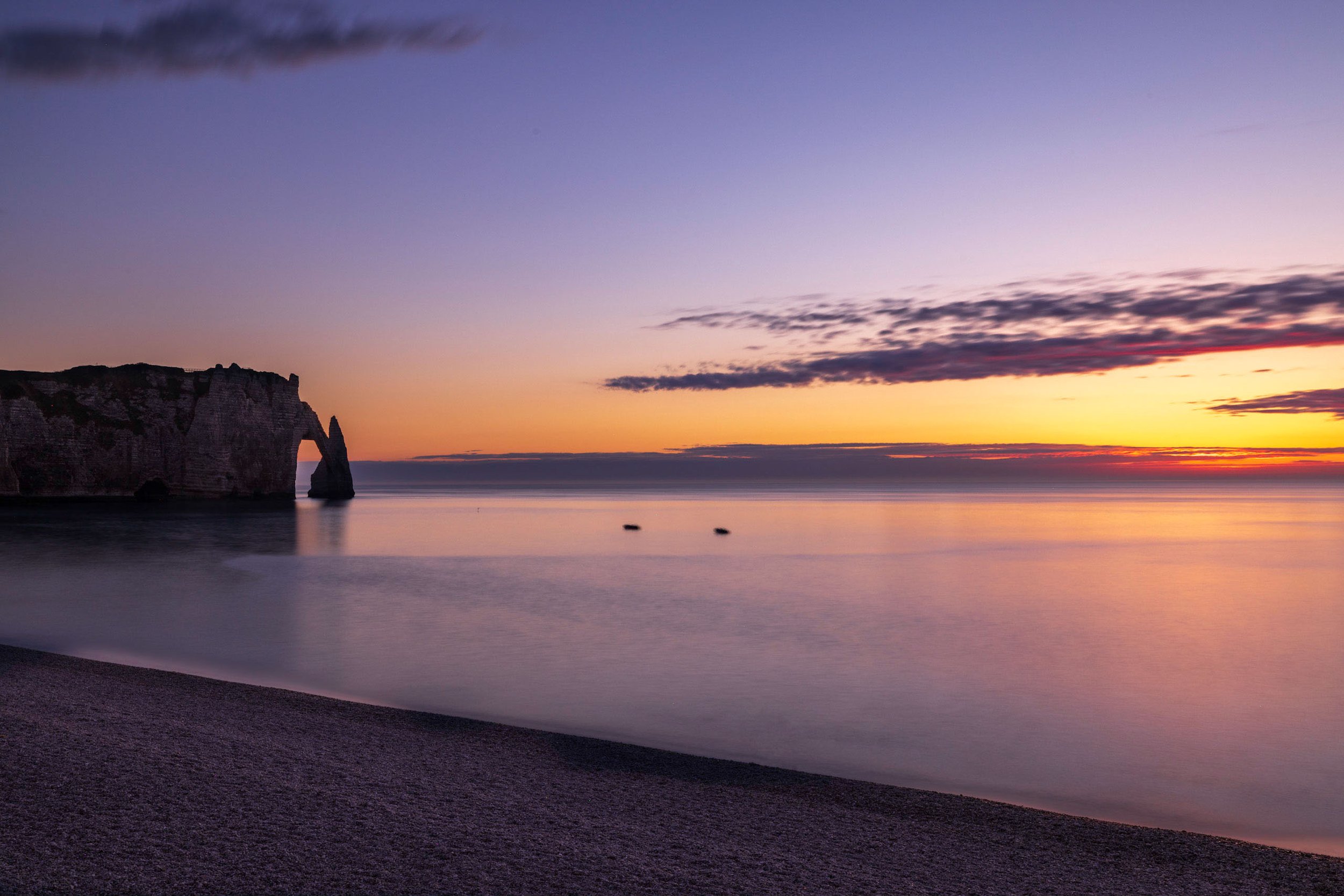
Falaise d’Aval at Sunset
Étretat is small, quiet, and almost entirely walkable. The chalk cliffs rise straight from the English Channel with a scale that photographs do not fully prepare you for. The arches are ancient and natural, carved by the sea over millions of years, and the light here changes constantly. One minute it is flat and grey. Next, the clouds part and the white limestone seems to glow against the deep blue water. For photographers, that unpredictability is the whole game.
In this Photography Guide to Étretat, I share the places and experiences that continue to draw me back. You will find my favorite photography locations, guidance on when and where to shoot, practical travel tips, and gear recommendations, along with cultural insights to help you explore and photograph Étretat with confidence, respect, and ease.

From the Western Side towards the Aiguille (Needle)
Photographer's Notes
Before you go, here are my own takeaways.
Favorite Season: May and September
Favorite Location: Falaise d'Aval and the Aiguille
Favorite Hotel: Les Tilleuls Étretat
Favorite Restaurant: Le Donjon Restaurant at Domaine Saint Clair
Favorite Café: Le Café des Falaises
Favorite Lens: 15-35mm f/2.8
Would I Return? I loved it, and I would return.
So, where is Etretat Located?
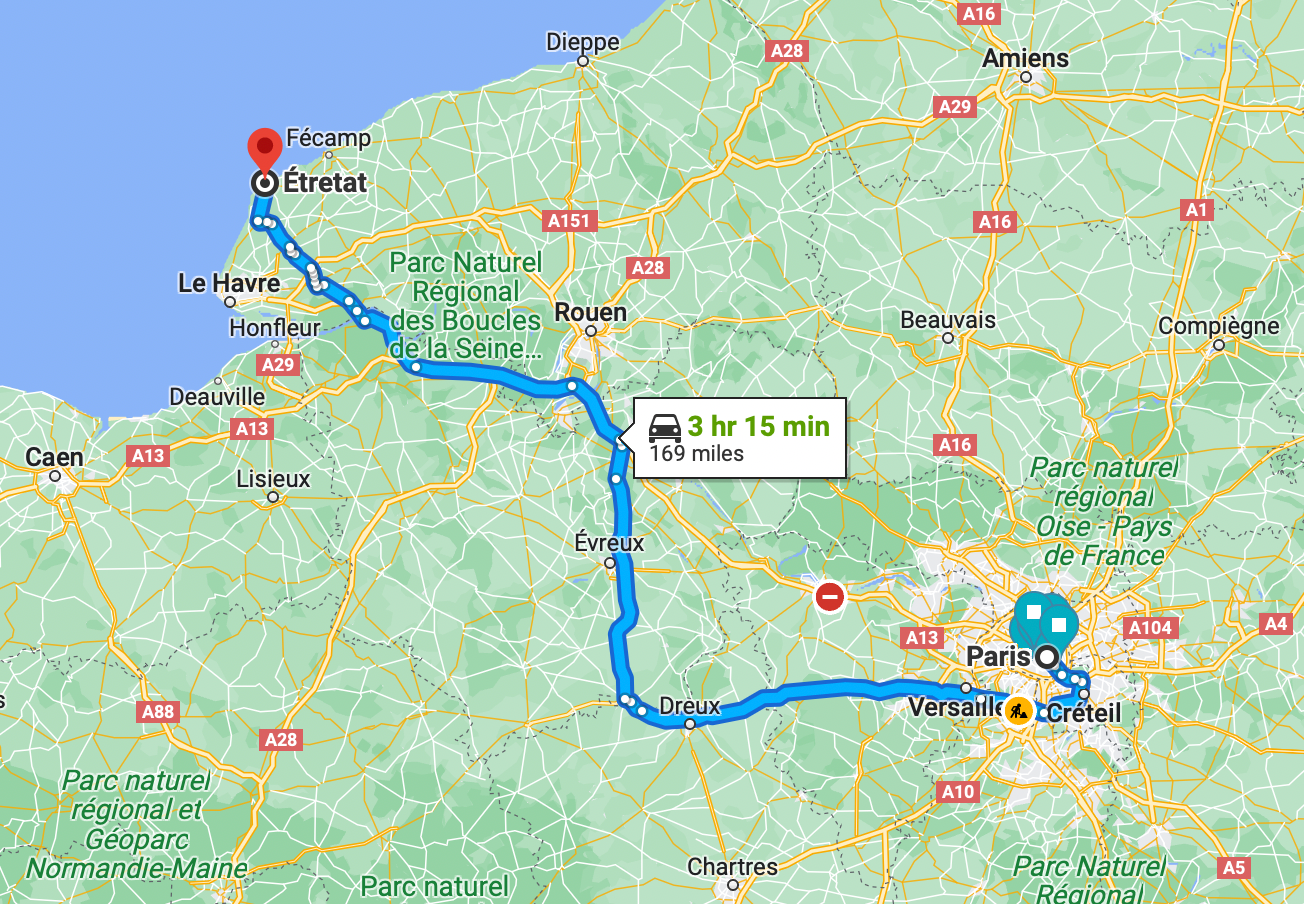
Étretat is located in the north of France. It is about a 3-hour drive from Paris. The easiest way to reach Étretat is by car. But once you reach the town, you will not need to use your car until you leave.
From Paris
How Many Days Should You Stay in Étretat?
Two nights is the minimum, and I mean that genuinely. You need two sunrises and two sunsets. The first morning, you get your bearings on the west cliff and learn how the light moves. The second morning, you put that knowledge to use. Shoot the east cliff at dusk on day one, the west cliff at dawn on day two, and you will have covered the primary photography positions at their best light. Three nights gives you a buffer for weather, which in Normandy you should assume will be needed.
A flexible outline for two to three days:
Day 1: Arrive, walk the beach at midday to understand the geography, climb the east cliff in the afternoon, position yourself at the Porte d'Amont for sunset. Dinner in town.
Day 2: West cliff at sunrise for the Falaise d'Aval and the Aiguille (Needle). Gardens of Étretat mid-morning. Beach at low tide in the afternoon. Le Donjon or Dormy House terrace for an aperitif at golden hour.
Day 3 (if you have it): Return to whichever side gave you the best light and do it again. Drive to nearby Fécamp or Yport for additional coastal photography. Leave in the afternoon.
Best Time to Visit Étretat
Late spring to early autumn (May to September) gives you the best weather and the longest days. Golden hour in June and July runs well past 9:30 PM, which gives you extraordinary light on the cliffs well into the evening. The downside is crowds, particularly on summer weekends when Étretat fills with visitors from Paris and beyond.
May and September are the sweet spots. The weather is still reliable, the light is warm and directional, and the crowds are manageable. September light in Normandy has a quality that I find especially appealing for photography: softer, more golden, and beautifully atmospheric before the autumn rains arrive.
Off-season (October to April) has genuine appeal for photographers. Fewer people means cleaner compositions on the beach and the clifftops. The cliffs can look dramatic under storm light and cloud cover, and you will have vantage points entirely to yourself at dawn. The tradeoff is weather: Normandy winters are wet, and the wind on the headlands can be significant. Pack rain gear and go anyway.
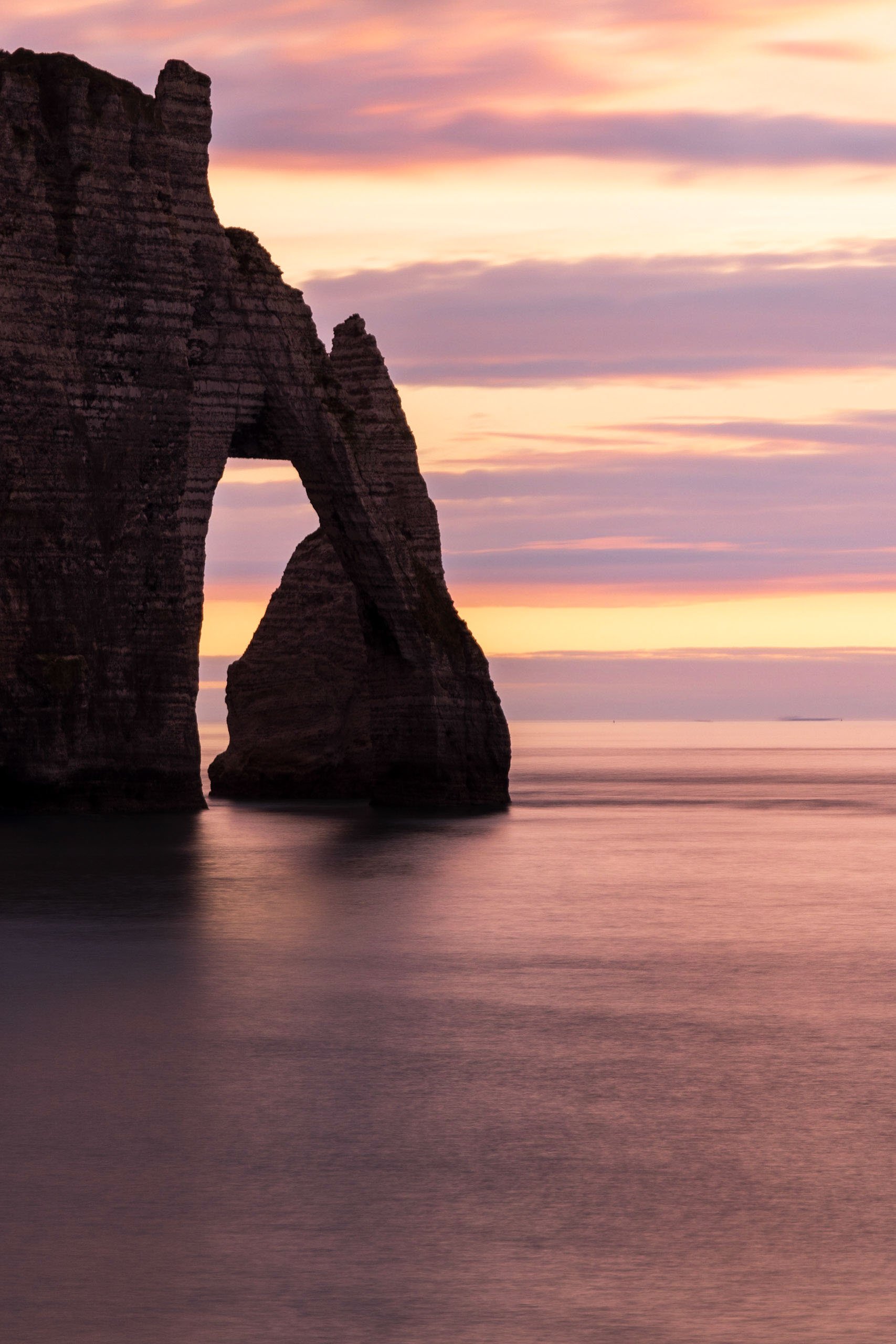
Sunset of the Arches & Aiguille
Where should you stay in Étretat?
The town center is the only place you need to consider. Étretat is small enough that staying anywhere outside of walking distance to the cliffs defeats the purpose. You want to be out on the headlands at sunrise and back in a warm room before the tour buses arrive. Choose your base accordingly.
Luxury Hotels in Étretat
Domaine Saint Clair, Le Donjon Perched on the hillside above the town, Le Donjon is a 19th-century Anglo-Norman château set in a wooded park with views over the cliffs and the sea. The restaurant holds a Michelin recommendation, the rooms are beautifully appointed, and the terrace at sunset is one of the finest viewpoints in Étretat. This is the property if you want views from your window as well as your camera.
Hôtel Dormy House Sitting on the western cliffs with direct access to the beach and the adjacent golf course, Dormy House offers panoramic sea views and a classic Norman atmosphere. The location is exceptional for photographers who want to roll out of bed and be on the headland within minutes. The restaurant has solid reviews, and the terrace is excellent for an evening drink while watching the light change over the Channel.
Le Manoir de la Salamandre A beautifully restored 14th-century manor in the heart of the village, Le Manoir de la Salamandre offers an intimate, historically rich atmosphere. Fewer rooms means more personal service, and the location keeps you within a few minutes' walk of every photography vantage point in town.
Mid-Range Hotels in Étretat
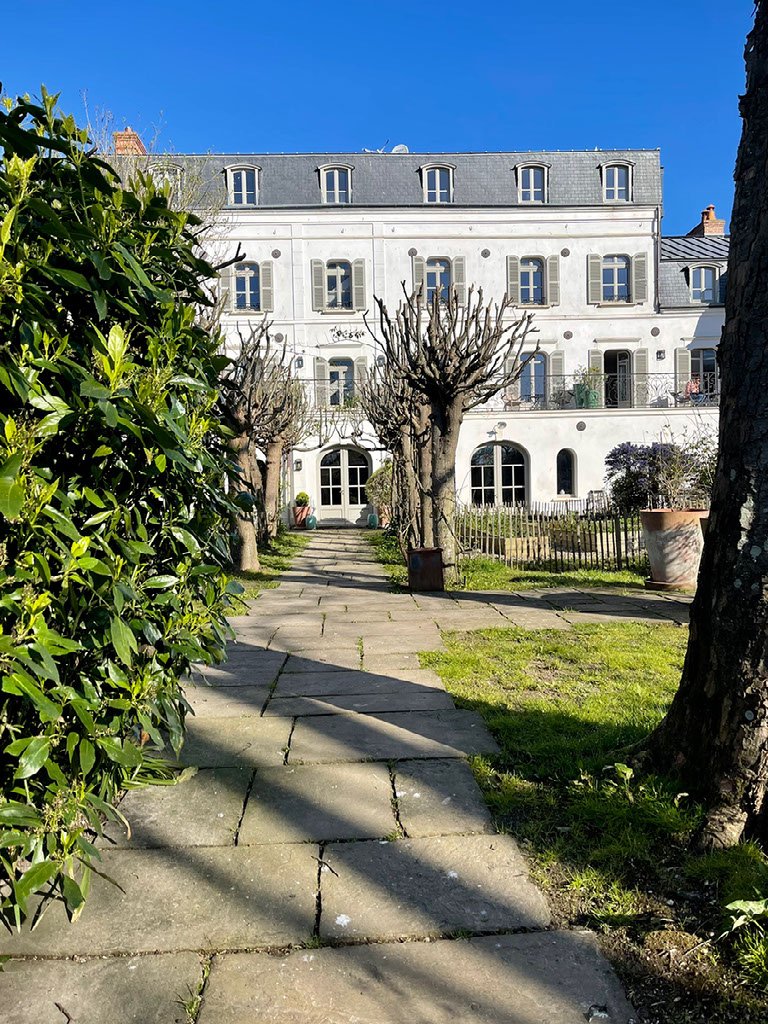
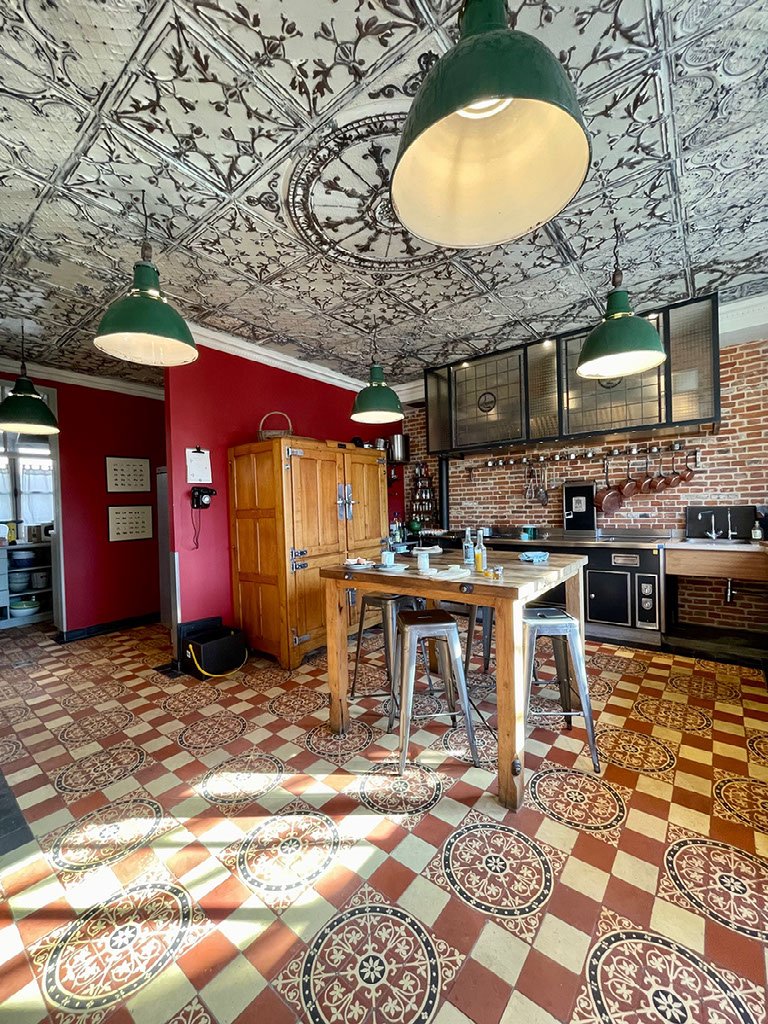
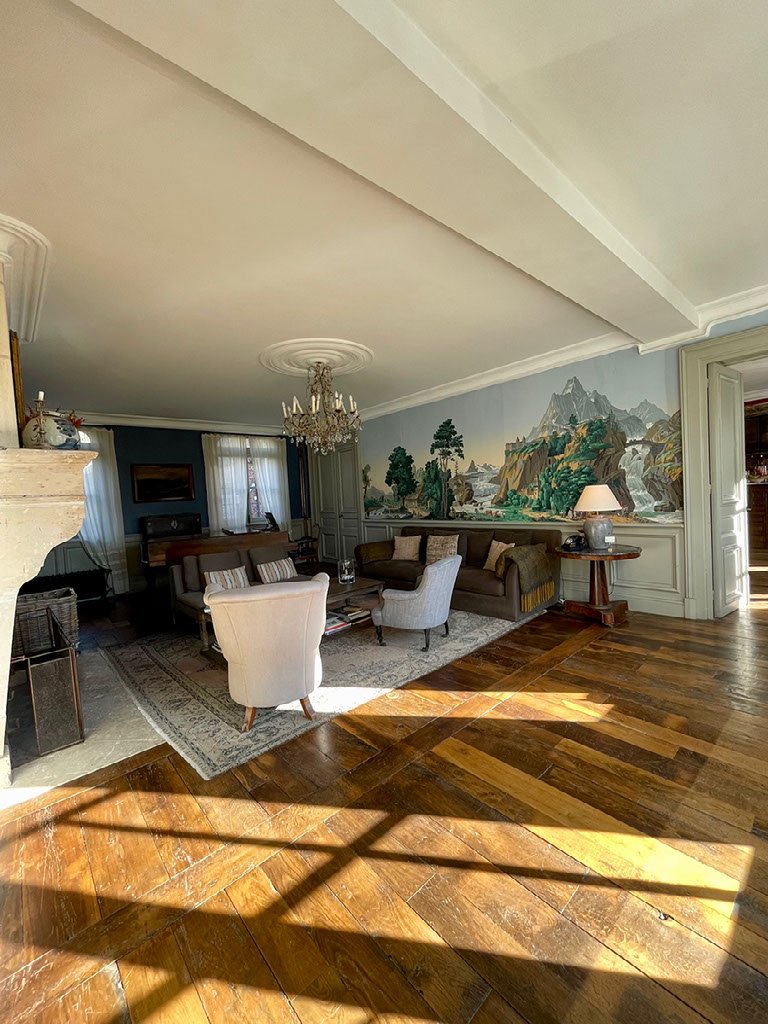
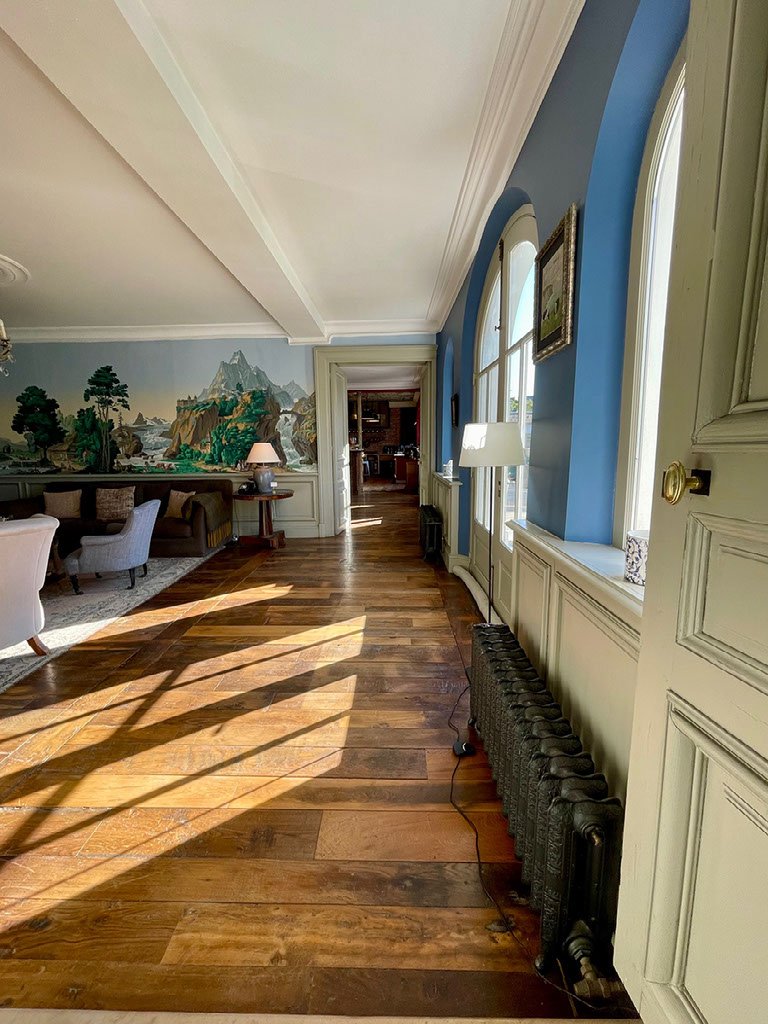
Les Tilleuls Étretat. This is where we stayed, and I would go back without hesitation. Les Tilleuls is a private mansion dating to 1738, renovated by a Belgian family who spent three years getting every detail right. It sits 300 meters from the cliffs, in the heart of the village. What made the stay extraordinary was the general manager, David, whose hospitality makes the place feel more like a family home than a hotel. The breakfast is worth waking up early for, which in Étretat means arriving before the cliffs catch the morning light. Highly recommended.
La Résidence is a well-positioned mid-range option in the town center with comfortable, clean rooms and easy access to the beach and both cliff staircases. A practical base for photographers who want to minimize walking time between locations.
Villa Alexandra A charming guesthouse option close to the village center, with a relaxed Norman atmosphere and friendly owners. Good value for the area, and close enough to the cliffs that early-morning shoots require no logistics at all.
Getting Around Étretat
Once you arrive, you do not need a car. The entire town is walkable. The beach, both cliff staircases, the gardens, and every restaurant are within fifteen minutes of the center on foot. For photographers, this is a significant advantage. You can move quickly between locations as the light changes without worrying about parking.
Getting to Étretat: The easiest option is driving. From Paris, it is roughly three hours on the A13 and then regional roads through Normandy. Trains run from Paris Saint-Lazare to Le Havre, with a connecting bus service to Étretat. The bus journey from Le Havre takes about an hour.
Uber and ride apps: Not reliably available in Étretat. Book a taxi through your hotel if you need one for airport transfers or regional day trips. Your hotel will always be able to arrange this.
For day trips: If you want to explore the broader Normandy coast, having a car is useful. Fécamp, Étretat's neighboring cliff town, is 30 minutes north and worth the drive. The D-Day landing beaches are a two-hour drive west and an essential stop on any Normandy trip.
Where to Eat in Étretat
Normandy is serious about food. You are in the land of camembert, apple cider, calvados, and the freshest seafood on the French Atlantic coast. Étretat is small, so the dining scene is not vast, but what it has is good.
Restaurants in Étretat
Le Bicorne A reliable address for traditional Norman cooking: duck, seafood, and local cheeses in a warm, rustic setting a short walk from the beach. This is the kind of place that feels genuinely local rather than built for tourists. The kind of meal you come back from feeling satisfied and very slightly in need of a walk.
La Marie Antoinette A well-regarded bistro with a menu that combines Norman classics with a modern touch. The decor is charming, the service is attentive, and it is a strong option for a relaxed dinner after a long day on the cliffs.
Le Bel Ami A chic spot with a contemporary feel and a menu that leans into local ingredients. Good for a more refined dinner. Worth booking ahead in summer.
Le Galion On the seafront with views toward the cliffs, Le Galion has changed ownership in recent years and moved toward a more casual menu of moules, fish, and Norman staples. It is a perfectly good lunch option for the location and the view, though less polished than it once was. Go for the terrace table and the atmosphere rather than a destination meal.
Le Donjon Restaurant at Domaine Saint Clair For a special dinner, the restaurant at Le Donjon holds a Michelin mention and offers modern Norman cooking at a genuinely high level. The dining room features a fresco by Jean-Charles de Castelbajac, and the view of the town and cliffs through the window is extraordinary at sunset. Book well in advance in summer.
Coffee in Étretat
Le Romain d'Étretat A small, friendly café perfect for a morning coffee before heading to the cliffs, or a croissant and a café au lait after the sunrise shoot. The atmosphere is genuinely local.
Le Café des Falaises Near the cliff access, this café is well-positioned for a mid-morning break between east and west cliff sessions. Good for editing a few frames while the light shifts.
The café at Les Tilleuls If you are staying at Les Tilleuls, breakfast is served family-style at a large shared table, and the coffee is excellent. Even if you are not a guest, the courtyard is worth a look.
Photography Gear for Étretat
Étretat is fundamentally a landscape and seascape destination, so prioritize lenses and accessories that serve that work.
Camera body: Any of the current full-frame options handle Étretat well. I used the Canon EOS R5 Mark II here, and the Sony A7R V would be equally strong. The Nikon Z8 is another excellent choice. For the cliff and arch compositions, resolution matters when you are cropping to a precise framing from the top of the headland. All three deliver that.
Wide-angle lens (15-35mm f/2.8): Essential. The scale of the cliffs and the arches is massive. You need to go wide to get the full sweep of the Falaise d'Aval from the clifftop, and even wider when you want to include both arch and sky in a single frame from the beach below.
Telephoto (70-200mm f/2.8): More useful than you might expect. From the clifftops, a telephoto lets you isolate the Aiguille against the sea, compress the arch against the horizon, and reach across the bay to the chapel on the opposite headland. Very worthwhile.
Standard zoom (24-105mm): Useful for the gardens and the village, where a wide-angle is too broad and you want to compose tighter.
Tripod: Non-negotiable. The wind on the headlands in Normandy is real and persistent. Blue hour and long exposures require a solid base. Bring one you trust.
ND Filters (3, 6, and 10 stop): You are shooting near moving water constantly in Étretat. Long exposures smooth the Channel into something graphic and powerful, and the ND filters let you do that in daylight. The 6 and 10 stop get the most use here.
Extra batteries and cards: The cold and the wind drain batteries faster than you expect. Bring at least two, ideally three.
Samsung T7 SSD: Back up in the field. Every night.
Drone: Étretat's cliffs are spectacular from the air. However, check current French civil aviation regulations before flying. France has specific rules about flying near natural formations and in areas with public access. The clifftops attract crowds, particularly in summer, and drone use is restricted in many public areas. Verify current regulations with the French Direction Générale de l'Aviation Civile (DGAC) before your trip.
iPhone Photography Tips
For iPhone photographers, Étretat is one of the most rewarding destinations in Normandy. Here is how to approach the key locations:
Use ProRAW mode (iPhone 12 Pro and later) when shooting at dawn and dusk on the cliff. The chalk is highly reflective and the sky can be dramatically darker than the foreground. RAW gives you the latitude to recover both in Lightroom Mobile without blowing the cliff face.
At the Porte d'Aval arch from the beach below, switch to the ultrawide camera to fit the full arch and the Aiguille (Needle) into a single frame. The standard lens is too tight. Get low and include the pebbles in the foreground for depth.
On the clifftop looking down, use the standard lens at around 1x to 2x (using optical zoom, not digital) to compress the arch against the sea and eliminate distracting sky. Shoot in burst mode when waves are breaking through the arch from above, and pick the frame where the water is mid-motion.
For the gardens, switch to Portrait mode on the sculptural elements. The whimsical topiary and bronze figures separate well from the clifftop background and work beautifully with subject blur.
Best Photography Locations in Étretat
Photographing the White Cliffs of Étretat
Because Étretat is so small, there are only a handful of photography locations to photograph. If you look at the diagram below, you will want to photograph 3 locations: 1) the West Side (to the Left as you look out from the beach), 2) on the Beach, and 3) the East Side (or Right side as you look out from the beach). But trust me when I say that these will be more than enough to keep you busy for at least a couple of days.
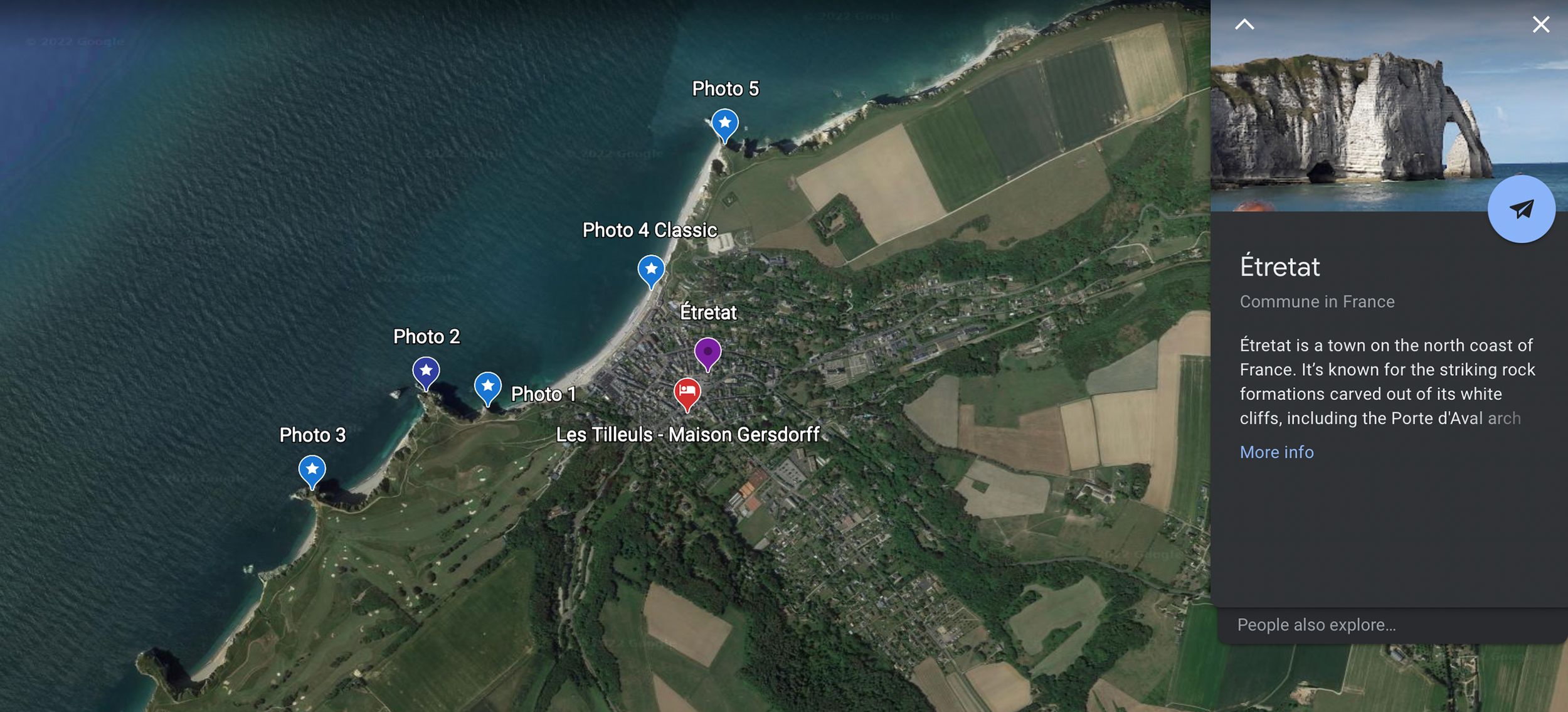
Photo 1, 2,3 are on the West Side (LEFT SIDE) then Photo 4 is from Beach and on the Opposite Side is the Eastern Locations or RIGHT SIDE (Photo 5)
Falaise d'Amont (East Cliff) and Porte d'Amont
On the east side of the bay, the Falaise d'Amont reaches out into the Channel as a thin alabaster ridge nearly 120 meters long. At its tip is the smallest of Étretat's three arches, the Porte d'Amont. It is less dramatic than the west side but more intimate, and the view back across the bay toward the gardens, the chapel, and the full sweep of the Falaise d'Aval is exceptional. This is a strong sunset location.
The east cliff also gives you the best elevated perspective on the beach, the town, and the full western cliff line. From up here, you see the geography of Étretat clearly: the small bay, the pebble beach, the fishing boats scattered below, and the arches on either side.
📷 Pro Tip: Take the 350 steps from the right side of the beach (facing the sea). The path is steep but well-paved and easy to follow. Allocate 15 minutes. Once at the top, walk out along the ridge toward the arch. The best composition looking west uses the cliff edge as a leading line into the bay and the Falaise d'Aval beyond. Bring a telephoto (70-200mm) to isolate the chapel and compress the bay. At sunset, position yourself on the eastern ridge with the arch to your right and shoot back west toward the golden cliff face. Do not stand too close to the edge; the chalk crumbles and the drops are significant. Access is free.
Best time: Sunset. Access: Free, via beach staircase on the right.

From the Eastern Side at Sunset
There are lots of photos to be made from the top
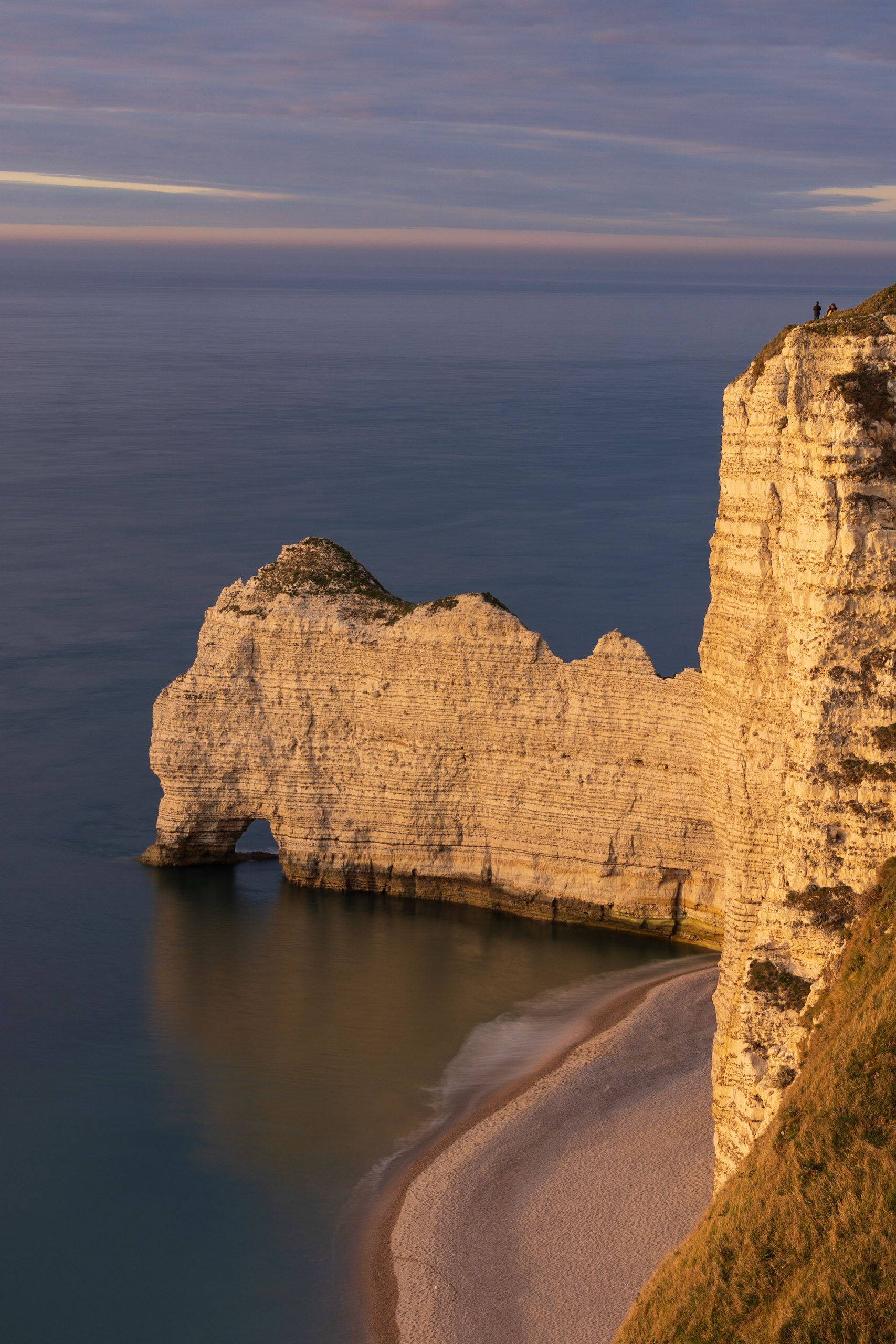
These 2 tourists were right on the Edge
Here is another view
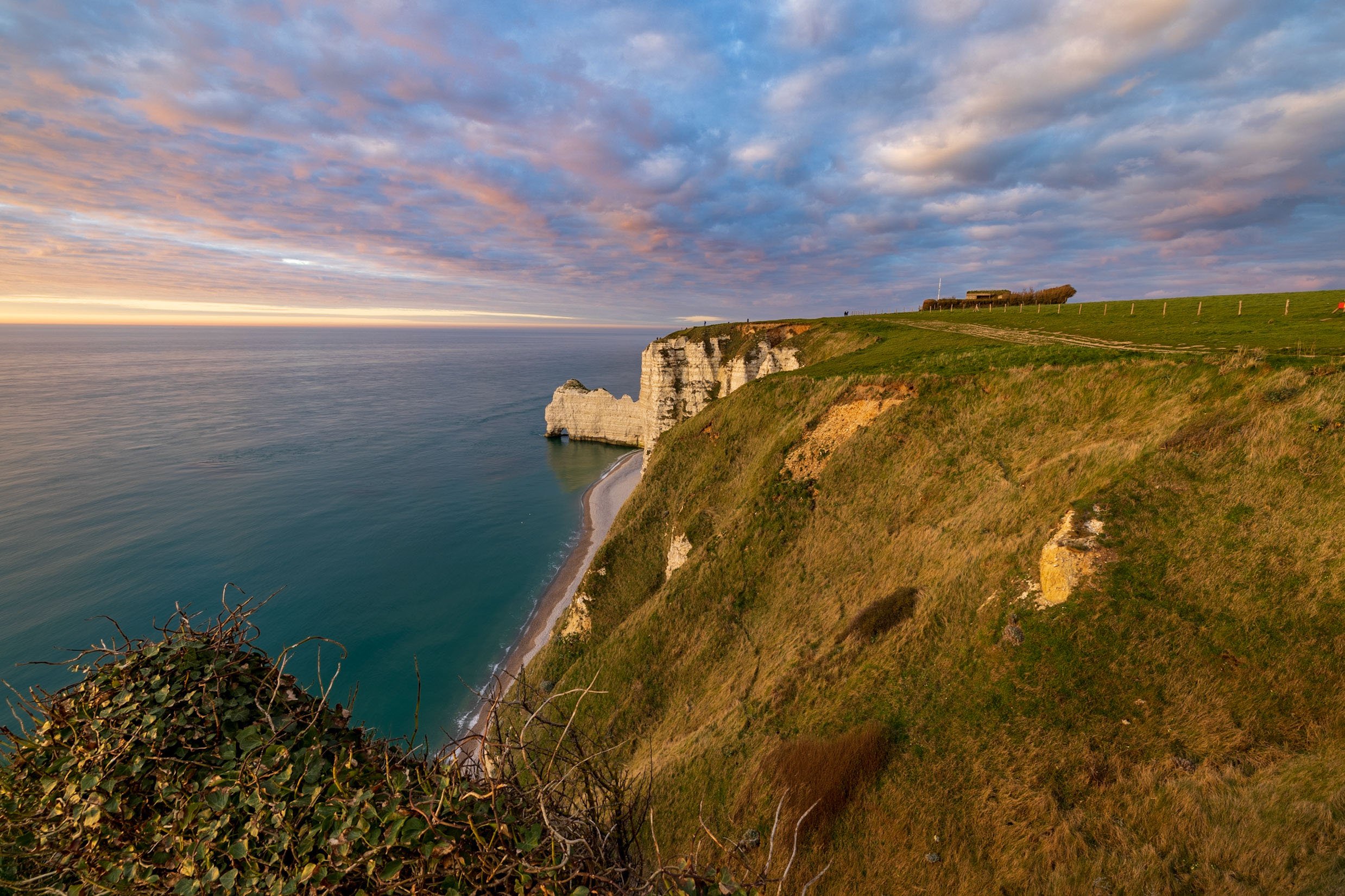
Eastern Ridge Shooting Away from the Town
To get to the top of the cliff, take the long 350-step stairs from the right side of the beach (15 minutes of walking). It is a steep climb, but the pathway is easy to follow. Once you are at the top, there are plenty of nice images to take along the coastline, including the chapel and the gardens.
Notre-Dame-de-la-Garde Chapel
The small white chapel sits at the top of the east cliff and can be seen from both the beach and the opposite headland. It is a simple Norman structure, elegant in its proportions, and surrounded by a fence that has been covered over the years by small votive offerings and mementos left by fishermen's families. The chapel itself is photographically interesting both as a subject and as a compositional anchor when shooting across the bay from the west cliff.
From the beach, the chapel sits small on the skyline above the east cliff. From the west clifftop, it appears as a white vertical against the green headland and the blue sea beyond. Both framings work.
📷 Pro Tip: The most interesting shot of the chapel is from the west clifftop looking back east, with a telephoto lens (100-200mm) compressing the chapel against the sea. Shoot in the late afternoon when the light comes from the west and the chapel facade catches warm light. If you are on the east cliff near the chapel, a wide-angle shot including the chapel, the cliff edge, and the sea below creates a strong sense of scale. Access is free via the east cliff staircase.
Best time: Late afternoon. Access: Free, open to visitors.

Les Jardins d'Étretat (The Gardens of Étretat)
The gardens are probably the most underappreciated photography location in Étretat, and that surprises me every time I think about it. They overlook the chalk cliffs directly, offering a panoramic view across the top of the bay that few other vantage points can match. But the gardens themselves are extraordinary subjects: inspired by Monet's paintings, they were originally created in 1905 by the French actress Madame Thébault and were restored in 2015 with landscape architect Alexander Grivko. The result is a topiary and sculptural garden unlike anything else on the Normandy coast.
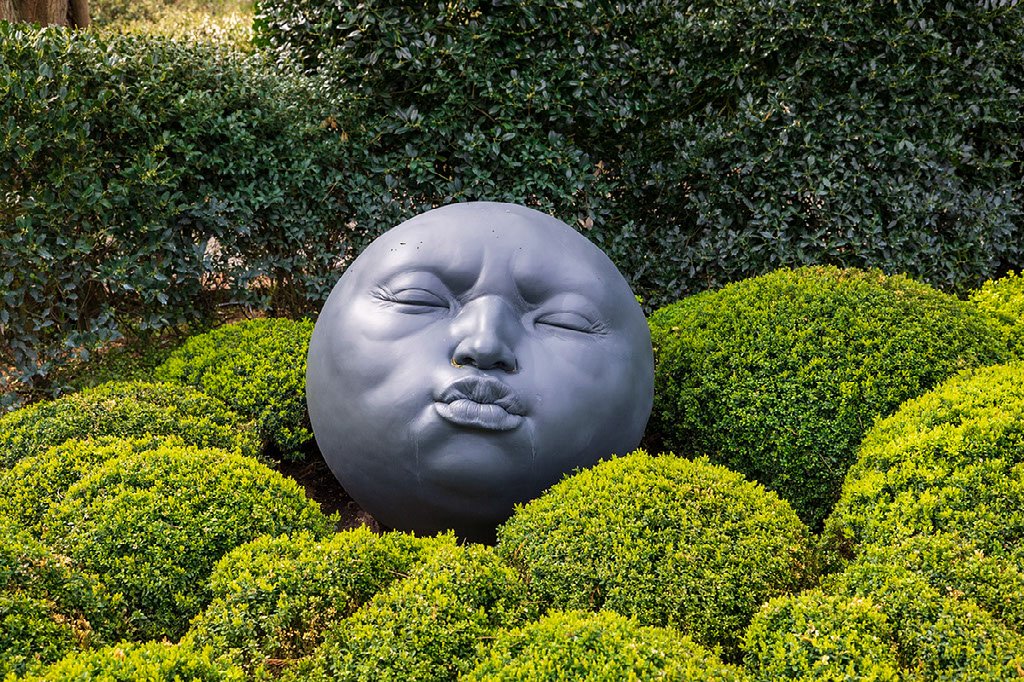
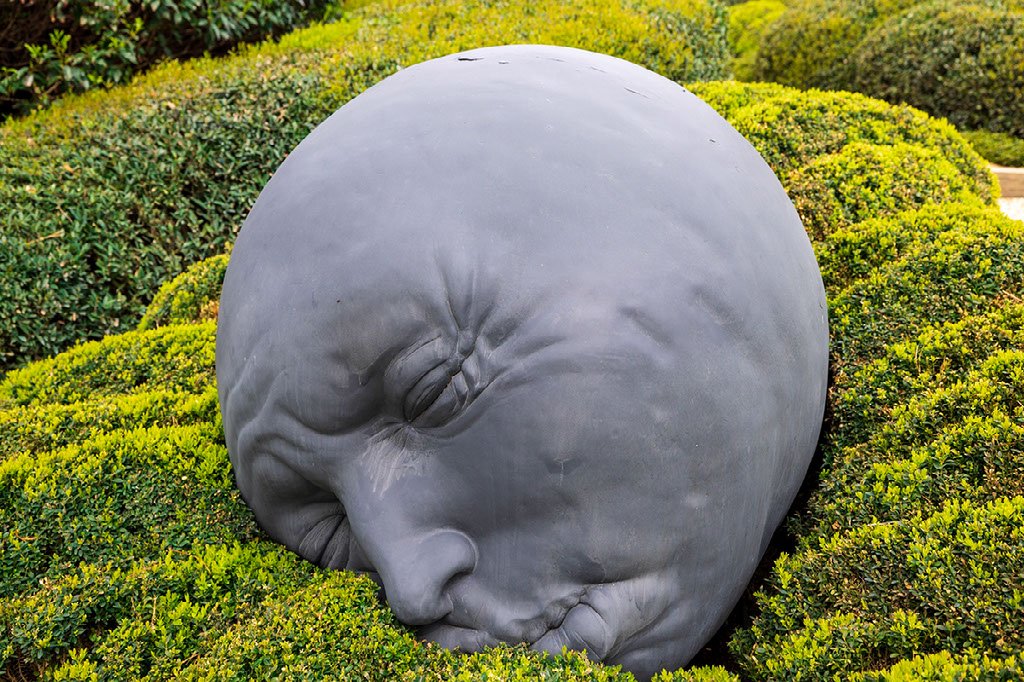
The compositions here mix the architectural geometry of the sculpted hedges with the natural drama of the cliff backdrop. Smiling sculptural figures emerge from manicured greenery with the Falaise d'Aval visible behind them. The juxtaposition is genuinely strange and genuinely compelling.
📷 Pro Tip: The gardens sit just across the road from the Notre-Dame-de-la-Garde chapel on the east cliff. Use a 35-50mm focal length to compose garden sculptures with the clifftop view in the background. Mid-morning light from the east falls cleanly on the sculptures and the greenery without the harsh shadows that midday creates. The gardens open at a specific time (typically 10:00 AM) and charge a small admission fee. Go early, when the light is still directional and before the gardens fill. Use a wide aperture to separate sculptural subjects from the background and draw attention to the detail in the topiary work.
Best time: Mid-morning. Access: Paid admission, seasonal hours. Check current times before visiting.
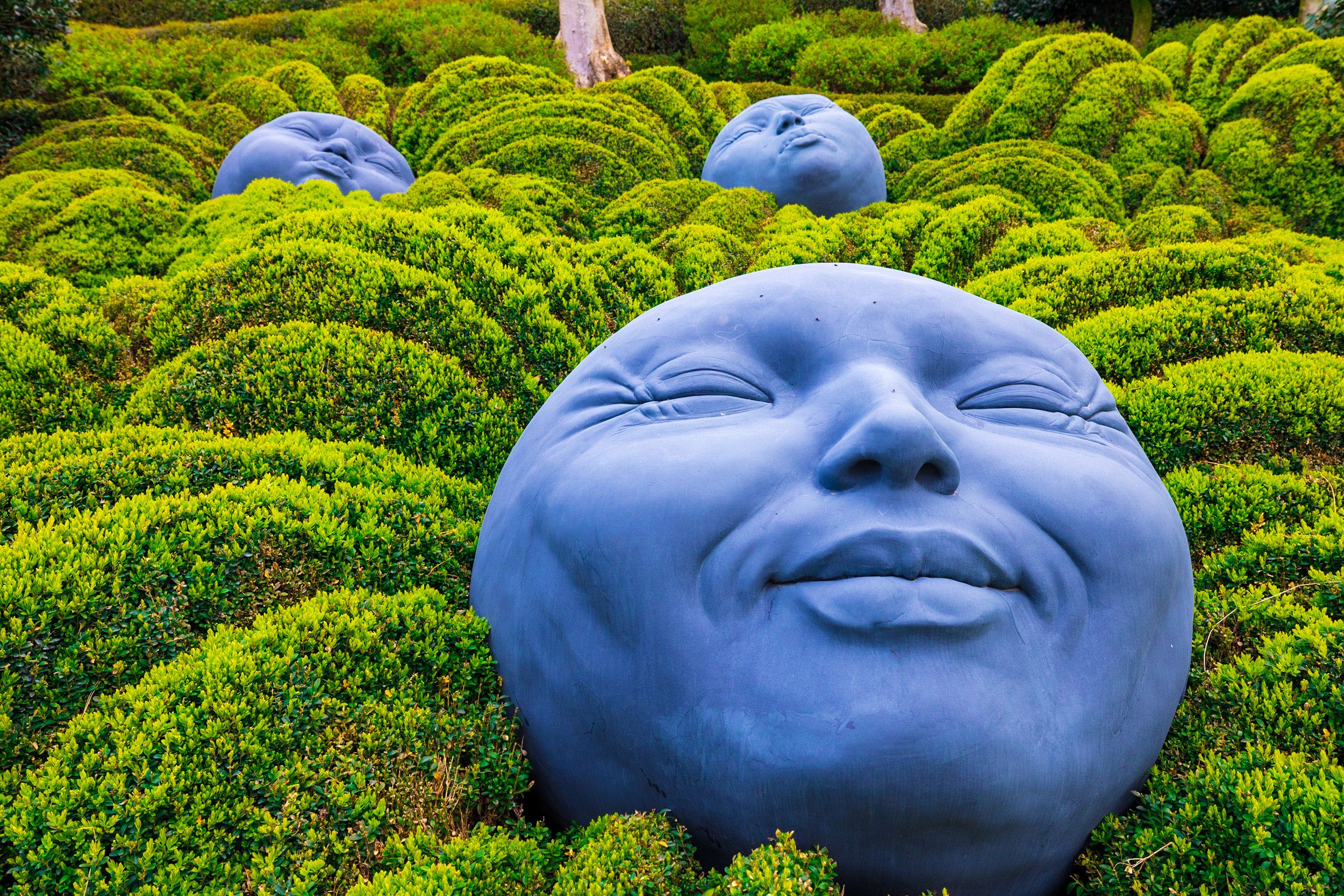
The Smiling Sculptures of the Gardens
Inspired by Monet's paintings, the French actress Madame Thébault created Etretat Gardens in 1905 by planting the very first tree. It was not until 2015, with landscape architect Alexander Grivko, that the gardens were restored and became what they are today. These gardens overlook the white chalk cliffs, offering a breathtaking panorama.
The Étretat Beach
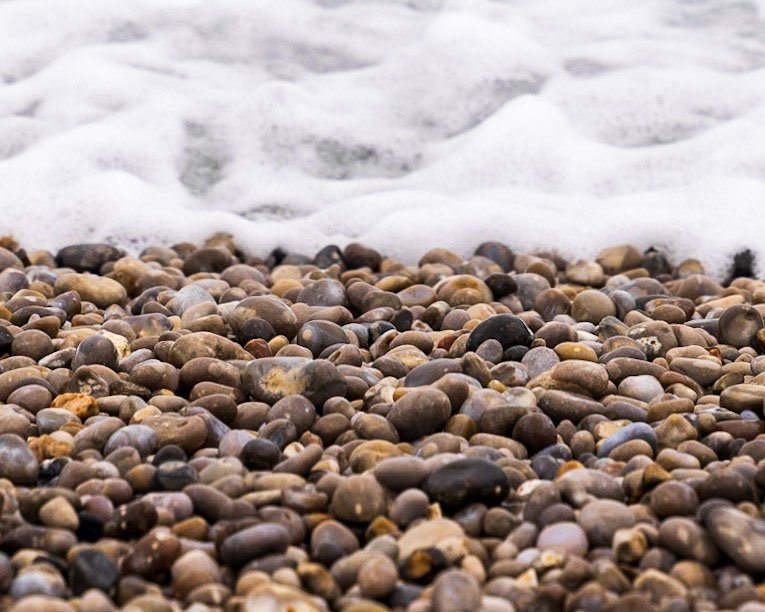
The beach is pebbled rather than sandy, which immediately gives it a graphic quality that works well for photography. At low tide, the pebbles take on interesting textures and the fishing boats scatter along the shoreline in an almost painterly arrangement. From the beach, you have a direct line of sight to the Falaise d'Aval arch and the Aiguille, framed by the bay.
The beach is not an easy composition. The scale means you need to be selective about what you include and what you leave out. There is no single obvious setup here, and that is part of what makes it interesting. Work the foreground, experiment with the pebbles at different times of tide, and use the boats as anchors for your compositions.
📷 Pro Tip: For a beach-level shot of the full arch and Aiguille, position yourself near the left edge of the beach (west side) and use a wide-angle lens at 15-20mm. Get low, almost to pebble level, and include the texture of the foreground. The arch-and-needle combination from this angle is the classic Étretat composition. At dawn, the light comes from behind you and illuminates the face of the arch; this is the shot that Monet painted. Arrive before sunrise. At high tide, the water reaches far up the beach and creates reflections that can add significantly to the composition. Check tide times before you go.
Best time: Sunrise or sunset. Access: Free.

Fisherman on the Beach at Sunrise
It is an especially convenient location when you do not have enough time to explore the other vantage points. And yet, I wouldn’t necessarily call it quick or easy. There is no readily available composition here, so you will have to search for one yourself.
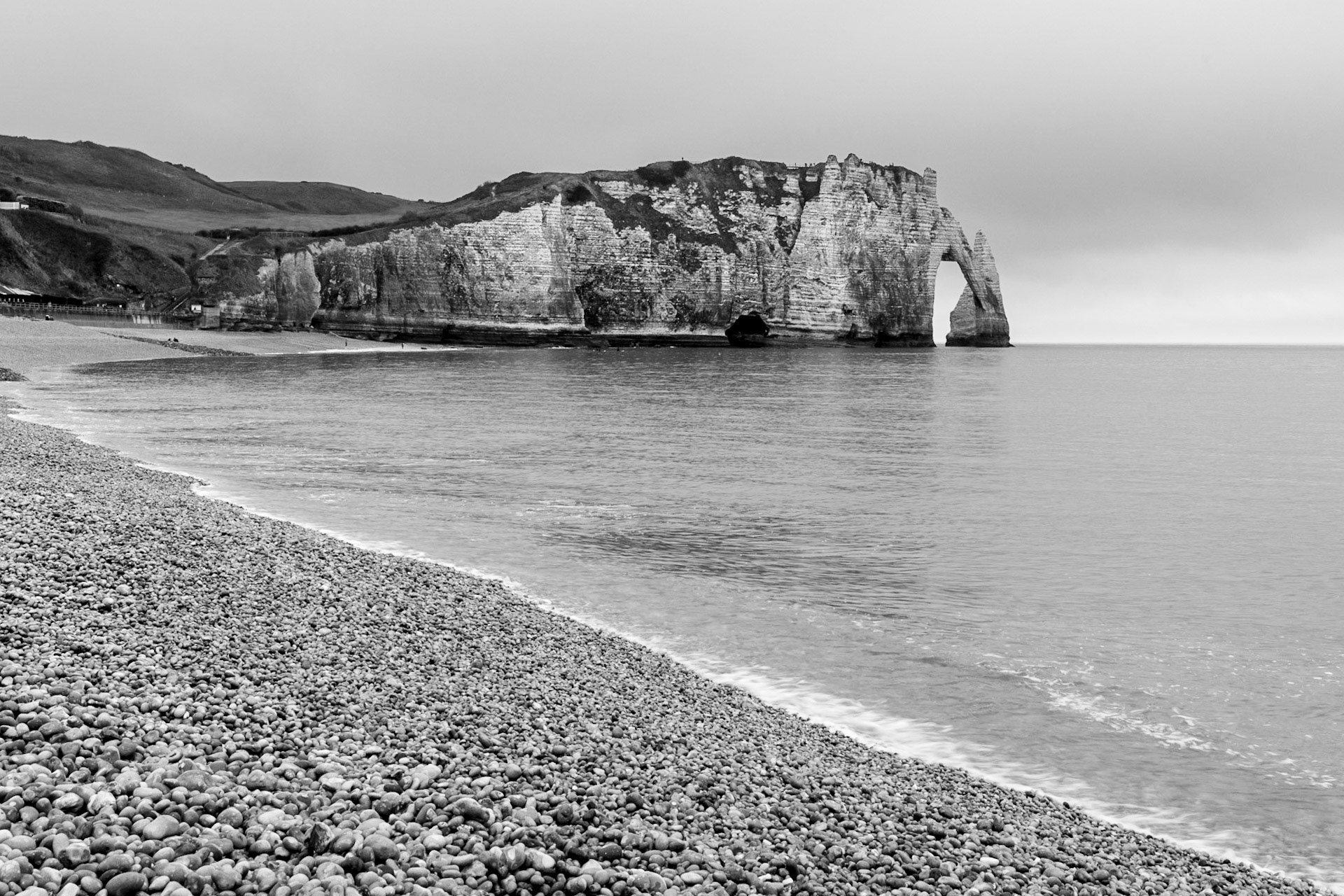
I loved the pebble beach…
The beach cliffs at sunset are just stunning

and at sunset its just magical

Falaise d'Aval (West Cliff) and the Aiguille
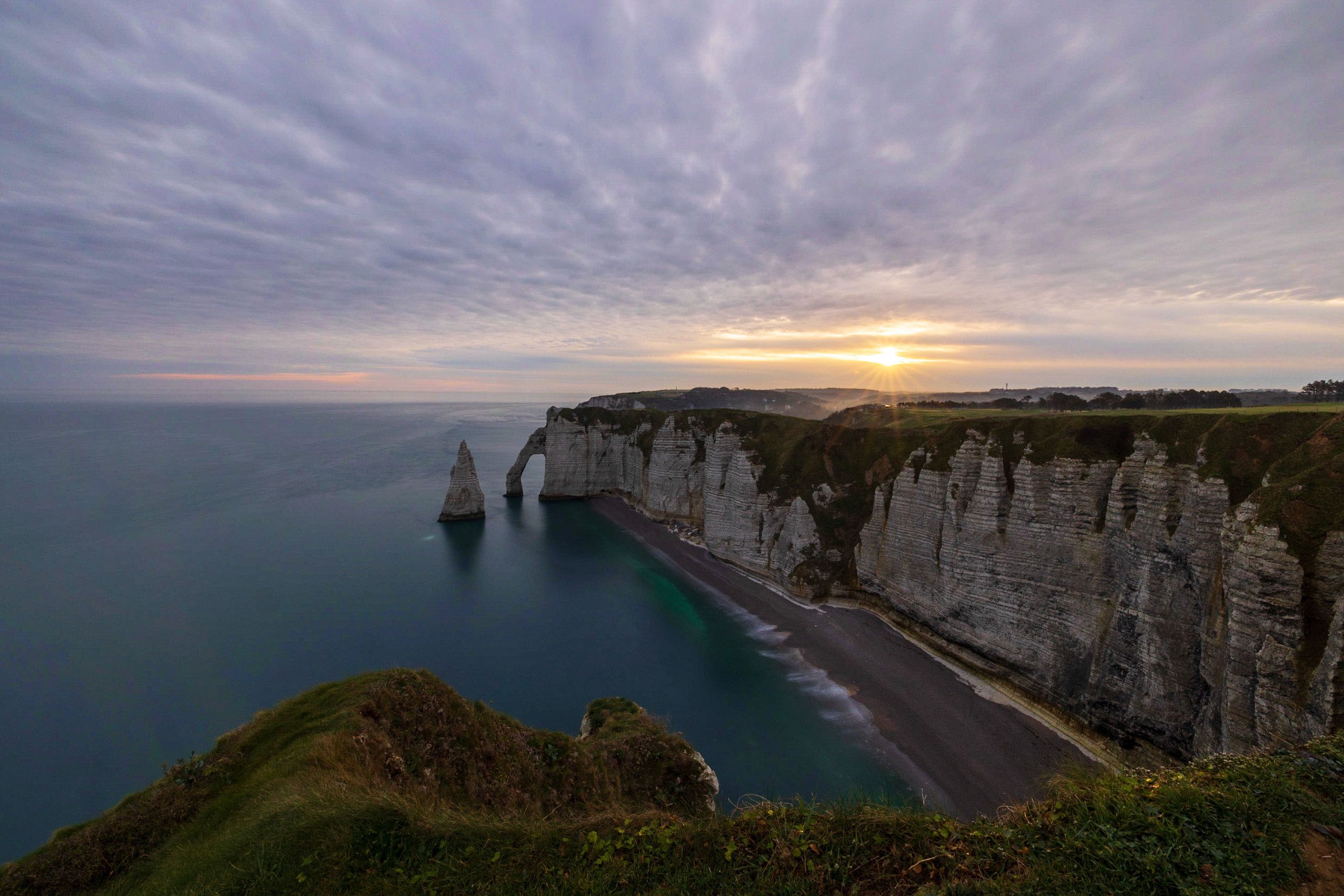
The Falaise d'Aval is the most photographed side of Étretat, and for good reason. The arch here is massive, elegant, and immediately photogenic. Just beyond it stands the Aiguille, a freestanding needle of chalk rising from the sea, which Arsène Lupin used as a fictional hiding place for the treasures of France. Standing on top of the arch, looking west along the clifftop, with the Aiguille cutting the horizon and the English Channel below, is one of the most extraordinary views I have encountered in Europe.
The light here is best at sunrise, when the low sun comes from the east and catches the face of the cliff and the arch. The sea is often calmer at dawn, and you are far more likely to have the headland to yourself.
📷 Pro Tip: Take the left staircase from the beach (as you face the sea) to reach the clifftop. The climb takes about 15 minutes and is steep but well-marked. Once at the top, walk to the edge of the arch and look down. From directly above, the arch frames the beach and the opposite cliff beautifully. For the classic arch-and-needle composition, walk west along the headland for about five minutes until you can see the full arch and the Aiguille together from a slight elevation above them. Use a wide-angle lens (15-24mm) to capture both elements and include the channel horizon. Arrive at least 45 minutes before sunrise to position yourself before the light changes. Access is free.
Best time: Sunrise. Access: Free, open access via beach staircase.
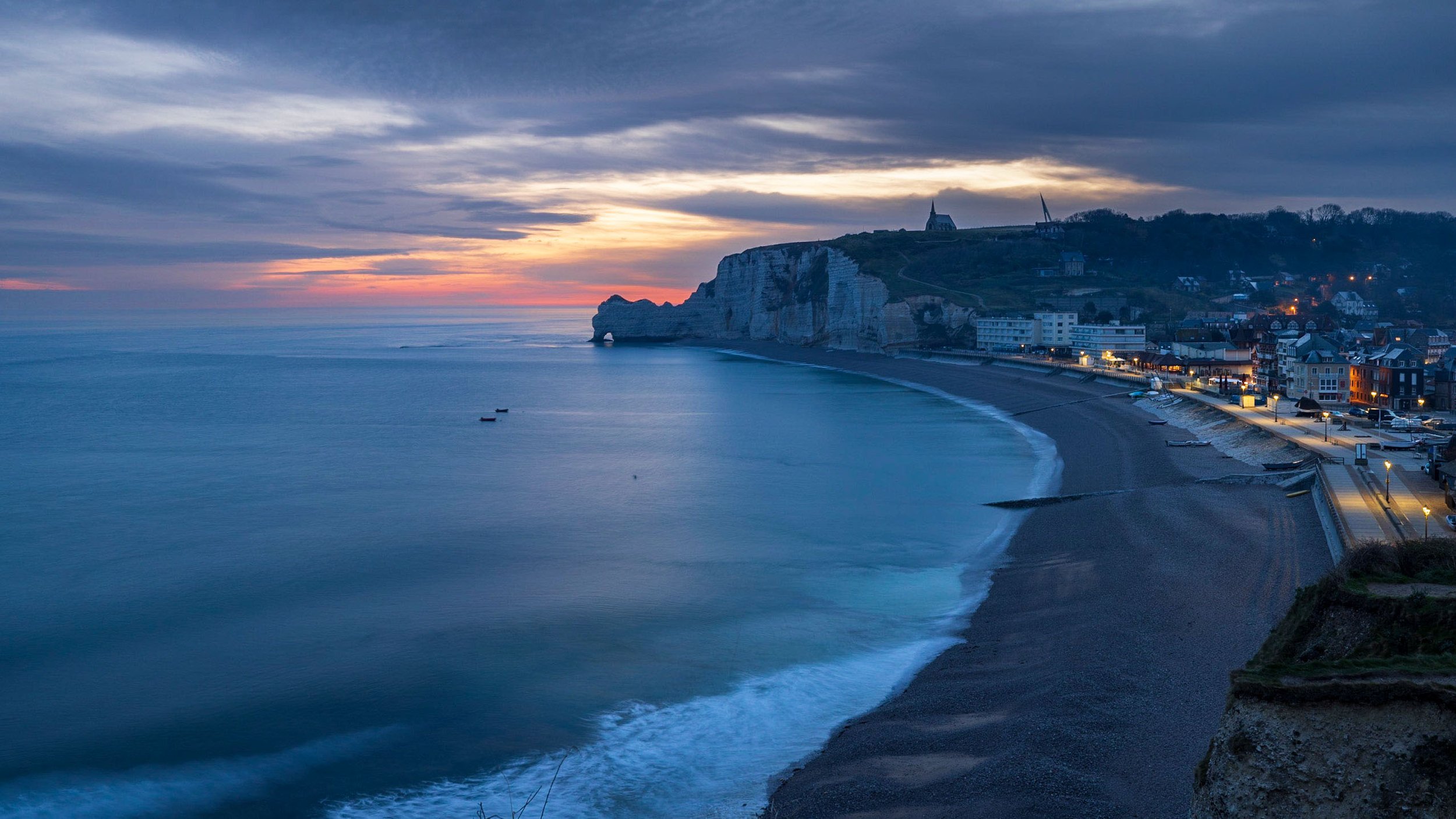
Sunrise
If you keep walking towards the west, away from Étretat, you will see the third natural arch of Étretat – Manneporte (Falaise d’Aval).
Festivals & Events
Étretat is a small town and does not have a packed events calendar, but a few moments in the calendar are worth knowing about.
D-Day Commemorations (June): The Normandy D-Day anniversary draws significant attention to the broader region every June. While Étretat is not a D-Day site itself, the surrounding area fills with commemorations, historical events, and international visitors. It adds cultural depth to a Normandy trip and the landing beaches are within driving range.
Normandy Impression Weekend (Autumn): Étretat periodically hosts events celebrating the region's connection to Impressionist painting, with exhibitions, guided walks to Monet's painting locations, and cultural programming that draws art enthusiasts. Worth checking local listings before your trip.
Étretat in Winter (December to February): Not a formal event, but the off-season period when the town returns to its local rhythm. Christmas decorations appear in early December and the village becomes noticeably quieter. If you want dramatic cliff light without crowds, winter is when you go. The Norman coast in winter storm light is extraordinary.
Summer Weekends (July to August): Not a festival, but worth noting that Étretat's weekends in peak summer can be extremely crowded, particularly on sunny days when visitors arrive from Paris and Le Havre. If you are traveling during this period, shoot at dawn and be on the cliffs before 7:00 AM. By 10:00 AM, the vantage points fill.
Frequently Asked Questions About Visiting Étretat
Do you need a car in Étretat?
Not once you arrive. The town is entirely walkable, the beach, both cliff staircases, and every restaurant are within fifteen minutes of the center. A car is only useful for getting there and for day trips like Fécamp or the D-Day beaches.
Is Étretat expensive?
Not particularly, there's a real range. Le Bicorne and other local spots offer honest, reasonably priced Norman cooking, while Le Donjon reserves the special-occasion budget for a genuinely memorable dinner.
What are the best photo spots in Étretat?
Falaise d'Aval and the Aiguille at sunrise, the beach for the classic Monet composition, and Falaise d'Amont at sunset for the view back across the bay are three that consistently deliver. The full list with Pro Tips is above.
Can you fly a drone in Étretat?
Check current French DGAC regulations before flying. The clifftops attract crowds, particularly in summer, and drone use is restricted in many public access areas around the formations.
What surprised you most about Étretat?
Discovering it through the French Netflix series Arsène Lupin, which is partially set here. Learning that Monet and Manet had both painted the same cliffs, and that a fictional thief's hideout was inspired by the same Aiguille I was photographing, added a layer to the whole trip I didn't expect going in.
How many days do you need in Étretat?
Two nights minimum, genuinely, you need two sunrises and two sunsets to cover both the east and west cliffs properly. Three nights gives you a weather buffer, which in Normandy is worth having.
Is Étretat worth combining with Mont Saint-Michel or Paris?
Yes, both work well. Paris is the natural gateway, about three hours south. Mont Saint-Michel sits two and a half hours southwest and makes an essential addition to any broader Normandy photography trip.
Final Thoughts
Étretat stays with you. It is one of those places where the photographs are never quite as good as the experience of standing there, and that gap is itself a kind of compliment to the place. The cliffs are simply too large, too present, and too constantly changing for any single image to capture them fully. Which means you keep coming back and keep trying.
If you are planning a Normandy trip and are not sure whether Étretat is worth including, the answer is yes, absolutely. Two nights is all you need to see it properly, but you may find yourself extending the stay.
For photographers, the combination of scale, light, and architectural natural structure is rare. Étretat is one of the few places in Europe where you can shoot at professional quality with a single prime lens, a tripod, and patience. Everything else the location supplies.
Want to improve your photography while exploring some incredible destinations? Join me on one of my photography workshops! You can find all the details, including upcoming destinations and dates, through the links below.
Let's Stay Connected!
More Guides from the Region
My Photography & Travel Guide to Paris Paris is the natural base for a Normandy trip. Three hours by car or train, and you have the best possible jumping-off point for the drive north to the cliffs. My Paris guide covers all the photography locations, best neighborhoods to stay in, and the specific timing advice that makes Paris rewarding to photograph. Do both.
My Photography & Travel Guide to Mont Saint-Michel, France One of the most photographed structures in the world, and justifiably so. Mont Saint-Michel sits about two and a half hours southwest of Étretat and is an essential addition to any Normandy itinerary. The tidal approach, the medieval silhouette, and the light at golden hour are unlike anything else in France. My guide covers the best shooting positions and tide timing in detail.
My Photography & Travel Guide to Colmar, France If you are doing a broader France circuit, Colmar is in Alsace, several hours southeast, but it is one of the most photogenic towns in the country. The half-timbered architecture, the canals of La Petite Venise, and the Christmas market are all exceptional subjects. A natural extension of any French photography trip.
Finally—a beginner-friendly photography guide that makes sense.
If you've ever picked up a camera and thought, "Now what?" this is the book for you.
Photography Made Simple is written for adults who are just starting out and want a clear, encouraging, real-world approach to learning photography. Whether you're using a DSLR, mirrorless, or just your smartphone, this guide walks you through the basics—without the jargon or tech overwhelm.
Inside, you'll learn:
The only camera settings you really need to know to get started
How to shoot sharper, more intentional photos using light and composition
Simple tips for portraits, landscapes, travel, and everyday life
What gear you do (and don’t) need
How to create better photos without upgrading your camera
You’ll also get practical exercises, cheat sheets, and tips for organizing and editing your images—plus the confidence to shoot off Auto Mode for good.
This is not a textbook. It’s a friendly guide to seeing the world with fresh eyes—and finally capturing what you see the way you imagine it.
📸 Format: PDF download
Pages: 100+
Perfect for: Beginners, hobbyists, and anyone ready to take better photos without the stress

Unlock the power of long exposure and take your photography to the next level.
Mastering ND Filters is your complete guide to understanding and using Neutral Density (ND) filters with confidence. Whether you’re a beginner or a hobbyist looking to expand your creative toolkit, this practical, easy-to-follow book walks you through everything you need to know—from gear choices and exposure calculations to creative shooting techniques and real-world examples.
Inside you’ll learn:
What ND filters are and how they work
How to choose the right strength and type of filter
Step-by-step workflows for photographing waterfalls, clouds, seascapes, and city scenes
How to calculate long exposures using apps and charts
Pro tips for reducing noise, focusing with dark filters, and getting tack-sharp results
Packed with clear explanations, inspiring images, and field-tested advice, this guide will help you shoot with intention, slow down your process, and create stunning photographs that capture not just motion—but mood.
Whether you're shooting with a DSLR, mirrorless camera, or even a smartphone, Mastering ND Filters will help you bring your creative vision to life.