Edinburgh, Scotland Travel & Photography Guide: Best Photo Spots, Things to Do & Hidden Gems
I had been wanting to get back to Edinburgh for years. The last time I was there, I was a young boy, and the city had lodged itself in my memory as something out of a storybook: grey stone towers, narrow cobbled streets, a castle sitting up on a rock like it owned everything below it. That image never left me. So when I finally returned, camera in hand and a full week ahead of me, I was not just visiting a city. I was going back to find out if it was as extraordinary as I remembered.
It was better.
What caught me off guard was how much the city rewards the people who slow down. Edinburgh is not a city you race through, checking boxes. It is a city you stroll. You turn down an unmarked close on the Royal Mile and find yourself in a stone passageway that descends steeply into shadow, and you stop, and you look, and you realize you have been standing there for ten minutes just watching the light move. The food is serious, the afternoon teas are extraordinary, the bakeries are worth an alarm clock, and the street photography is some of the richest I have found anywhere in the UK. Bagpipers on the Royal Mile. Locals cutting through the closes. Tourists discovering Greyfriars Bobby for the first time. The city never stops giving you something to photograph.
For photographers, Edinburgh delivers on nearly every level. The architecture is dramatic and layered, the light is moody and constantly shifting, the closes create natural frames and compressed perspectives you cannot find anywhere else, and the elevated viewpoints at Calton Hill and Arthur's Seat put the entire skyline at your feet. Whether you are shooting with a mirrorless kit or working with your iPhone, this is a city that meets you wherever you are.
In this Photography Guide to Edinburgh, I share the places and experiences that continue to draw me back. You will find my favorite photography locations, guidance on when and where to shoot, practical travel tips, and gear recommendations, along with cultural insights to help you explore and photograph Edinburgh with confidence, respect, and ease.
Photographer's Notes
Before you go, here are my own takeaways.
Favorite Season: Spring (April-May)
Favorite Location: Calton Hill
Favorite Hotel: The Balmoral Hotel
Favorite Restaurant: The Spence at Gleneagles Townhouse
Favorite Café: The Milkman
Favorite Lens: 16-35mm f/2.8
Would I Return? Yes, I would love to explore more of Scotland.
Where to Stay in Edinburgh, Scotland
The best base for photographers in Edinburgh is the Old Town or the New Town, and the choice between them shapes the kind of experience you have. The Old Town (Grassmarket, Royal Mile, Cowgate) is the most atmospheric base, putting you inside the historic core, close to the closes, Victoria Street, and the Castle. It can be noisy on weekend evenings, but you wake up in the middle of everything. The New Town (George Street, St Andrew Square, Princes Street) is quieter and more elegant, and it positions you beautifully for Calton Hill and the Georgian streetscapes of the northern grid. Both areas are within walking distance of every major photography location in the city.

Luxury Hotels in Edinburgh, Scotland:
The Balmoral Hotel — 1 Princes Street, Edinburgh
The Balmoral has been Edinburgh's most distinguished address since it opened in 1902, its 190-foot clock tower set deliberately three minutes fast so Victorian travelers would not miss their trains from Waverley Station below. More than a century later, under Sir Rocco Forte's stewardship, it remains the benchmark against which every other Edinburgh hotel is measured. We stayed here and I can tell you firsthand that the rooms are generous in size, thoughtfully designed in a palette drawn from the Scottish landscape — Hebridean blues, heather tones, and classic Scottish art throughout — and the views are exceptional.
My room looked directly out at the Scott Monument, that dramatic Gothic spire rising above Princes Street Gardens, which is not a bad thing to have framed in your window first thing in the morning. It put me outside with a camera before breakfast. The J.K. Suite, where Rowling completed Harry Potter and the Deathly Hallows in 2007, is a particular draw for literary guests. The whisky bar holds over 500 Scottish malts, one of the finest collections in the country. For photographers, the location at the east end of Princes Street could not be more central. Calton Hill is a five-minute walk. The Royal Mile is ten. The castle is eleven. The clock tower itself, illuminated at night, is one of Edinburgh's most photographed architectural details, and you are looking straight up at it from your front door.
Gleneagles Townhouse — 39 St Andrew Square, Edinburgh (One Michelin Key)
The legendary Gleneagles resort has long been one of Scotland's most celebrated destinations. Its Edinburgh outpost, opened in a magnificently converted Victorian bank building on St Andrew Square, brings that same standard of Scottish luxury into the capital. The 33 rooms channel the Gleneagles house style — moss green, dusky pink, antique furnishings, velvet upholstery, and local contemporary artwork — in spaces that feel both historically grounded and entirely contemporary. The spa occupies the original bank vault below the building, one of the more atmospheric wellness spaces in Scotland. The Spence restaurant is among the finest in the city, and for hotel guests, the Lamplighters rooftop bar offers sweeping views over the New Town skyline that are well worth a cocktail before dinner. I ate at The Spence during my stay and it was exceptional — modern Scottish cooking with a kitchen that takes its sourcing seriously.
The Edinburgh Grand — 42 St Andrew Square, Edinburgh
The Edinburgh Grand occupies the former Dome building on St Andrew Square, one of the grandest neoclassical interiors in Edinburgh, with a spectacular atrium that is a photography subject in its own right. The apartments and suites are among the most spacious hotel accommodations in the city, and the position, steps from the Gleneagles Townhouse and a short walk from Princes Street, is excellent. If you are staying elsewhere, it is worth walking in to ask about photographing the atrium. It is extraordinary.
Mid-Range Hotels
The Inn on the Mile — 82 High Street (Royal Mile), Edinburgh Old Town
A well-run boutique hotel positioned directly on the Royal Mile. You wake up inside the most photographed street in Edinburgh and are at the closes, St Giles Cathedral, and Greyfriars within minutes on foot. The rooms have genuine character, and the Tolbooth Tavern pub below is one of the better casual spots on the Royal Mile. For photographers who want to roll out of bed at first light and be shooting within five minutes, this is the one.
Apex Grassmarket Hotel — 31–35 Grassmarket, Edinburgh Old Town
The view of Edinburgh Castle from the upper floors and rooftop terrace is one of the finest in the city. The Grassmarket location also puts you directly below the castle and within easy walking distance of Victoria Street, Greyfriars, and the Vennel Steps. A strong choice for photographers who want castle views without the five-star price.
Ibis Styles Edinburgh Centre — South Bridge, Edinburgh Old Town
Well-located, affordable, and a reliable base for photographers who want to put their budget into experiences rather than the room. Walking distance to the Royal Mile, the closes, and the major photography locations of the Old Town.

A Young Man Playing the Bagpipes on the Royal Mile
How Many Days Should You Visit Edinburgh, Scotland?
Three days is the minimum to cover the major photography locations at a reasonable pace. Five days is the photographer's ideal, giving you enough time to revisit the best locations in different light conditions without feeling rushed.
A five-day framework:
Day one should go to the Old Town. Start at dawn on the Royal Mile before anything opens, work the closes in the morning light, then move to Edinburgh Castle for the esplanade and the views. Afternoon in Greyfriars and Victoria Street. Blue hour at Princes Street Gardens with the castle illuminated.
Day two is for elevation. Arthur's Seat at sunrise, which means a 4:30 am start in spring and summer. Descend through Holyrood Park and walk north to Calton Hill for late morning. Afternoon recovery and editing. Sunset back on Calton Hill for the classic skyline composition.
Day three for neighborhoods. Dean Village in the early morning, then north to Stockbridge, then across to the National Gallery and Princes Street Gardens for midday. Afternoon for the New Town's Georgian streets and St Andrew Square. Evening at The Spence or The Witchery.
Day four is a revisit day. Go back to whatever location you felt you did not fully get. Walk the Water of Leith Walkway. Spend a morning just doing street photography on the Royal Mile as the buskers and performers set up.
Day five is for day trips. Rosslyn Chapel is a 45-minute bus ride. Cramond Beach is 20 minutes. The Forth Rail Bridge at South Queensferry is 30 minutes and one of the great Scottish photography subjects.

Best Time of Year to Visit Edinburgh, Scotland
Edinburgh rewards photographers in every season, but the light and the crowds change dramatically depending on when you go.
Spring (April to May) is the sweet spot. The days are long, the light is clean, and the cherry trees in the Royal Botanic Garden are in full bloom. Crowds are manageable, and you can still get Arthur's Seat and Calton Hill nearly to yourself at sunrise. Golden hour arrives early and lingers. This is when I visited, and I would not trade it.
Summer (June to August) brings the longest days in Europe's northern latitudes. Golden hour extends past 10pm in June and July, which gives photographers extraordinary shooting windows. Edinburgh in summer also means the Edinburgh International Festival and the Fringe in August, when the city fills with performers, street artists, and energy that is unlike anything you will find the rest of the year. The trade-off is crowds everywhere, especially on the Royal Mile. If you want empty-street photography, you are setting a 4:30am alarm.
Autumn (September to October) is the other strong window for photographers. The summer crowds have thinned, the light takes on a warmer quality, and Arthur's Seat and Holyrood Park shift into golden and amber tones. Hogmanay planning begins in October, and the city has a focused, settled energy that suits slower, more deliberate photography.
Winter (November to February) is Edinburgh's most underrated season for photographers. The low winter sun stays close to the horizon all day, giving you dramatic raking light from morning through mid-afternoon. The Edinburgh Christmas Market at East Princes Street Gardens transforms the city with warm lights and festive atmosphere, and Hogmanay, Scotland's New Year celebration, is one of the great photography events anywhere in the UK. Expect cold, expect wind, and expect the closes to be at their most atmospheric when mist rolls through them on a grey morning.
Weather note: Edinburgh weather is genuinely unpredictable year-round. A waterproof jacket and a rain cover for your camera bag are non-negotiable, whatever month you visit. The moody overcast days are not failures; they are opportunities. Flat light eliminates harsh shadows in the closes and adds a quiet drama to the skyline that clear days cannot match.

A Fantastic Book Store called Goldern Hare Bookstore
Getting Around Edinburgh, Scotland
Edinburgh is one of the most walkable capital cities in Europe, and for photographers, that is exactly what you want. The Old Town and New Town are both compact and flat enough — mostly — that a full day of shooting requires nothing more than comfortable shoes and a good bag. The major photography locations, from Victoria Street to Calton Hill, from Dean Village to the Royal Mile, are all reachable on foot from a central base.
For longer distances, Edinburgh has a reliable bus network that covers the entire city. The tram line connects the airport to the city center and runs along Princes Street, which is useful for getting oriented quickly after arrival. Uber and Bolt are both available and work well for returning to the hotel after a late blue-hour shoot when you have gear to carry.
One specific note for photographers: do not take a taxi to Dean Village when you can walk. The approach on foot from the city center, descending along Bell's Brae with the gorge opening up below you, is part of the experience. Same with the closes — you only find the best ones by walking slowly and looking at everything. The city reveals itself at walking pace.

The Royal Bank of Scotland
Where to Eat in Edinburgh, Scotland
Scottish cuisine is more serious and more interesting than its reputation suggests. The cold North Sea and the Atlantic coast give Edinburgh access to shellfish, fin fish, and seafood of exceptional quality. The grouse season in August brings game to menus across the city. Lamb from the Scottish hills, beef from Highland cattle, soft fruit from Perthshire, and cheese from the Scottish Lowlands all feed a restaurant scene with more Michelin-recognized restaurants per capita than almost any other British city outside London.
And the whisky. Scotland produces the world's finest single malts, and Edinburgh's whisky bars let you understand why. The Balmoral's collection of over 500 malts is the benchmark, but you will find serious selections in pubs and bars across the Old Town.
Before you leave, try the haggis. Scotland's national dish, made from sheep offal mixed with oatmeal, onion, and spices, is far more compelling than its ingredients suggest. Order it with neeps and tatties — turnip and mashed potato — and a dram of whisky alongside. It is the flavor of the Scottish countryside in one bowl.

The Spence at Gleneagles Townhouse
The Kitchin — 78 Commercial Quay, Leith
Tom Kitchin's flagship restaurant in Leith's historic port has held its Michelin star since 2007, making it one of the most consistently celebrated restaurants in Scotland. Kitchin trained with Alain Ducasse and Guy Savoy in Paris before returning to Scotland with a clear philosophy: from nature to plate. The seasonal Scottish larder, Newhaven lobster, roasted venison loin, Highland wagyu beef tartare, and grouse in season, is given the precision of classical French technique. Ask for a table by the kitchen's glazed wall to watch the action directly. The well-priced set lunch menu is one of the best fine dining values in Edinburgh.
The Witchery by the Castle — Castlehill, Royal Mile
For an evening that uses Edinburgh's Gothic atmosphere as its full backdrop, The Witchery is the answer. Set just below Edinburgh Castle on the Royal Mile, the restaurant occupies two dramatically decorated rooms with candlelit interiors, gilded leather walls, and oak paneling that makes the food taste better than it would anywhere else. The menu focuses on the finest Scottish produce: aged beef, langoustines, hand-dived scallops, and a wine list that is one of the most extensive in Scotland. It is not the most innovative kitchen in the city, but it is the most atmospheric meal you can have in Edinburgh.


Number One at The Balmoral — 1 Princes Street, The Balmoral Hotel
The Michelin Guide-recommended restaurant inside Edinburgh's finest hotel is a room of warm red lacquer, soft lighting, and confident service that reflects decades at the top of the city's dining hierarchy. Head chef Mathew Sherry's menu focuses on the finest Scottish ingredients — langoustine, scallop, hand-dived Orkney scallops with N25 caviar, and exceptional cheese. We ate here during our stay and the meal was excellent, the kind of unhurried dinner that a room like this is designed to support. Before sitting down, spend time in the whisky bar. It is one of the oldest bars in Edinburgh, holding over 500 Scottish single malts, and working your way through even one glass with the help of the staff is an education. I tried a malt I had never heard of and came away with three bottles to bring home. Do not skip it.
The Spence at Gleneagles Townhouse — 39 St Andrew Square
The restaurant inside the Gleneagles Townhouse is one of the finest in the New Town, combining modern Scottish cooking with the warmth and precision that characterizes everything the Gleneagles brand does. The kitchen works with seasonal Scottish produce throughout the year, and the room itself, with high ceilings, beautiful light, and the energy of a well-run contemporary dining room, makes for an excellent evening. I had dinner here during my stay, and it was exceptional.
The Scran & Scallie — 1 Comely Bank Road, Stockbridge
Tom Kitchin's gastropub in Stockbridge, Edinburgh's most pleasant residential neighborhood, serves traditional Scottish dishes including fish and chips, haggis, Scotch pie, and excellent Sunday roasts in a warm, family-friendly room. It is also close to Circus Lane, making it a natural lunch stop after a Stockbridge photography morning.
Café St. Honoré — 34 NW Thistle Street Lane, New Town
Tucked away on a quiet lane in the New Town, Café St. Honoré is a long-running Edinburgh favorite: a classic French bistro with a Scottish accent, emphasizing local and organic ingredients in dishes that feel genuinely like something you would find in a Lyon bouchon. The room is candlelit and unpretentious in exactly the right way. The pre-theater menu is excellent value.
Palmerston — 1 Salisbury Place, Southside
A farm-to-table neighborhood restaurant in the Marchmont area operating a seasonal menu that changes with what Scottish farms are producing that week. Warm, unfussy, and reliably excellent. The kind of neighborhood restaurant that Edinburgh's residential areas do very well.


Coffee & Cafes
The Milkman — Cockburn Street. The one we kept coming back to, three or four times during the week. Quaint, warmly lit, excellent coffee, and the kind of atmosphere that makes you stay longer than you planned. A perfect recharge stop between Royal Mile photography sessions.
Cairngorm Coffee — Frederick Street and multiple locations. Bright, modern, serious about its beans. The New Town location is ideal for post-Calton Hill recovery.
Lannan Bakery — Stockbridge. Exceptional pastries and specialty brews. A reason in itself to walk to Stockbridge in the morning.
Beatnik — Clerk Street, Southside. Hip atmosphere, excellent coffee, and good wifi for post-shoot editing sessions.


Photography Gear to Bring to Edinburgh, Scotland
Here is what I would bring and why.
Camera body: I shot Edinburgh with the Canon EOS R5 Mark II as my primary body and carried the Leica Q3 for street work and the morning walkabouts. The Leica's 28mm fixed focal length is almost ideal for the close-ups, and its compact size lets you move through crowds without announcing yourself. If you are bringing one body, any current mirrorless camera will handle the range of conditions Edinburgh presents.
16–35mm f/2.8: This is the Edinburgh lens. The closest demand it. The interior of St. Giles Cathedral demands it. Arthur's Seat and the panoramic views from Calton Hill benefit from it. You will use this more than anything else you bring.
24–70mm f/2.8: The everyday workhorse for street photography on the Royal Mile, architecture in the New Town, and general walking shots. The range covers most situations you encounter outside the specific wide and telephoto scenarios.
70–200mm f/2.8: Essential for the Calton Hill compositions. From the hill, a 70–200mm lens compresses the castle, the Old Town skyline, and the Firth of Forth into layered landscape frames that no wide-angle can achieve. Also useful for isolating architectural details on the castle and the Scott Monument from a distance.
Tripod or Platypod: Required for blue-hour castle shots from Princes Street Gardens, long exposures inside St. Giles Cathedral, and any pre-dawn work on Calton Hill or Arthur's Seat. I use a travel tripod that fits in the carry-on without issue.
ND filters: A 6-stop ND is useful in Princes Street Gardens for long exposures in the early morning before the foot traffic builds. If you want to shoot the Water of Leith at Dean Village with a silky water effect, bring a 6 or 10-stop.
Rain cover for your bag and camera: Non-negotiable. Edinburgh weather changes fast. A dry camera in a wet city is a happy camera.
Extra batteries and cards: Cold weather drains batteries faster than you expect. Bring two spares minimum for winter visits.
Samsung T7 SSD: My standard backup drive. After every shoot, the cards go to the SSD. Do not leave Edinburgh with images on cards only.
Drone note: Drone flying in Edinburgh requires careful planning. Edinburgh City Center and the airspace around Edinburgh Airport have significant restrictions. The Castle, Holyrood Park, and most of the Old Town fall under controlled or restricted airspace. Check the UK CAA drone map and the NATS drone assist app before flying anything in or near the city. Obtain the required permissions before your trip, not after you arrive.
iPhone Tips for Edinburgh
Edinburgh is a genuinely strong iPhone city because so much of what makes it photogenic works at any focal length.
Use the ultra-wide lens in the closes. The narrow passageways and tall stone walls are exactly what the ultra-wide was made for. Position yourself at the entrance to a close and shoot straight down the passage. The converging lines and compressed depth do the compositional work for you.
Use Portrait mode for street moments on the Royal Mile. The bagpipers, the wedding parties, the tourists discovering the closes for the first time — Portrait mode separates your subject cleanly from the stone background and gives you a frame that reads as intentional rather than casual. Get within 4 to 6 feet for the best subject separation.
Shoot the Edinburgh Castle at blue hour in Night mode. Set your iPhone on a railing or low wall in Princes Street Gardens, use the three-second timer to avoid shake, and let Night mode do its work. The castle illumination against a deep blue sky is one of the most satisfying Night mode subjects I have found anywhere in Europe.
For Dean Village, switch to the standard lens (1x) rather than the ultra-wide. The river, the bridge, and the mill buildings are best framed at a moderate angle rather than stretched wide. Come before 8am on a weekday when the village is quiet, and let the soft morning light do the work.
Use Lightroom Mobile for editing. The flat Scottish light — especially on overcast days — gives you a lot of dynamic range to work with. A small lift in the shadows, a gentle boost to clarity, and a modest shift toward cooler tones brings the stone textures to life without making the image look processed.

The News Steps
Edinburgh, Scotland Travel & Photography Guide: Best Things to Do, Photo Spots, Map & Hidden Gems
Discover Edinburgh's historic landmarks, castles, viewpoints, hidden closes, cafés, whisky bars, scenic walks, and photography locations. Every stop includes travel advice, photography tips, and my personal recommendations.
Best Photography Locations in Edinburgh, Scotland
Edinburgh Castle
Perched on the volcanic rock of Castle Rock, Edinburgh Castle has dominated the city's skyline since at least the 12th century. It is visible from virtually every elevated position in Edinburgh and from many points in the valleys below. At night, floodlit against the dark sky, it is one of the most dramatically lit structures in Britain.
Photography is permitted throughout the castle grounds and at the battlements, which offer some of the finest elevated views of the New Town and Princes Street gardens.
📷 Pro Tip: The castle's main face and esplanade look broadly east, which means the front elevation is best lit at sunrise and goes into shadow by mid-afternoon. For the classic castle-at-blue-hour shot, position yourself on Princes Street or in Princes Street Gardens, shooting west, after sunset when the floodlights have come on and the sky still holds color. A 70–200mm from this distance compresses the castle and the buildings of the Royal Mile below it beautifully. For a different angle, the Vennel Steps (see below) give you the castle looming above the Grassmarket walls — one of the most distinctive compositions in the city.
Best time: Blue hour for the illuminated castle. Sunrise from the Vennel Steps for the front elevation in warm light.Admission: £18 adults (includes the Scottish Crown Jewels and the Stone of Destiny). Book in advance at edinburghcastle.scot.

During Blue Hour
Arthur’s Seat
Arthur's Seat is an extinct volcano rising 251 meters above the city at the eastern edge of Holyrood Park, offering the finest panoramic views of Edinburgh available from any elevated position. On clear days, the Firth of Forth, the Bass Rock, and the distant hills of Fife are all visible. The city spread below you from the summit looks, in Robert Louis Stevenson's phrase, like "a hill for magnitude, a mountain in virtue of its bold design."
The main path from Holyrood Palace takes approximately 45–60 minutes to ascend. Wear proper shoes — the path is rocky and can be slippery after rain.
📷 Pro Tip: Sunrise from Arthur's Seat, when the city is silent below, and the first light catches the castle and the spires of the Old Town, is one of the great Edinburgh photography experiences. Come 45 minutes before sunrise and climb by headlamp — you will have the summit to yourself. A 16–35mm captures the full panoramic sweep; a 70–200mm compresses the city, the Forth, and the distant hills into a layered landscape. After the summit, work the slopes of Salisbury Crags on the descent — the dramatic volcanic rock faces and the views west toward the castle make strong secondary compositions.
Best time: Sunrise. Any clear morning is excellent. Avoid midday in summer for the most dramatic light. Access: Free. Start from the car park near St Margaret's Loch off Holyrood Park Road. Download a map — the path is well-worn but multiple routes exist.

From the Opposite Side

The Balmoral Hotel
The Balmoral is a grand Victorian hotel with a beautiful clock tower. It is located right on Princess Street and it’s a short walk from Calton Hill.

In the evening, the clock tower is lit, providing a beautiful architectural shot.

Calton Hill
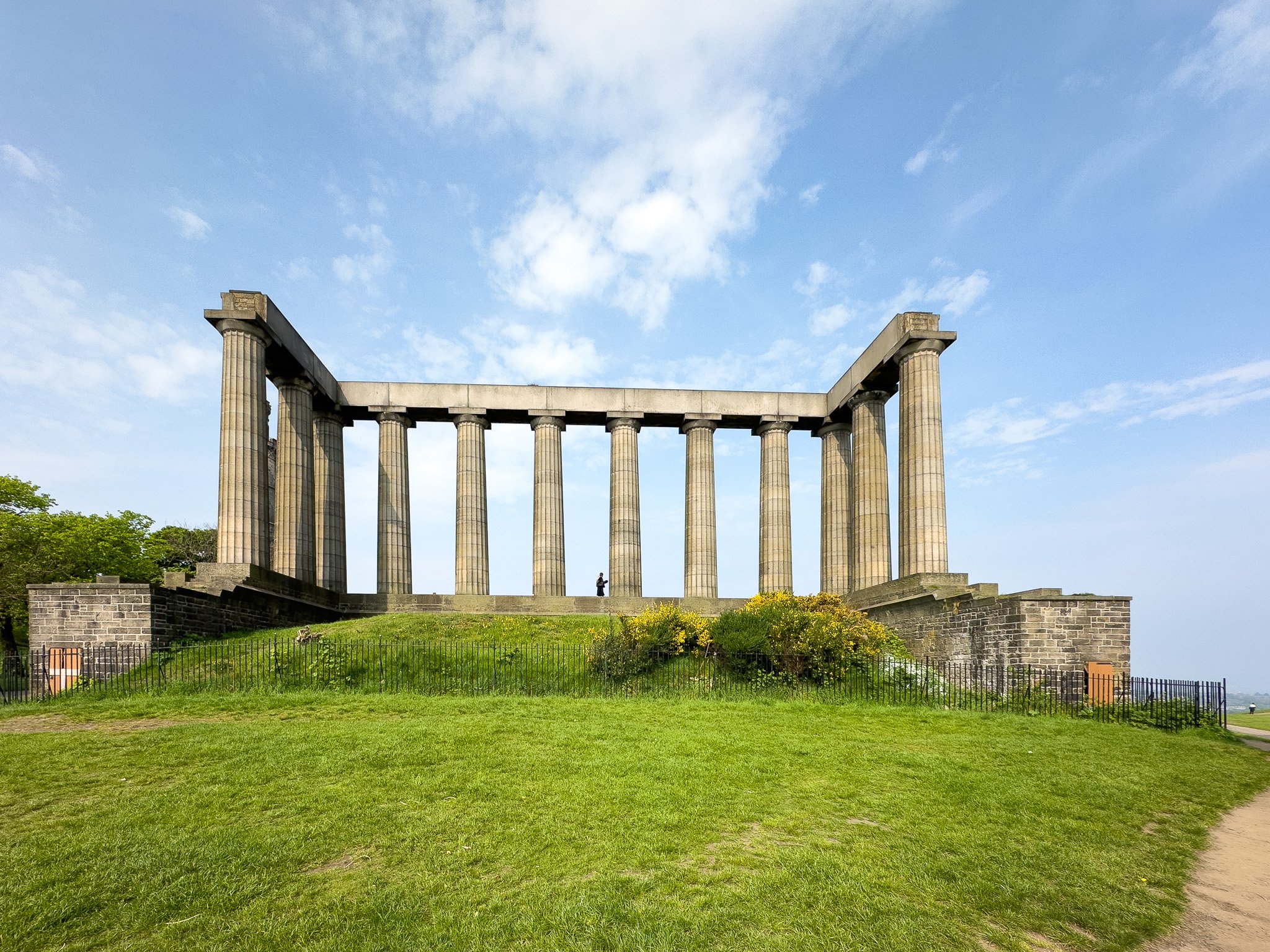
Calton Hill, five minutes' walk from the east end of Princes Street, is Edinburgh's most famous panoramic viewpoint and the location where thousands of the city's most recognized photographs have been made. From the summit, the city spreads in every direction: Edinburgh Castle and the Old Town to the west, Arthur's Seat and Holyrood Park to the south, the Firth of Forth to the north, and the New Town's Georgian grid below. The hill is home to the Nelson Monument, the Dugald Stewart Monument — a circular Doric temple that serves as the classic foreground element for sunset compositions — and the National Monument, Scotland's unfinished replica of the Parthenon begun in 1826 and abandoned for lack of funds.
📷 Pro Tip: Sunset is the best time on Calton Hill. The sun sets behind the Old Town skyline and the castle, and the Dugald Stewart Monument gives you the classic Edinburgh composition. Position yourself on the west side of the hill and use the monument as a foreground anchor with the castle and skyline beyond. A 70–200mm compresses the layered buildings of the Old Town beautifully. For a less crowded alternative, come at sunrise when the light from the east is excellent for the castle's front face, and between May and July at 5–6am you often have the hill entirely to yourself. Bring both your 16–35mm for the full 360-degree panorama and your 70–200mm for the compressed city views, because you will use both.
Best time: Sunset for the classic composition. Sunrise for an empty hill and strong east-facing light. Access: Free, open 24 hours. Getting there: Short steep staircase from the east end of Princes Street.


At Sunrise

I found that Sunset is the best time to visit Calton Hill.

You will have beautiful views of the Sea from this high vantage point.

The Royal Mile
The Royal Mile runs from Edinburgh Castle at the top to Holyrood Palace at the bottom — a full mile of medieval buildings, historic closes, pubs, restaurants, and shops that form the spine of the Old Town. It is busy, occasionally overwhelming, and absolutely essential. But the real photography of the Royal Mile is not on the main street. It is in the closes.
The closes are the narrow, covered alleyways that descend steeply from the Royal Mile into the older layers of the city below, and discovering them was one of the highlights of my entire trip. They are marked with entrance nameplates and are easy to miss unless you are walking slowly and looking for them. Step inside and you find dim stone passageways with walls worn smooth over centuries, iron lanterns, staircases descending into shadow, and fragments of sky visible above. Each one has a different character. Advocate's Close, Old Stamp Office Close, and Milne's Close are among the most atmospheric, but many others are unmarked and equally compelling. Wander every one you find. Some lead to unexpected courtyards. Some open onto views of the city below that feel like a discovery even though they have been there for 400 years.
📷 Pro Tip: Come to the Royal Mile before 8 am on any morning. The main street is quiet and the light falls cleanly from the east. For the closes, a 16–24mm handles the height of the stone walls and the compressed perspective down the passageway. The closes work best in overcast or soft light — harsh sunlight creates extreme contrast between the bright opening and the dark interior. After rain, when the cobblestones are wet and reflective, the closes are at their most atmospheric. Look for the play between the light at the entrance and the shadow deeper in. That gradient is the photograph.
Best time: Before 8 am for empty streets. After rain for wet cobblestone reflections. Overcast days for the closes specifically. Access: Free. Most closes are open and publicly accessible during daytime hours.


I am always happy to capture a couple getting married.

You will frequently find someone playing the bagpipes on the Royal Mile.

Dean Village
Dean Village is a former milling village tucked in a deep gorge along the Water of Leith, just a 20-minute walk from Princes Street and seemingly a world away from the city above. Stone mill buildings, a medieval weigh house, the ornate Bell's Brae Bridge, and the river running through the center create a setting that feels removed from any particular century. The Water of Leith Walkway runs through the village and connects to the National Gallery of Modern Art in one direction and the broader Leith district in the other.
📷 Pro Tip: Come before 8am on a weekday for the cleanest, most peaceful compositions. The village fills with pedestrians by mid-morning. A 24–50mm handles the riverside compositions from the bridges and the lane. The Bell's Brae Bridge is the architectural centerpiece — shoot it with the mill buildings behind and the Water of Leith in the foreground, ideally in soft morning light. In spring and early summer, the riverbanks are green and the light filtering through the canopy creates a dappled quality that harsh summer midday light eliminates. If you arrive after rain, the river runs faster and the stone reflects beautifully.
Best time: Early morning on weekdays. Spring and early summer for the green riverbanks and soft canopy light. Access:Free. Walk down Bell's Brae from the city center.

The Water of Leith Walkway runs through the heart of the village and I suggest a stroll along the riverside.

There are lots of cute houses with views of the river to photograph.


The Scott Monument, Edinburgh
The Scott Monument on Princes Street, a Gothic Victorian spire built in 1846 to honor Sir Walter Scott, is one of Edinburgh's most recognizable structures. The black-stained sandstone gives it a deliberately dramatic quality, and Princes Street Gardens, stretching below in two sections, provide the best castle-through-trees composition in Edinburgh.
📷 Pro Tip: The Scott Monument photographs best at night, illuminated against the dark sky. A 24–50mm from across Princes Street captures the full elevation. For the castle-through-trees shot in Princes Street Gardens, come in early morning or late afternoon when the light falls diagonally through the canopy. A 50–85mm isolates the castle rising above the treetops in a composition that uses the natural framing well. In winter, the Christmas Market fills the gardens with warm light and festive stalls that are excellent for environmental street photography.
Best time: Night for the illuminated monument. Early morning for the gardens. Winter for the Christmas Market atmosphere. Access: Free.

There is a beautiful park, Princess Park, right behind the monument. You will see many people walking and having a picnic in this area.

National Monument, Edinburgh
The National Monument of Scotland, on Calton Hill in Edinburgh, is Scotland's national memorial to the Scottish soldiers and sailors who died fighting in the Napoleonic Wars. It looks more like something I would see in Athens.
The Closes on the Royal Mile
The Closes of the Royal Mile are somewhere you need to visit when photographing Edinburgh. While thousands of people walk along the main thoroughfare daily, few realize these hidden gems exist, and if you look closely, you'll discover walkways with an entrance nameplate and steps leading down. Narrow and moody, the closes weave between tall buildings and were typically named after a notable resident who once lived in the apartments the staircases pass.

Each close is different in appearance, with some favorites including Advocate's Close, Old Stamp Office Close, and Milne's Close.


Victoria Street
Victoria Street is a curved, cobbled road of colorful facades descending from George IV Bridge to the Grassmarket, lined with shopfronts painted in deep red, cobalt blue, and mustard yellow. J.K. Rowling drew on it for Diagon Alley in the Harry Potter series. Victoria Terrace, the elevated walkway above the street, gives you a different compositional angle — looking down onto the curved rooftops and colorful facades below, with the castle visible above on clear days.
📷 Pro Tip: Victoria Street photographs best in the early morning before the shops open, when the cobblestones are quiet, and the light comes in from the east at a low angle. A 24–50mm handle handles the full curve of the street from the upper end, looking down toward the Grassmarket. For the classic compressed color-facade shot, position yourself at the bottom of the street looking uphill with the curved buildings narrowing toward the top. Victoria Terrace, accessed via a staircase from the top of Victoria Street, gives you the elevated view — a 24–35mm view from the railing captures the full sweep of the curved street below. After rain, the cobblestones are reflective, and the colors become richer. This is one of those locations that looks completely different wet versus dry.
Best time: Before 8 am. After rain. Any overcast morning. Access: Free.


Scottish National Museum
The Scottish National Museum is one of the most popular tourist attractions in Edinburgh. The museum was founded in 1854 and opened to the public in 1866. It is dedicated to Scottish history, culture, and art. It also has a wide range of exhibits on Scottish culture, including traditional music, dance, and clothing.
If you love art, you’ll want to save at least an hour or two to stroll the Scottish National Gallery, one of many excellent free museums in Edinburgh.
St. Giles Cathedral:
The High Kirk of Edinburgh has stood on this site in various forms since the 12th century, and the current building — with its crown spire, one of four in Scotland — dates primarily from the 14th and 15th centuries. The interior is one of the most visually extraordinary in Scotland: stained glass windows, carved stone, and the Thistle Chapel — a tiny ornate side chapel commissioned in 1911 with some of the finest Gothic Revival carving in Britain.
The ceiling above the nave is painted a striking blue with gilded details, and the light effects on clear days are exceptional.
📷 Pro Tip: Photography inside St. Giles requires a photography pass (£2). The nave ceiling is your primary subject — shoot from below with a 16–24mm and a slow shutter speed (handheld at ISO 3200–6400 or stabilized with a Platypod). The Thistle Chapel requires a 35–50mm for the detailed carved stonework. The exterior crown spire photographs best from the top of the Royal Mile looking south, or from Calton Hill looking west.
Best time: Any time for the interior when light comes through the windows. Midday in sunny weather for the stained glass. Admission: Free entry; £2 photography pass.*

Greyfriars
My favorite part of Greyfriars Kirkyard, though, is the story of Greyfriars Bobby.

Bobby was a Skye Terrier whose owner John Gray was buried in the graveyard. The story goes that for the next 14 years Bobby spent his life sitting by the grave and was then buried just inside the gates of Greyfriars Kirkyard. Visitors can now leave a stick for Bobby, a tradition that I couldn't resist adding to and was very close to bursting into tears at just how cute it was!

Princes Street Garden
London has Hyde Park, New York has Central Park, and Edinburgh has the Princes Street Gardens. Lined with historic buildings and filled with flower beds and green space, the gardens are a beautiful space within the city center.

Princes Gardens
The main reason I loved photographing the gardens was because they offer a great view of the buildings that lead toward the Edinburgh Castle, and the castle itself is ideal for some creative perspectives through the trees.

Festivals & Events
Edinburgh International Festival and Edinburgh Fringe (August)
August in Edinburgh is unlike any other month in any other city. The Edinburgh International Festival and the Fringe, the world's largest arts festival, run simultaneously and turn the city into a nonstop performance. Every street, every courtyard, every close becomes a stage. The Royal Mile fills with performers, flyerers, buskers, and spectators from early morning until late at night. The street photography during August is among the richest I have encountered anywhere in Europe — every turn reveals a performer in costume, a crowd gathered around a street act, or a quiet moment of exhaustion between shows. For photographers, the Fringe is a gift. Bring your 24–70mm for the street scenes and a 70–200mm for pulling performers out of the crowd. Ask before photographing ticketed performances, but street acts on the Royal Mile are fair game. The energy is extraordinary and it lasts the entire month.
Hogmanay (Late December and New Year)
Scotland's New Year celebration is one of the great photography events in the UK. Edinburgh's Hogmanay includes a torchlight procession through the city on December 30, a street party on Princes Street on New Year's Eve, and the Loony Dook polar plunge at South Queensferry on New Year's Day. The torchlight procession, with thousands of people carrying fire through the dark streets of the Old Town toward Calton Hill, is one of the most dramatic photography subjects Edinburgh offers. A 70–200mm from Calton Hill looking down on the procession route gives you the most powerful frames. Dress for extreme cold. Bring hand warmers for your battery case.
Edinburgh Christmas Market (Late November to Early January)
East Princes Street Gardens transforms each winter with the Edinburgh Christmas Market, one of the most photogenic festive markets in Britain. The combination of warm market lighting, the illuminated Scott Monument overhead, and Edinburgh Castle as the backdrop creates a layered nighttime scene that rewards a wide-angle and a tripod. Come at blue hour when the sky still holds color and the market lights are fully on.
The Royal Edinburgh Military Tattoo (August)
Held on the esplanade of Edinburgh Castle every August, the Military Tattoo is a spectacular performance of military bands, pipe and drum corps, and international performers set against the floodlit castle backdrop. Photography is permitted from the seated stands. A 70–200mm is essential for isolating performers and the castle. The combination of floodlighting, marching formations, and fireworks makes for technically challenging but visually extraordinary photography. Book well in advance; the Tattoo sells out months ahead.
Beltane Fire Festival (Late April)
Held on Calton Hill at the end of April, the Beltane Fire Festival is Edinburgh's revival of the ancient Celtic fire ceremony marking the beginning of summer. Hundreds of performers in costume carry fire across the hill in a processional that builds to a dramatic conclusion. Photographically, it is extreme — fire, darkness, fast-moving subjects — and it rewards a wide aperture prime (35mm or 50mm f/1.4) and high ISO shooting. Get there early for positioning on the hill.
Frequently Asked Questions About Visiting Edinburgh
Is Edinburgh safe?
Yes, it's one of the safer major cities in the UK to walk, day or night, including the Old Town closes. Normal city awareness covers most of what you need to know.
Do you need a car in Edinburgh?
No, and it's actively discouraged. Edinburgh is one of the most walkable capital cities in Europe, with buses, trams, and rideshare covering anything beyond walking distance.
Is Edinburgh expensive?
It can be, especially the Michelin-starred restaurants and the Balmoral, but there's real range. Casual pubs and cafés let you eat and drink well without a luxury price tag.
What are the best photo spots in Edinburgh?
Calton Hill at sunset for the classic skyline, the closes off the Royal Mile before 8am, and Dean Village on a quiet weekday morning are three that consistently deliver. The full list with Pro Tips is above.
Can you fly a drone in Edinburgh?
Not easily. The Castle, Holyrood Park, and most of the Old Town fall under controlled or restricted airspace given proximity to Edinburgh Airport. Check the UK CAA drone map and NATS drone assist app, and get permissions before your trip.
What surprised you most about Edinburgh?
The closes. Each one is genuinely unique, its own character, its own light, its own story. And the language, when locals speak Scots among themselves, I couldn't understand a word. It's a reminder of how much culture and identity exist just beneath the surface of a city you think you already know.
How many days do you need in Edinburgh?
Five days is the photographer's ideal, enough time to revisit key locations in different light without feeling rushed. Three days covers the essentials if you're tighter on time.
Is August a good time to visit for photography?
Yes, if you want the Fringe and International Festival's energy, the street photography is unmatched. If you'd rather have quieter streets, spring or autumn are better windows.
Final Thoughts
Edinburgh feels cinematic from the moment you arrive. The castle rises dramatically above the city. The Royal Mile winds through centuries of history. Arthur's Seat watches quietly from the edge, offering sweeping views that shift with the light and the weather.
What makes Edinburgh unforgettable is the atmosphere. The city feels moody in the best possible way. Clouds roll in and out quickly. Sunlight breaks through stone arches. Rain leaves the cobblestones reflective and rich in texture. It is a place where the weather becomes part of the composition, not a problem to work around.
For photographers, Edinburgh is about elevation and timing. Climb early for sunrise views from Calton Hill or Arthur's Seat. Capture the castle glowing at blue hour. In the Old Town, focus on layers — narrow closes, lanterns, staircases, and hidden courtyards. Bring a wide lens for the dramatic cityscapes and a mid-range zoom for architectural details and street moments. But most importantly: embrace the changing light. The grey days are not failures. They are opportunities.
Edinburgh offers more than just beautiful views. It offers mood, history, and a sense of story that lingers long after you leave.
Want to improve your photography while exploring some incredible destinations? Join me on one of my photography workshops! You can find all the details, including upcoming destinations and dates, through the links below.
Let's Stay Connected!
Edinburgh is a natural base for the rest of Britain and a gateway to some of the finest photography destinations in the world. Here is where I would go next.
My Photography & Travel Guide to London, England Two and a half hours south by direct train from Edinburgh Waverley. Tower Bridge at blue hour, the Royal Mile's rival in the Balmoral Hotel, and the photography of a city that rewards those who wake up early. My complete London guide covers everything.
My Photography & Travel Guide to the Lofoten Islands, Norway A short flight from Edinburgh to Bergen or Oslo, then north. The red fishermen's houses at Reine, the Northern Lights from September to March, and the most dramatic coastal light in Northern Europe. For any photographer who loved the moody quality of Edinburgh, the Lofotens are the natural next chapter.
My Photography & Travel Guide to Paris, France An easy flight from Edinburgh. Trocadéro at dawn, Montmartre before the crowds, and the streets of the Marais that most photographers never find. The city that inspired J.K. Rowling's imagination almost as much as Edinburgh did.
Finally—a beginner-friendly photography guide that makes sense.
If you've ever picked up a camera and thought, "Now what?" this is the book for you.
Photography Made Simple is written for adults who are just starting out and want a clear, encouraging, real-world approach to learning photography. Whether you're using a DSLR, mirrorless, or just your smartphone, this guide walks you through the basics—without the jargon or tech overwhelm.
Inside, you'll learn:
The only camera settings you really need to know to get started
How to shoot sharper, more intentional photos using light and composition
Simple tips for portraits, landscapes, travel, and everyday life
What gear you do (and don’t) need
How to create better photos without upgrading your camera
You’ll also get practical exercises, cheat sheets, and tips for organizing and editing your images—plus the confidence to shoot off Auto Mode for good.
This is not a textbook. It’s a friendly guide to seeing the world with fresh eyes—and finally capturing what you see the way you imagine it.
📸 Format: PDF download
Pages: 100+
Perfect for: Beginners, hobbyists, and anyone ready to take better photos without the stress
Are you carrying too much camera equipment, but still coming home disappointed with your travel photographs?
You are not alone. Many photographers fall into the packing trap. They bring too much, plan too little, and spend their trip scrambling to capture photographs instead of enjoying the experience.
Capture the World offers a better approach.
In this practical guide, travel photographer Vito L. Tanzi shares the five step system he uses to plan photography trips, pack with purpose, work with the best light, and return home with stronger images.
Inside, you will learn how to:
• Travel lighter without sacrificing image quality
• Choose destinations that match your photography goals
• Visit at the right time for weather, light, wildlife, festivals, or seasonal conditions
• Build a photography itinerary around sunrise, sunset, blue hour, and changing weather
• Select the equipment you will actually use
• Find promising locations before you arrive
• Avoid the stress and exhaustion that can ruin a photography trip
• Stay flexible when weather, crowds, or travel plans change
This guide includes practical planning advice, useful photography tools, real travel examples, and a complete system you can use again and again.
Whether you are preparing for your first international photography trip or planning a weekend closer to home, Capture the World will help you travel with greater purpose, photograph with more intention, and spend less time worrying about what is inside your camera bag.
Because the best photography trip is not the one where you carry everything.
It is the one where you are ready when the right moment appears.
📸 Format: PDF download
Instant Download