Crete, Greece Travel & Photography Guide: Best Photo Spots, Things to Do & Hidden Gems
My first memory of Crete is waking up at the Blue Palace resort and opening the curtains to find the sea directly in front of me, flat and blue-green, with Spinalonga Island sitting in the middle of the bay like it had always been there waiting. I had not expected that view. I walked down to the beach before breakfast, then wandered through the small village next to the hotel, where octopus hung drying on a clothesline in the morning sun like laundry. That image, the octopus, the light, the salt smell, the unhurried pace of a place completely indifferent to impressing anyone, told me everything I needed to know about this island.
Crete does not perform for you. It just is what it is, and what it is happens to be extraordinary.
Later on that same trip, I stood at the edge of the Venetian harbor in Chania before the city woke up, camera on a tripod, watching the lighthouse slowly emerge from a deep blue predawn sky. The water was flat and perfectly still, the reflections of the old stone buildings mirror-sharp. Fishing boats rocked gently at their moorings. Nobody else was there. In that quiet, I understood something else about this island: Crete rewards the patient and the early. It gives its best light, its quietest streets, its most honest version of itself to those who show up before the crowds arrive.
Crete is Greece's largest island, and it earns that distinction. This is not Santorini or Mykonos. There are no whitewashed cliffs above a caldera and no package-tour convenience. Crete is wilder, more complex, and more rewarding than any of the more famous Greek islands. The landscapes shift dramatically from west to east: from the Venetian harbor and pink sand beaches of the west, through the gorges and white mountains of the interior, to the palm-fringed beaches and Minoan ruins of the east. You can spend two weeks here and still feel like you have only scratched the surface.
For photographers, Crete is close to paradise. The Mediterranean light is extraordinary year-round, the subjects range from 3,500-year-old palace ruins to dramatic coastal cliffs, and there is a Venetian harbor, a Byzantine monastery, a pink sand beach, and a mountain gorge all within a few hours' drive of each other. You will not run out of things to shoot.
For travelers, Crete does something rarer still. It makes you feel like a guest, not a tourist. The island has its own food, its own dialect, its own culture, its own fierce pride. Sit long enough at a Cretan table, and you will almost certainly receive a complimentary raki and dessert. That gesture is not a sales tactic. It is just Crete being Crete.
In this Photography Guide to Crete, I share the places and experiences that continue to draw me back. You will find my favorite photography locations, guidance on when and where to shoot, practical travel tips, and gear recommendations, along with cultural insights to help you explore and photograph Crete with confidence, respect, and ease.

Photographer's Notes
Before you go, here are my own takeaways.
Favorite Season: Spring or fall
Favorite Location: Spinalonga Island
Favorite Hotel: Blue Palace Elounda
Favorite Restaurant: To Maridaki
Favorite Café: Monogram Coffee
Favorite Lens: 15-35mm f/2.8
Would I Return? Yes, I would love to explore more of the island.
Where to Stay in Crete
Chania is the best base for photographers visiting Crete. It puts you within reach of the Venetian harbor before sunrise, Elafonissi and Balos within a 90-minute drive, Seitan Limania within 40 minutes, and the Samaria Gorge trailhead within an hour. If you have more time and want to explore the east of the island, Elounda and the area around Spinalonga Island make a wonderful second base.

Here is where I would stay.
Luxury Hotels in Crete
Casa Delfino Hotel & SpaTheofanous 9, Chania Old Town
This is the most distinguished address in Chania, and it has been in the same family for six generations. Built in the 17th century as a Venetian merchant's mansion, Casa Delfino sits behind wrought-iron gates in the heart of the Old Town, its cream walls and pebble-mosaic courtyard completely unchanged from the outside, while the 24 suites inside have been restored with an obsessive attention to luxury. Stone archways frame individually decorated rooms with rich fabrics, marble bathrooms, and the kind of deep quiet that is rare in a building this old and this central.
The rooftop bar is one of the best in Chania, with panoramic views over the harbor and the old town's terracotta roofscape. Breakfast is served in the courtyard and is exceptional, reportedly largely prepared by the proprietress herself. The spa, with its marble steam room and oversized hot tub, earns its own attention.
For photographers, the location is irreplaceable. The harbor is a four-minute walk. The alleyways of Chania's Old Town are literally outside your door.
Domes Noruz Chania, Autograph CollectionAgioi Apostoloi, 4 miles west of Chania Old Town | Adults Only
Domes Noruz is the definitive beachfront luxury escape near Chania. The architecture draws from the Venetian arsenals, with Cretan sandstone as the primary building material, and the entire property feels rooted in the island rather than imposed upon it. All accommodations have extended outdoor living areas; many feature private plunge pools or outdoor bathtubs with sea views.
Two pools overlook the Aegean, the spa includes a hammam, sauna, and full treatment menu, and the restaurant Topos serves Cretan cuisine at a level that holds its own. The private sandy beach is one of the best in this part of the island.
The trade-off is distance. Chania Old Town is a 15-minute drive, which means early morning harbor shoots require either a car or some logistical planning. For a photographer who wants to combine serious location work with genuine resort relaxation, this is the right balance.
Domes Zeen Chania, A Luxury Collection ResortAgioi Apostoloi, near Chania
The sister property to Domes Noruz and positioned at Marriott's Luxury Collection tier, Domes Zeen brings a more expansive resort experience to the same stretch of coastline. Multiple pools, a world-class spa, exceptional dining, and direct beach access make this one of the most complete luxury resort offerings in western Crete. The design is contemporary and elegant, with local materials and Cretan craftsmanship throughout.
Blue Palace Elounda, a Luxury Collection ResortElounda, Eastern Crete
If you are planning to spend time in eastern Crete, the Blue Palace is the hotel to know. This is where I woke up on my first morning in Crete to find Spinalonga Island sitting directly across the water, and that view has stayed with me longer than almost any other on this island. The resort sits above the Gulf of Elounda with private beach access below, rooms and villas arranged across the hillside, many with private pools and an unobstructed view of the bay.
The small village adjacent to the hotel is worth an early morning walk before breakfast. The fishing boats come in before most guests are awake, the pace is completely unhurried, and the octopus hung out to dry on lines in the morning sun is as authentically Cretan as anything you will find anywhere on the island.
For photographers, the combination of the Spinalonga ferry crossing just down the road, the morning light on the bay, and the village scenes right outside the hotel gates makes the Blue Palace one of the most naturally productive places to stay in all of Crete.
Mid-Range in Crete
Porto Veneziano Hotel Akti Enoseos, Chania Old Harbor
Porto Veneziano is all about location. Sitting directly on Chania's old harbor, it puts the most photogenic waterfront in Crete outside your window. Some rooms offer direct harbor views, and the proximity to Chania's restaurants, cafés, and photography locations is unbeatable. Modern, comfortable rooms with solid service make this a practical and well-positioned base for any photographer-traveler.
Samaria Hotel Chania City Center
A polished, contemporary option in central Chania with easy walking access to the Old Town and harbor. Clean design, reliable service, and a strong location for photographers who want to be mobile without paying boutique-hotel prices.
Kriti Hotel Chania, near Old Town
Comfortable and practical, with excellent access to the Old Town and the harbor. A solid value choice for travelers spending most of their time outside exploring.

Best Time to Visit Crete
The best window for photographers in Crete runs from late April through early June, and again from mid-September through October. These shoulder seasons give you warm, workable weather, manageable crowds, and the light quality that makes the difference between a good photograph and a great one.
Spring (April to June) is the most rewarding time of year. The Samaria Gorge opens in May, wildflowers cover the hillsides and the gorge trail, and the Mediterranean light has a clarity and softness that the haze of high summer simply does not. Golden hour lasts well into the evening by June, and the pink sand at Elafonissi glows in early morning light without a crowd in sight.
Summer (July to August) brings the most visitors and the harshest midday light. The beaches are packed by 10am, atmospheric haze can flatten distant views, and the Samaria Gorge fills with hikers from early morning. None of this makes summer impossible for photography. You just have to work harder for the shot, arriving before 6am and staying out after 7pm. The upside is reliably clear skies and the longest days of the year.
Autumn (September to October) is the second-best window. Crowds thin after mid-September, the light softens, and sea temperatures are still warm. The Rethymno Renaissance Festival runs through this period. October brings occasional dramatic storm clouds over the coast, which can produce extraordinary skies at Falassarna and the harbor.
Winter (November to March) is quiet and largely uncrowded. Many tourist-facing businesses close, but the island does not shut down. The mountains receive snow, which creates rare photographic conditions with the White Mountains visible behind the harbor. If solitude and the authentic off-season version of Crete interest you, winter delivers both.
For drone pilots, note that Greece enforces EU drone regulations. You must register your drone with the Hellenic Civil Aviation Authority before flying. Drone flights are restricted or prohibited at archaeological sites including Knossos, within national park boundaries including the Samaria Gorge, and near airports. Check current HCAA restrictions before your trip; regulations update regularly.

Getting Around Crete
Renting a car is not optional in Crete. It is the only way to reach Elafonissi, Balos, Seitan Limania, Falassarna, the Samaria Gorge trailhead, and most of the photography locations in this guide. Book your rental in advance, particularly in summer when availability tightens and prices rise.
A few practical notes for photographers carrying gear: the road to the Balos parking area is unpaved gravel and can be rough. A standard rental with decent clearance handles it, but you will feel every rut if you are driving fast. Give yourself time. The road to Seitan Limania is paved but narrow, and parking near the trailhead is limited. Arrive early.
For Chania itself, you will not need the car. The Old Town and harbor are compact and best explored on foot. Parking near the old harbor can be frustrating, so use your hotel's parking or leave the car when exploring the city center.
Uber and Bolt are not available in Crete. Local taxis are reliable and available throughout Chania and the main towns. For longer transfers or early morning shoots at remote locations, arrange a local taxi in advance through your hotel.
Public buses (KTEL) cover the main towns and tourist routes, including Chania to Heraklion, Rethymno, and the Samaria Gorge trailhead at Omalos. They are reliable and affordable but run on fixed schedules that rarely align with photographer-friendly departure times. For reaching the key photography locations before sunrise, a rental car gives you full control.
How Many Days in Crete
Plan for a minimum of seven days. Five days is enough to cover Chania and the western locations at a reasonable pace, but you will feel rushed, and you will miss things. Ten days lets you do the island properly, including a move east to Elounda and Spinalonga.
Here is how I would structure a seven-day photographer's visit:
Days 1 to 3: Chania base. Arrive in the afternoon, get oriented, and walk the harbor at sunset. Day two: up before 5am for blue hour at the harbor and lighthouse, then drive to Seitan Limania by mid-morning before the crowds arrive. Afternoon rest. Day three: full day to Elafonissi. Leave by 5 am to arrive at or before sunrise. Spend the morning shooting the beach and lagoon, then stop at the mountain villages on the drive back.
Day 4: Balos and Falassarna. Drive to the Balos parking area early. Hike down and back before noon. Afternoon recovery, then drive to Falassarna for golden hour and sunset. Stay through blue hour.
Day 5: Samaria Gorge. This is a full-day commitment. The gorge opens at 7 am; be at the Omalos trailhead at opening. The hike takes 4 to 6 hours. You exit at Agia Roumeli on the Libyan Sea and return by ferry. Book the ferry in advance. Bring water, snacks, and a small daypack. The telephoto lens earns its weight here.
Day 6: Rethymno day trip. Drive east to Rethymno. Morning in the Old Town for street photography. Afternoon at the Fortezza for golden hour. Return to Chania or stay overnight in Rethymno.
Day 7: Arkadi Monastery and transition. Morning at Arkadi for the late afternoon light, then either continue east toward Elounda for a second base, or use the day to revisit any location you want to reshoot with better light or timing.
If you have ten days, use days eight through ten to base in Elounda, photograph Spinalonga Island by morning ferry, drive to Knossos near Heraklion, and end at the palm beach at Vai on the far eastern tip of the island.


Where to Eat in Crete
One of the things that stayed with me longest about Crete was not any single view or photograph. It was the experience of sitting at a table on a warm evening, a plate of grilled fish in front of me, a carafe of local wine being refilled by someone who clearly wanted me to stay longer, the faint smell of salt air coming off the harbor.
Cretan food is not complicated. It is honest, ingredient-driven, deeply connected to the land and sea around it, and almost universally good. The olive oil alone, poured generously over almost everything, will make you rethink every olive oil you have ever tasted at home. Below are the places I would take you.

My Favorite Restaurants in Chania
Tamam Zambeliou 49, Chania Old Town
Tamam is set inside a beautifully restored former Turkish hammam and is the most consistently recommended restaurant in Chania's Old Town, and for good reason. The kitchen draws from the island's layered culinary history, blending Cretan, Greek, Venetian, and Ottoman influences into a menu that feels genuinely unlike anything else in the city. The chicken in apple and nut sauce is extraordinary. The moussaka is among the best you will eat in Greece. Portions are generous, the atmosphere inside the old bathhouse is warm and unhurried, and the outdoor tables on the narrow alley are among the most atmospheric dining spots in Chania.
Reservations are strongly recommended in summer, and the restaurant fills quickly on weekend evenings. Walk-ins at lunch are more forgiving.
Mid-range pricing. Reserve ahead of time June through September.
To Maridaki Daskaloyianni 33, Chania Old Town
Maridaki is the undisputed local favorite for seafood in Chania's Old Town, and it has earned that reputation the hard way: by serving only what the fishermen brought in that morning. The owner and chef, Yannis Koumakis, buys his fish daily directly from local boats, which means the menu changes with the catch and the season. The fish soup is the restaurant's signature and the one dish I would order every time. Simple, clean, deeply flavored.
This is not a tourist restaurant. Locals line up outside on busy evenings, which is both your best endorsement and your main logistical challenge. Come early, or expect to wait.
Affordable to mid-range. No reservations. Go early.
Salis On the new harbor, Chania
Salis is the closest thing Chania has to fine dining, and it is worth your most special evening. The restaurant sits on the harbor adjacent to the old town and offers a menu that takes traditional Cretan and Greek cuisine and gives it a genuinely creative, contemporary edge without losing the soul of the ingredients. The wine list is exceptional by Greek island standards, with labels that will surprise anyone who thinks they know Greek wine. Book a window table and time your reservation for golden hour.
Higher price point. Book at least a week in advance in summer, and two weeks is safer for weekends.
Colombo Kitchen & Bar Isodion 17, Chania Old Town
Tucked into one of the Old Town's most appealing alleys, Colombo is the place for a long, relaxed dinner when you want something slightly more contemporary but still deeply connected to Cretan flavors. The slow-cooked lamb, the seafood pasta, and the garlic bread have all generated consistent enthusiasm from local regulars and returning visitors. The outdoor tables in the evening are warm, candlelit, and exactly right for a second bottle of wine.
Mid-range. Reserve ahead for weekends.
Canale Restaurant Chania Waterfront
When what you want is sunset over the harbor with a good plate of food in front of you, Canale delivers. The waterfront position means the light during golden hour is genuinely beautiful, and the menu blends Cretan and Mediterranean flavors in a setting that feels more relaxed than formal. Come for the view, stay for the wine.
Coffee
Getting to Chania harbor before 6 am means finding coffee before most of the city is awake. These three are reliable:
Monogram Coffee — Quality coffee in a clean, modern space. Open early and have a good pre-shoot stop in the Old Town.
Pallas — Harbor views and good people-watching. Come for morning coffee and watch the boats come in.
Delicate Coffee House — Cozy, away from the tourist rush, with excellent pastries. A good place to recharge between shooting sessions.


Photography Gear to Bring to Crete
For a destination that spans dramatic coastline, ancient ruins, mountain gorges, and village street photography, you want a range in your kit without overloading yourself for long hikes.
Camera bodies: Any of the current full-frame mirrorless cameras perform extremely well here. I shoot the Canon EOS R5 Mark II as my primary body for landscapes and architecture, the Sony A7R V when I want maximum resolution for prints, and carry the Leica Q3 as my walk-around camera in the Old Town and villages. The Nikon Z8 is equally capable across all of these scenarios.
Lenses: A 15-35mm f/2.8 is the workhorse at Chania harbor, Balos, Elafonissi, and Falassarna. Wide-angle captures the full sweep of the harbor at blue hour and the scale of the lagoon from the clifftop. A 24-70mm f/2.8 is the all-purpose lens for Knossos, Rethymno, Arkadi, and street photography. A 70-200mm f/2.8 earns its weight in the Samaria Gorge for wildflowers, wildlife, and compressed cliff faces, and at Spinalonga for details of the Venetian fortifications from the ferry approach.
Tripod: Essential. Blue hour at the harbor requires it. Long exposures at Falassarna require it. The Samaria Gorge stream at the Iron Gates requires it. Do not leave it in the hotel room.
Filters: A circular polarizer is critical at Elafonissi and Balos. The shallow lagoon water shifts from flat to deep turquoise with a polarizer in place. It also cuts glare on the harbor reflections when the sun is higher. Kase ND filters (6-stop and 10-stop) are useful for long exposure work at Falassarna beach and smoothing water at any of the coastal locations. A 3-stop ND handles most daytime long exposure situations.
Other: Extra batteries (the Canon R5 Mark II and Sony A7R V both benefit from having two spares), plenty of cards, and a Samsung T7 SSD for end-of-day backup. A rain cover for your bag is worth having; Crete does get occasional rain in spring and autumn, often short and heavy.
iPhone Photography
The iPhone handles Crete exceptionally well, and there are several specific situations where it is the better tool.
Chania harbor at blue hour: Use Night Mode with the phone on a small Gorilla Pod or resting on a stable surface. The harbor lights and reflections at blue hour are well within Night Mode's capability, and the results will genuinely compete with a dedicated camera for social media and web use.
Elafonissi pink sand: This is a case where ProRAW makes a real difference. The subtle pink tone of the sand can look washed out in standard JPEG processing. Shoot ProRAW in Halide or the native camera app and pull the color latitude in Lightroom Mobile. The pink channels have much more range than you think.
Samaria Gorge: Leave the heavy telephoto in the car and carry the iPhone as a secondary body for the full 16km hike. The ultrawide on current iPhones is excellent for the narrow Iron Gates section, where the cliffs close in. Portrait Mode works surprisingly well on wildflowers along the trail in spring.
Street photography in Chania Old Town: The iPhone is less conspicuous than a mirrorless with a large lens. For candid market and street scenes, shoot with the 1x or 2x equivalent. The compact size lets you work close without disrupting the scene.
Drone: Greece enforces EU drone regulations and requires registration with the Hellenic Civil Aviation Authority before flying. Drone flights are restricted at archaeological sites (Knossos), within national park boundaries (Samaria Gorge), and near airports. The harbor and coastal locations in western Crete generally allow recreational drone flight with proper registration, but confirm current HCAA rules before travel as regulations update regularly.


Best Sunrise Photography Locations in Crete
Chania Harbor: One of my favorite sunrise locations in Crete. Soft morning light illuminates the harbor while reflections create beautiful compositions.
Balos Lagoon: Arrive before sunrise if possible. The early light adds depth and color while helping you avoid the crowds that arrive later in the day.
Elafonissi Beach: The famous pink sand often photographs best early in the morning when the light is softer and the beach remains relatively quiet.
Mountain Villages: Many of Crete's traditional villages become magical at sunrise as warm light begins spilling across stone buildings and winding streets.
Best Sunset Photography Locations in Crete
Falassarna Beach
Falassarna offers some of the most spectacular sunsets on the island. The combination of crashing waves, dramatic skies, and western exposure creates incredible opportunities for photography.
Chania Lighthouse
Photograph the lighthouse during golden hour, then stay through blue hour as the harbor lights begin reflecting across the water.
Rethymno Harbor
The warm evening light complements the Venetian architecture beautifully and creates excellent opportunities for both landscape and street photography.
Coastal Roads of Western Crete
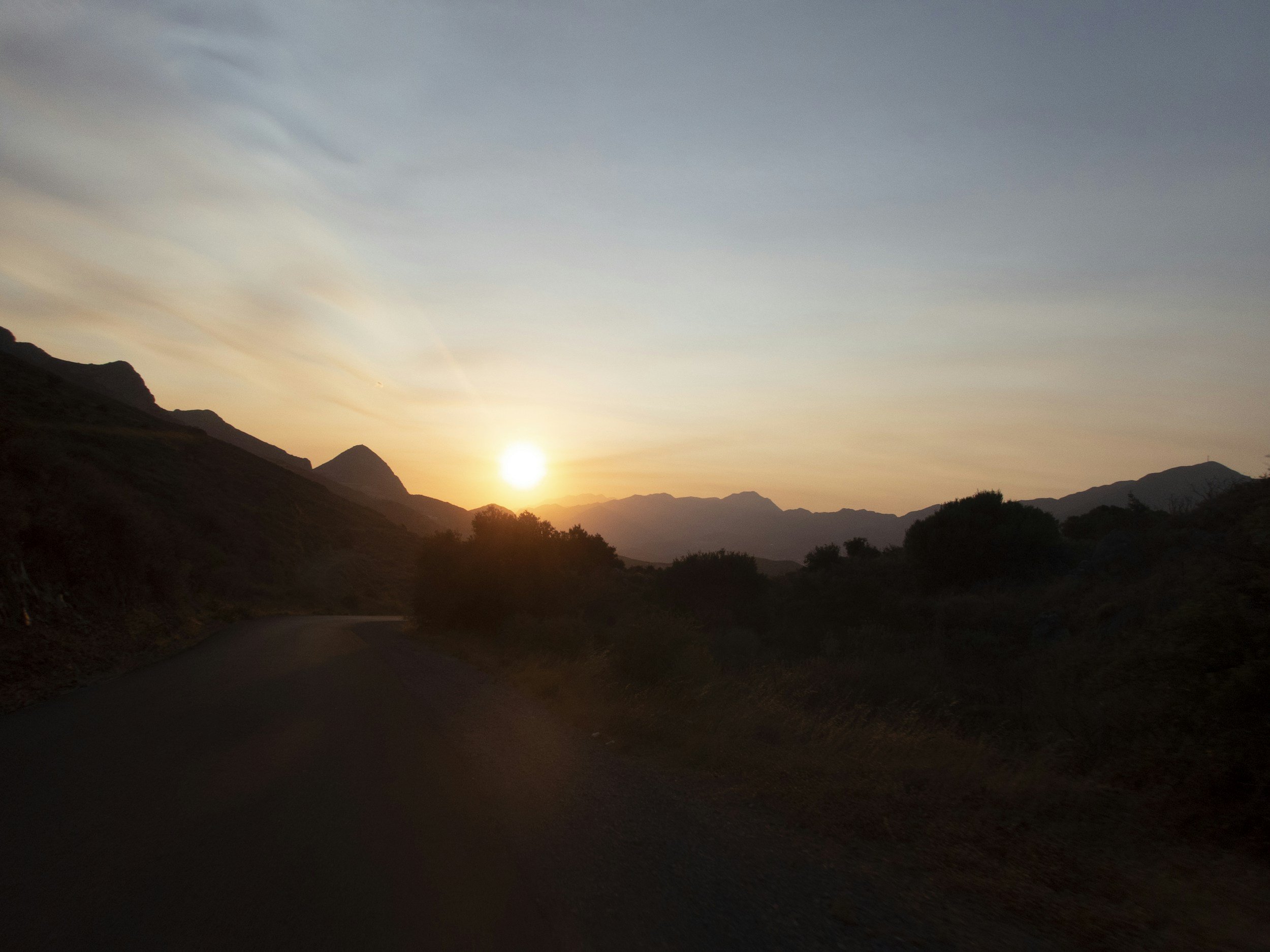
Some of my favorite sunset moments happened unexpectedly while driving. Always allow extra time and be prepared to stop when the light becomes exceptional.
Best Photography Locations in Crete
Chania Venetian Harbor and Lighthouse
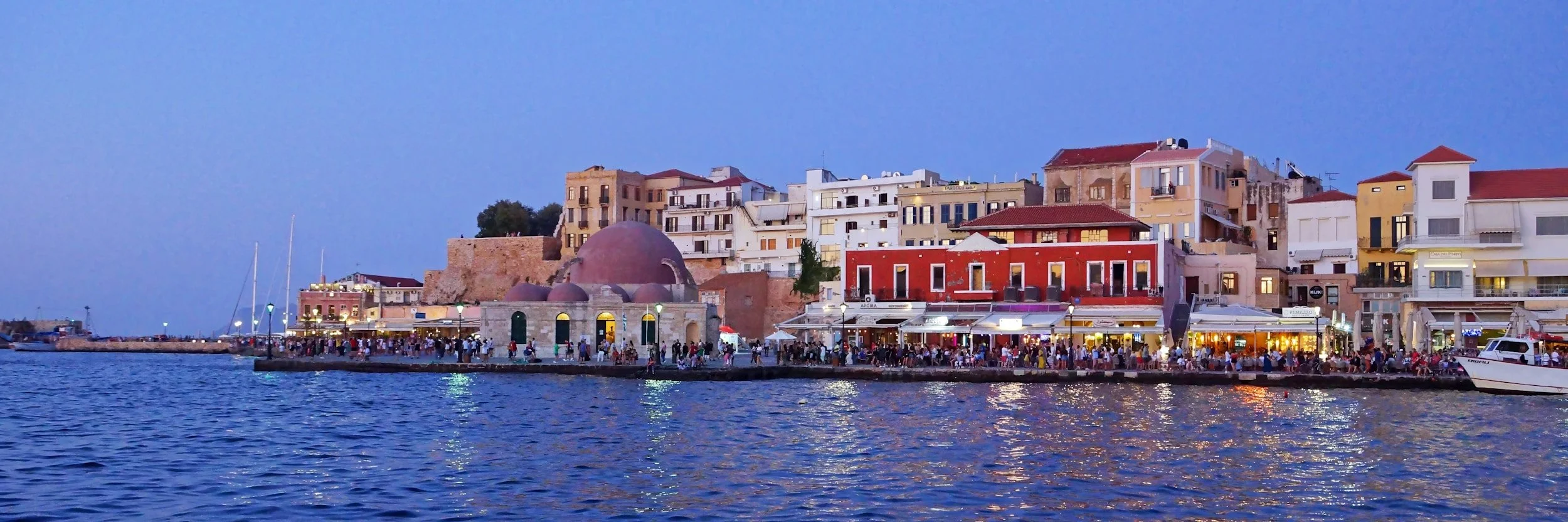
If there is one non-negotiable location for photographers in Crete, it is this one. The Venetian harbor in Chania is one of the most beautiful waterfronts in the Mediterranean: a crescent of honey-colored stone buildings reflected in sheltered water, with the lighthouse at the far end of the breakwater and the White Mountains visible in the distance on clear days.
The architecture is a palimpsest of Crete's history. The harbor itself was built by the Venetians in the 14th century. The lighthouse is Egyptian, built in the early 19th century. Ottoman minarets peek above the rooftops behind. Every element of Crete's layered occupation is visible from one position.
📷 Pro Tip: The single best shot in Chania is from the eastern end of the harbor at blue hour, when the lighthouse and the stone buildings are reflected in flat water, and the sky holds that deep, saturated blue. Set up on a tripod 30 minutes before sunrise. Shoot long exposures (8 to 15 seconds) to smooth out any ripples and saturate the color. A 16 to 35mm wide-angle captures the full sweep of the harbor. At golden hour in the evening, the light hits the western face of the harbor buildings from behind you and turns the stone warm amber. Both sessions are essential. Shoot both.
Best time: Blue hour before sunrise, or golden hour just before sunset. Access: Free. Walk from any hotel in the Old Town.
Elafonissi Beach
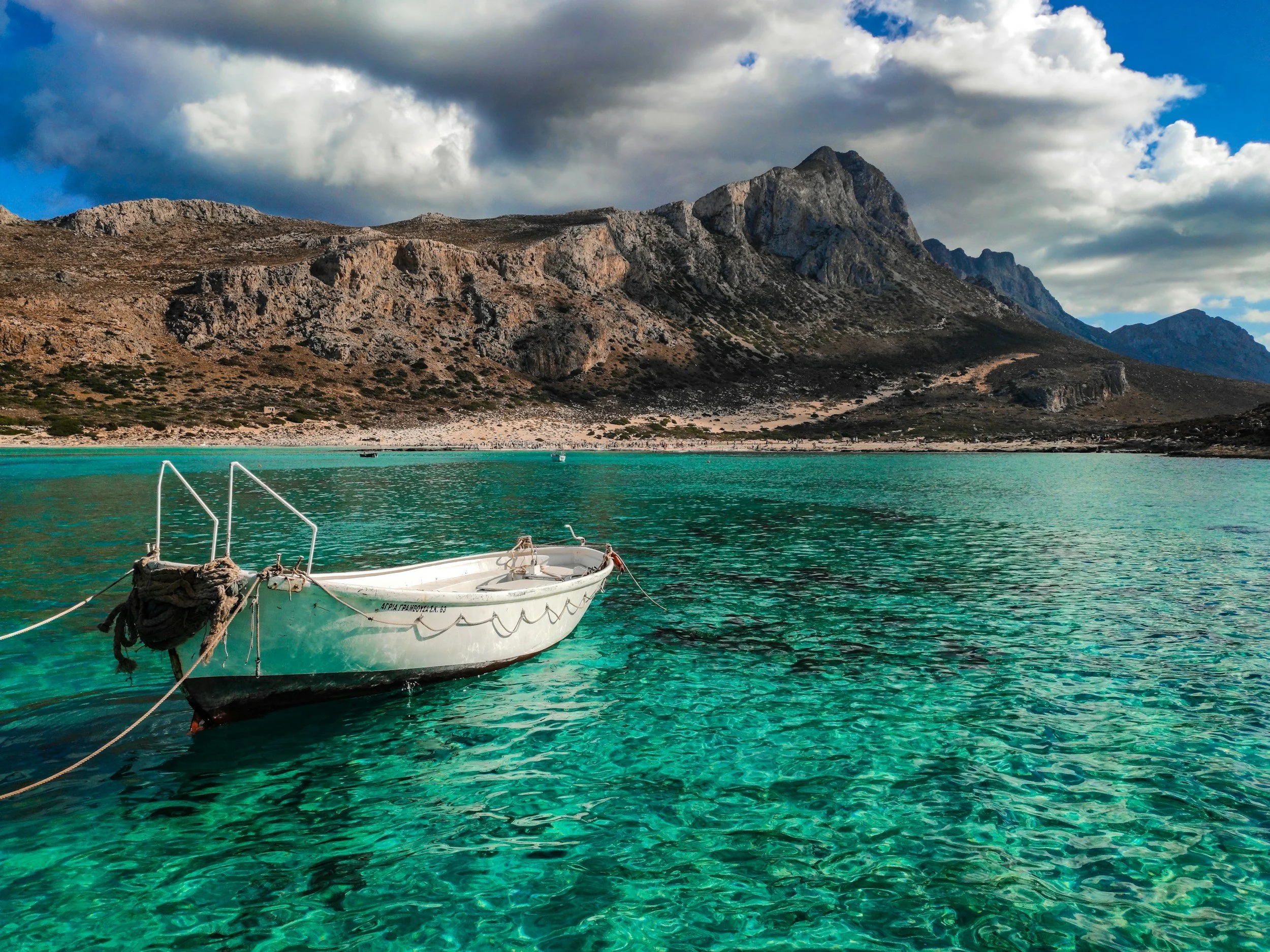
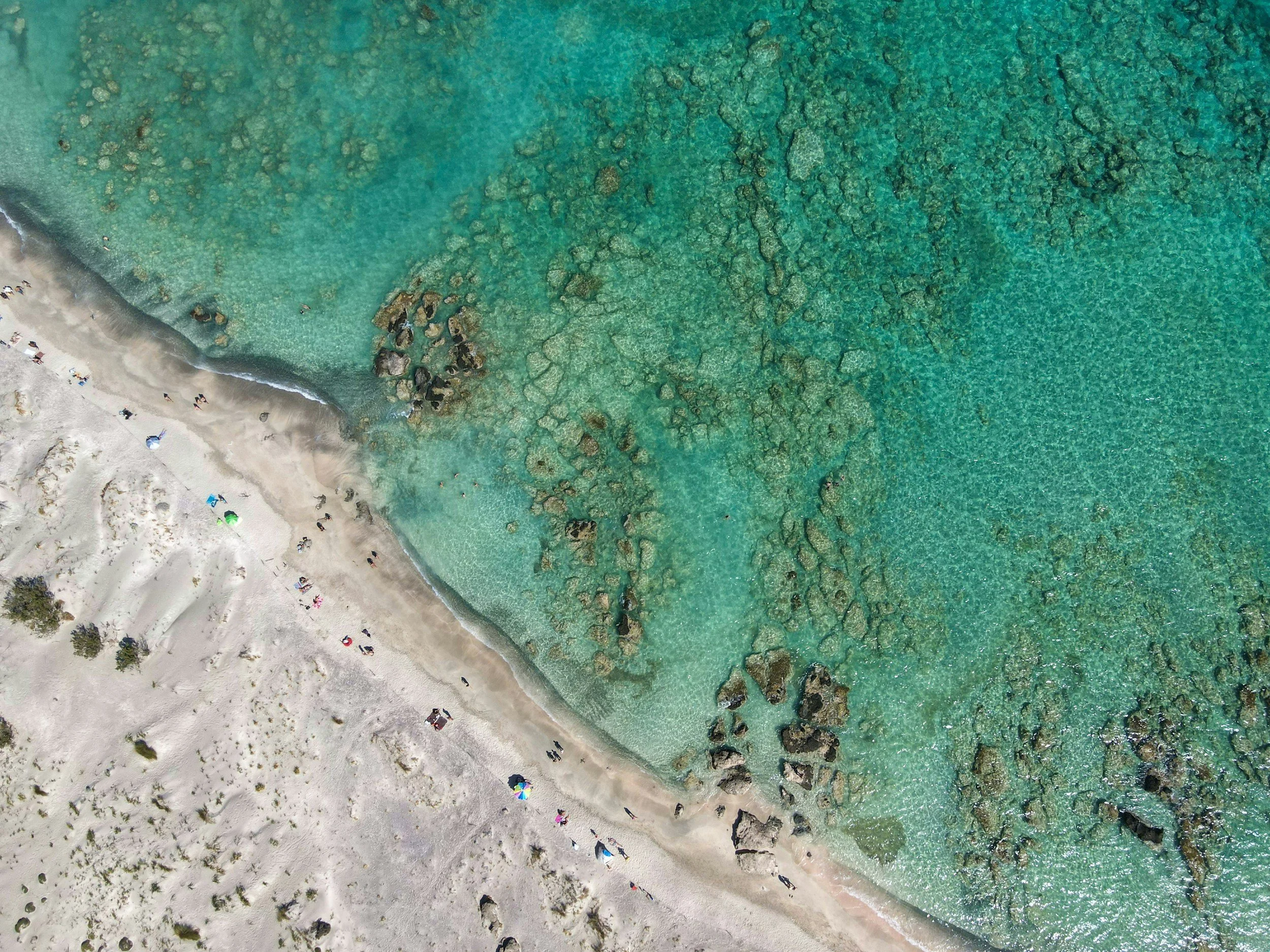
Few beaches anywhere in the world look like Elafonissi. The sand is tinged pink by crushed shells and red coral fragments, the shallow lagoon water shifts between clear, turquoise, and deep blue depending on depth and angle, and the small islands and sandbars scattered across the lagoon create compositional layers that most beaches simply do not offer.
The beach is located about 75 kilometers southwest of Chania, roughly 90 minutes by car along a road that winds through mountain villages before descending to the coast. The drive itself is beautiful and worth photographing.
The crowds in peak summer are significant. By 10 am in July and August, Elafonissi is packed. This is manageable if your priorities are right.
📷 Pro Tip: Arrive at or before sunrise. The beach is at its most extraordinary in the first hour of light, when the pink sand glows and the water shifts colors as the sun climbs. You will often have the beach largely to yourself until 8 am. Shoot the lagoon with a polarizer to cut the glare and deepen the turquoise of the water. The small islets accessible by wading provide elevated positions with better compositions than the main beach. A 16 to 35mm lens handles the landscape beautifully; carry a 50mm for tighter shots of the sand's texture and color.
Best time: Sunrise, or late afternoon when the crowds thin and the light softens. Distance from Chania: 75 km, approximately 90 minutes.
Balos Lagoon
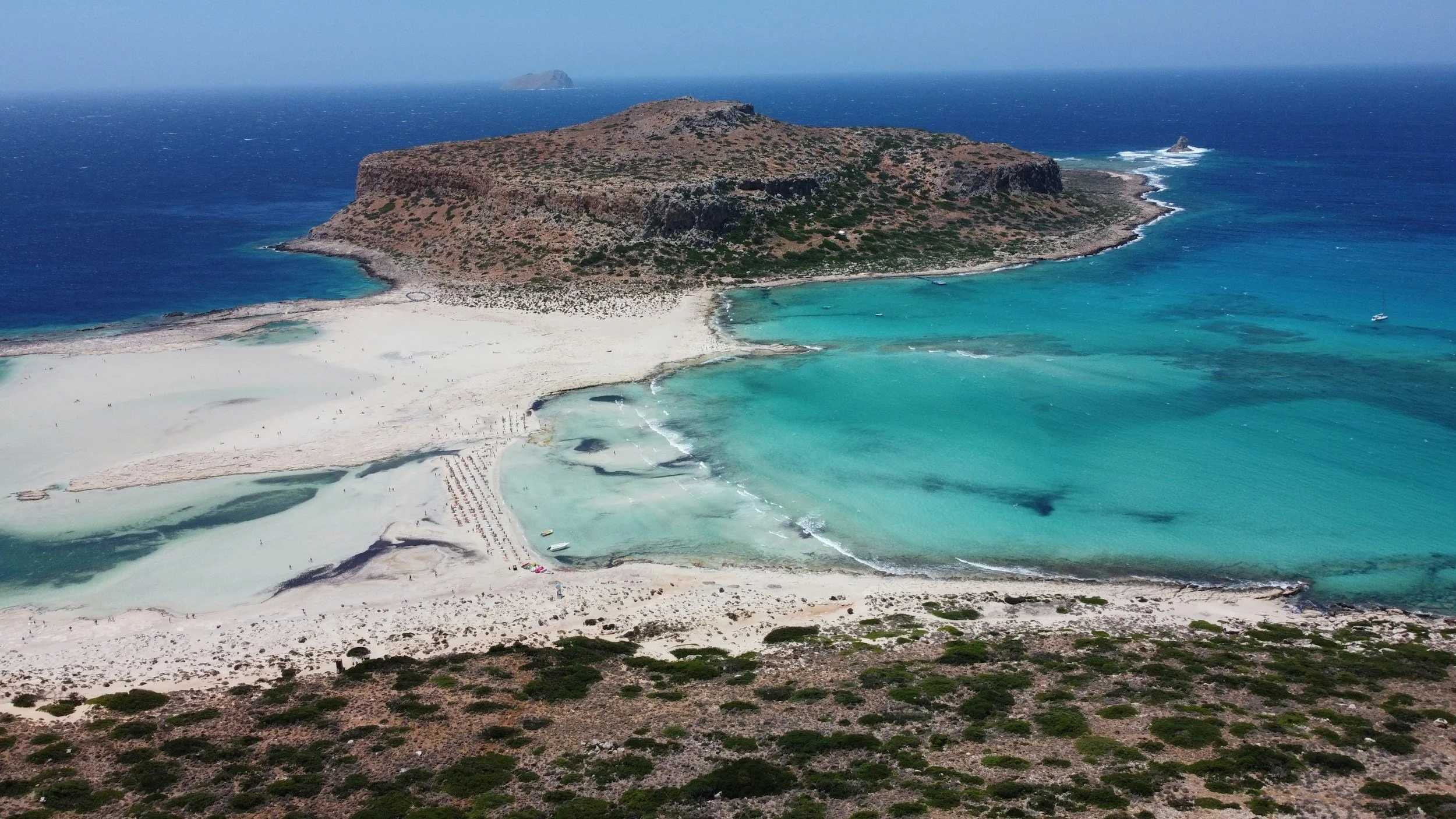
Balos is the most photographed beach in Crete, and standing above it on the clifftop trail, the view justifies every superlative. The lagoon stretches out in impossible shades: shallow white sand giving way to turquoise, then deep blue, with the rugged limestone cape of Gramvousa rising beyond. It looks, genuinely, like something invented for a travel magazine.
There are two ways to reach Balos: drive to the parking area and hike down the rocky trail (approximately 30 to 40 minutes each way), or take a ferry from Kissamos port. The road to the parking area is rough gravel and requires a standard rental car with reasonable clearance.
📷 Pro Tip: The clifftop viewpoint above the lagoon is the signature shot. You need the elevated perspective to capture the color graduation of the water and the scale of the lagoon. Shoot from the trail on the descent before you reach the beach, where the path offers several natural viewpoints above the turquoise water. Early morning gives you the best light and significantly fewer people. A 24 to 70mm covers both the wide panoramic and the tighter compositions of the sandbar patterns in the lagoon.
Best time: Early morning. Go on a weekday if possible. Avoid midday in summer. Access: Unpaved road from Kissamos. Alternatively, take the daily ferry from Kissamos port.
Seitan Limania
This is the beach most photographers do not find until their second trip to Crete, and they spend the rest of their lives wondering why nobody told them about it on the first.
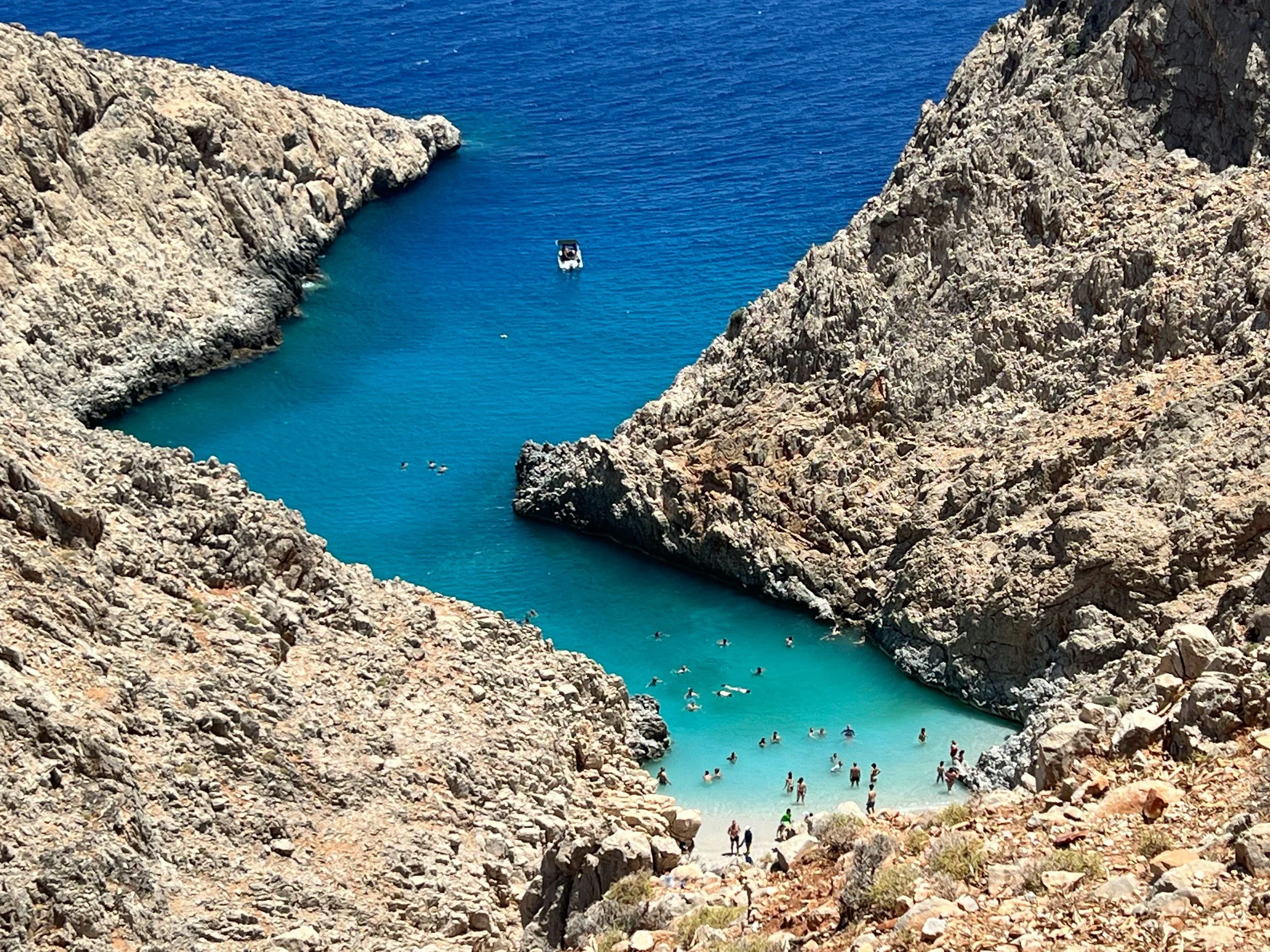
Seitan Limania, whose name means "Devil's Harbor" from the Turkish and Greek, is a narrow fjord-like cove on the Akrotiri Peninsula, just 35 minutes from Chania. The cove cuts deep into white limestone cliffs, the water at the bottom a shade of turquoise so vivid it looks altered. The cliffs rise steeply on both sides. The beach at the bottom is tiny: sand and pebbles in a space barely wide enough for a few dozen people.
The descent requires a steep hike of about 15 minutes on a rocky path. It is not technically difficult but demands solid shoes and some care with loose gravel. The path is not suited for people with a strong fear of heights. The reward is one of the most dramatically beautiful small beaches in the Mediterranean.
📷 Pro Tip: The best photograph at Seitan Limania is from the clifftop before you descend, not from the beach itself. The view from the top of the path, looking down into the fjord channel as it opens to the sea, is the defining shot of this location. Shoot it with a wide-angle (16 to 24mm) lens to capture both the depth of the cliffs and the extraordinary color of the water below. The sun only reaches the beach floor for a limited window during the day due to the height of the cliffs, so the water photography from above works better than shooting from the bottom. Come in the morning for the best light on the cliff faces.
Best time: Morning. Arrive before 9 am to beat the crowds and get the best clifftop light. Distance from Chania: 22 km, approximately 35 to 40 minutes by car.
Samaria Gorge
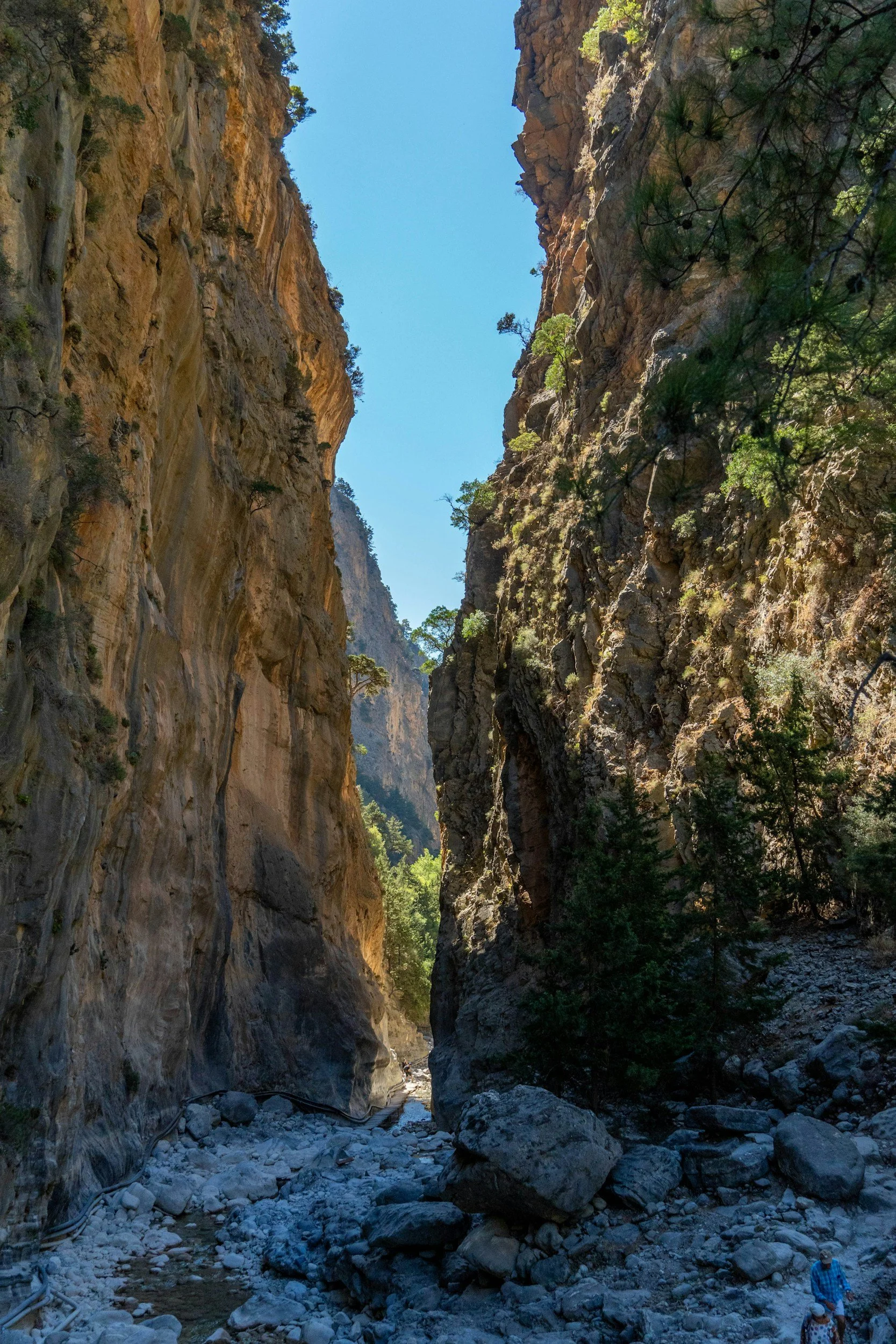
The Samaria Gorge is one of the longest gorges in Europe, running 16 kilometers through the White Mountains from the Omalos plateau to the coastal village of Agia Roumeli on the Libyan Sea. Hiking it is a full-day commitment: the descent takes 4 to 6 hours, and it is only possible to exit at Agia Roumeli by ferry, not by hiking back. Plan accordingly.
The gorge is at its most spectacular in spring (April and May), when wildflowers carpet the trail, the light filtering through the cliffs is soft and directional, and the stream running along the valley floor is full from winter rains. By summer, the stream has largely dried, and the crowds are significant.
📷 Pro Tip: The most famous shot in the Samaria Gorge is at the "Iron Gates," a section near the southern end where the gorge narrows to barely three meters wide and the cliffs tower hundreds of meters above. A 16 to 24mm lens with a slow shutter speed (tripod required) captures the scale and the silky movement of any remaining water. Start hiking early. The gorge opens at 7 am, and you want the morning light from the east coming through the cliffs before it becomes harsh overhead. A telephoto (70 to 200mm) is worth carrying for wildflowers and details along the trail.
Best time: May to June for wildflowers and less crowded trails. Open May to October (weather-dependent). Admission: Verify current price on site. Book ferry return from Agia Roumeli in advance at sfakia-crete.com.
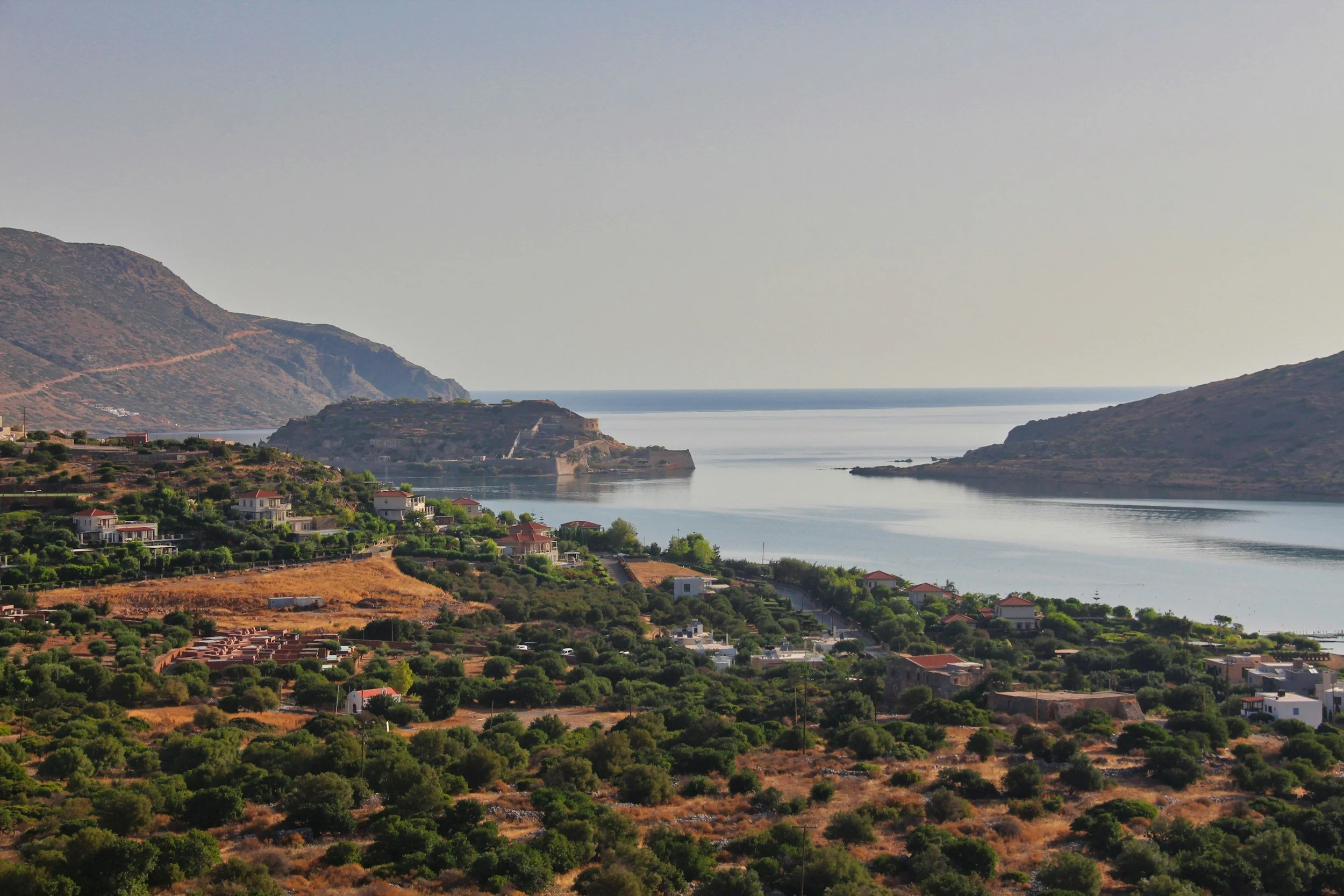
Spinalonga Island
Spinalonga is a small island at the mouth of the Gulf of Elounda in eastern Crete. For over 250 years, it functioned as a Venetian fortress. In the 20th century, it became one of Europe's last active leper colonies, abandoned only in 1957. Victoria Hislop's novel "The Island" brought it to international attention in the 2000s, and it has been a major tourist destination since.
It is also extraordinarily photogenic. The Venetian fortifications are among the best-preserved in the Aegean. The abandoned buildings of the leper colony have a quietly haunting beauty. And the approach by boat, with the fortress walls rising from the water, is one of the most dramatic arrivals in Crete.
📷 Pro Tip: Take the morning ferry from Elounda and arrive when the light is still low and directional from the east. The exterior walls photograph beautifully with side lighting that reveals the texture of the Venetian stonework. Inside the colony, the empty streets and doorways of the abandoned buildings make compelling architectural compositions with a 35 to 50mm. The view back toward the mountains of eastern Crete from the island's high point is worth the climb. Bring a wide-angle and a polarizer.
Best time: Morning ferry. Ferries run from Elounda and Plaka; the crossing takes approximately 15 minutes.
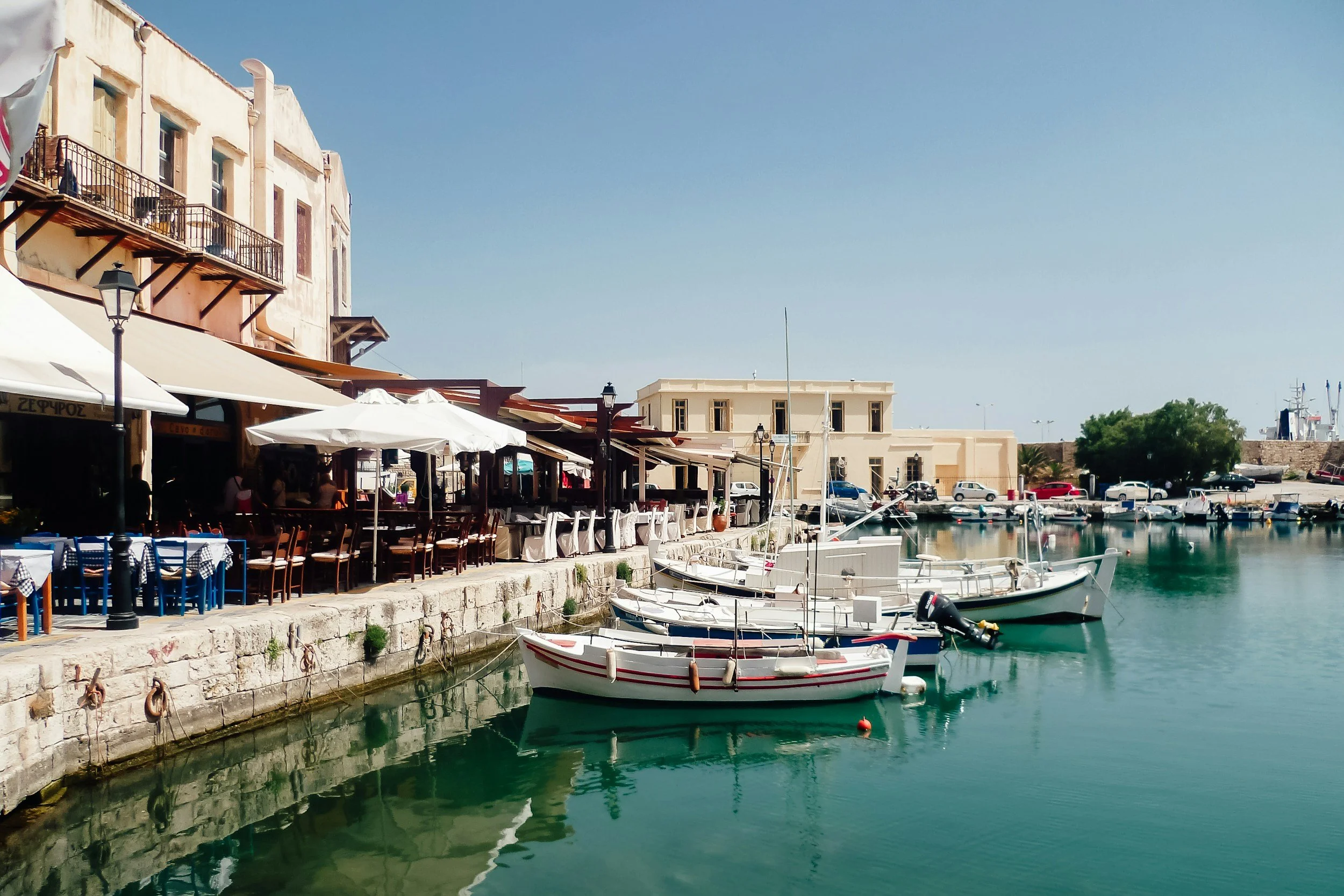
Rethymno Old Town and the Fortezza
Rethymno is Crete's third city, a beautifully preserved Venetian and Ottoman town on the north coast between Chania and Heraklion. The Fortezza, a massive Venetian fortress perched above the town, offers one of the best elevated panoramas in Crete: the old town below, the harbor curving to the east, the sea beyond.
The old town itself is one of the most photogenic urban spaces on the island: narrow streets, Ottoman fountains, minaret towers, Venetian loggia, bougainvillea over stone archways, and a harbor lined with restaurants and fishing boats.
📷 Pro Tip: Visit the Fortezza at golden hour, when the sun comes from the west, and the warm light on the honey-colored stone of the walls is extraordinary. From the highest point of the fortress, the combination of old town, harbor, and sea in a single frame is one of the most compositionally layered shots in western Crete. In the town below, the Rimondi Fountain near the Venetian loggia makes a strong focal point for street photography at any time of day. A 24 to 70mm lens handles both the fortress panoramics and the intimate street scenes.
Best time: Golden hour for the Fortezza. Early morning for street photography in the Old Town.
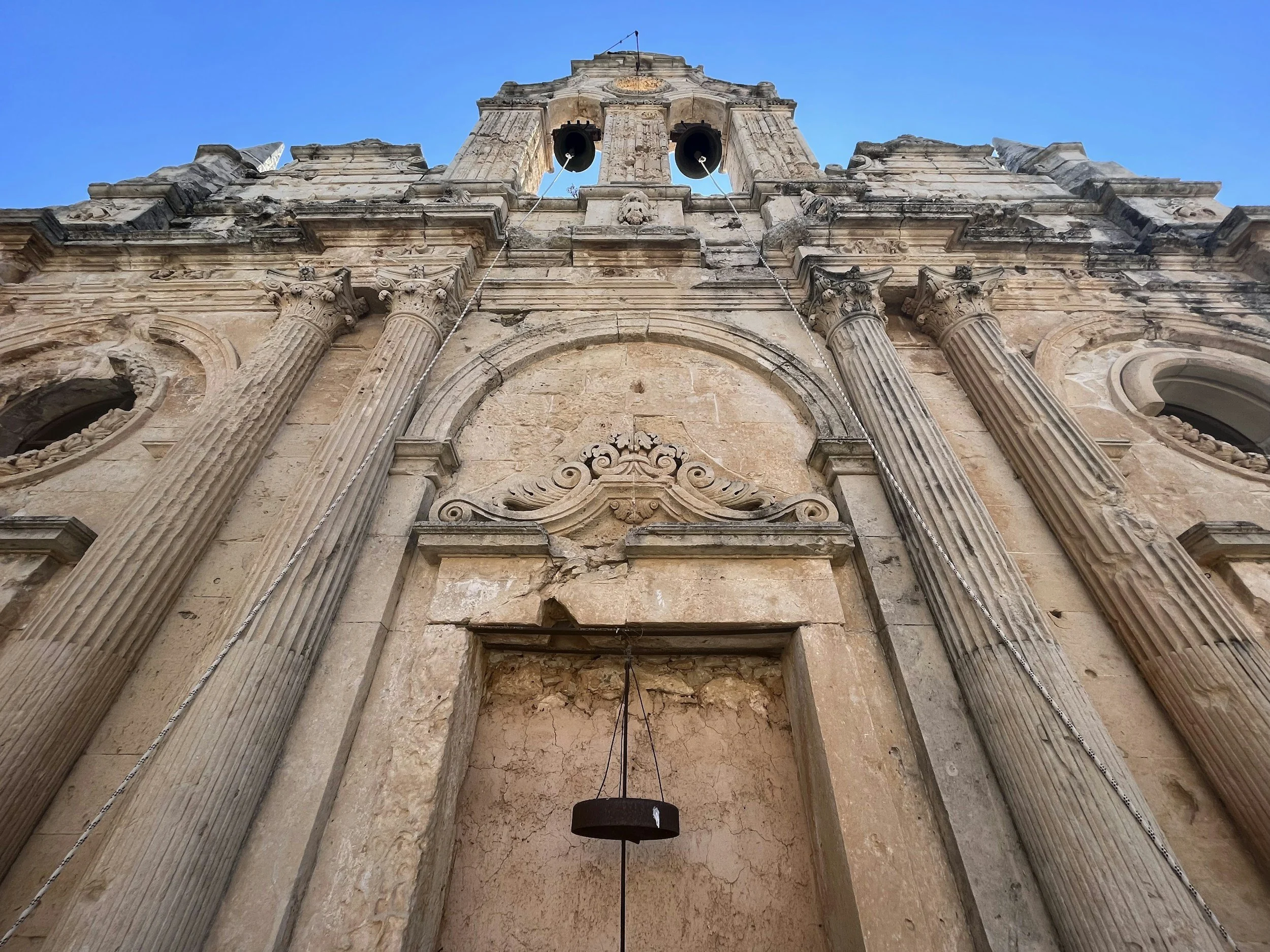
Arkadi Monastery
One of the most historically significant and visually striking sites in Crete, Arkadi Monastery sits in the hills southeast of Rethymno, surrounded by pine forests and farmland. The 16th-century Venetian baroque facade is one of the most photographed architectural subjects on the island, especially at golden hour when the warm light illuminates the carved stonework.
The monastery is also the site of one of the defining moments of Cretan resistance: in 1866, surrounded by Ottoman forces, the Cretans inside chose to ignite the gunpowder stores rather than surrender, killing hundreds on both sides. This act of defiance accelerated the movement for Cretan independence and made Arkadi a symbol of freedom across Europe.
📷 Pro Tip: Arrive in the late afternoon and wait for the light. The baroque facade faces west, which means golden hour from behind your position as you face the church gives you extraordinary warm side-lighting on the carved stone. A 50 to 105mm focal length compresses the decorative detail of the facade beautifully. The courtyard inside is quieter and more intimate. Use a wide angle to capture the full scale of the courtyard with the church at the far end.
Best time: Late afternoon, golden hour. Admission: Verify current price on site. Open daily. Distance from Rethymno:23 km, approximately 30 minutes.
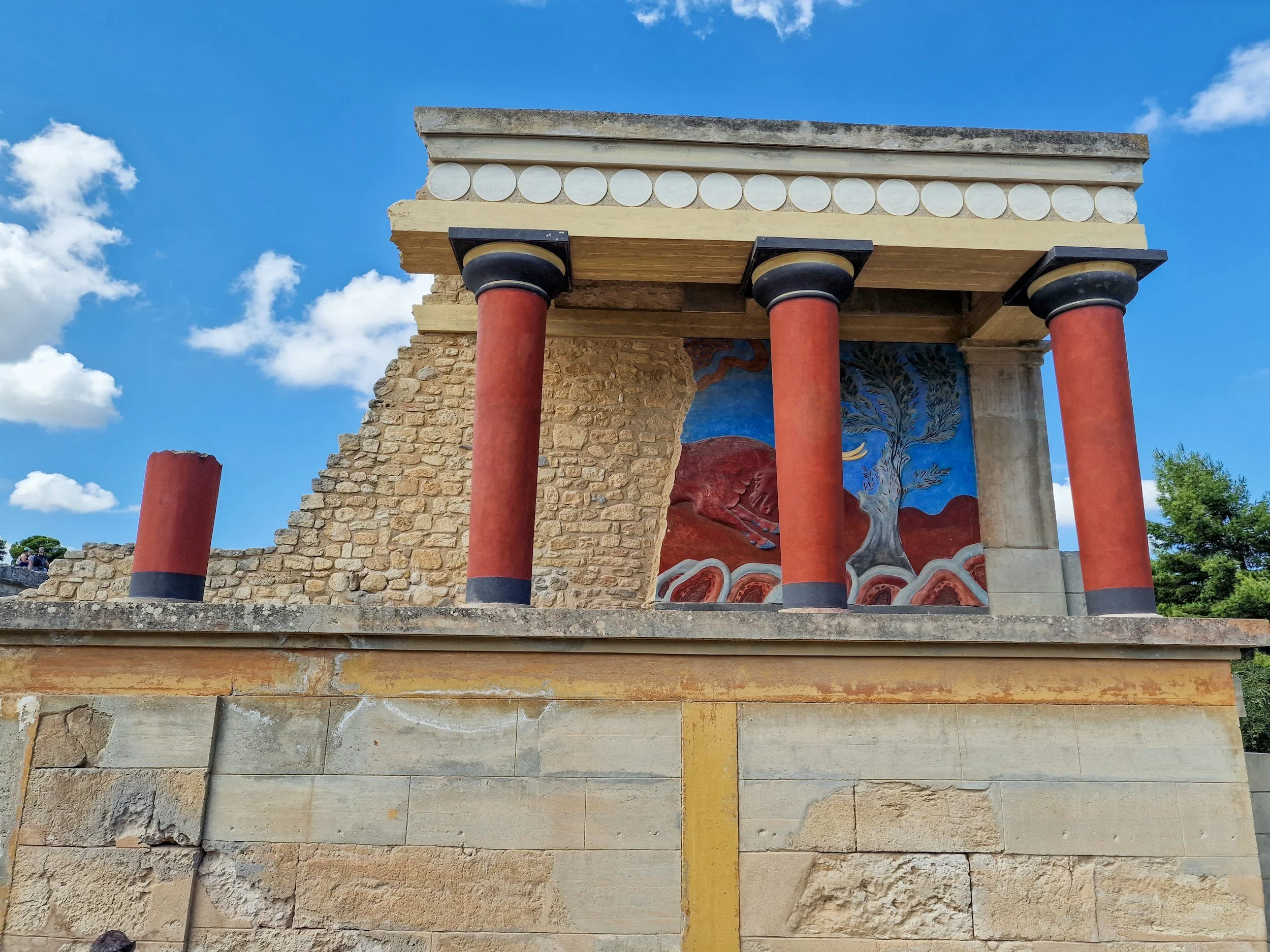
Knossos Palace
The Palace of Knossos, located just south of Heraklion, is the most important archaeological site in Crete and one of the most significant in all of Europe. This was the center of Minoan civilization, the culture that produced the first advanced society in European history, more than 3,500 years ago. The site covers an area larger than five football fields and includes throne rooms, storage chambers, frescoed halls, and a drainage system that predates most of the world.
The reconstructed sections, with their vividly painted red and blue columns, are controversial among archaeologists but make for some of the most visually dynamic ruins in Greece.
📷 Pro Tip: Come as early as possible. Knossos opens at 8 am, and the best photography light is in the first two hours before the tour groups arrive and the sun climbs overhead. The reconstructed columns with their deep red color photograph beautifully against a blue sky with a polarizer. A 24 to 70mm handle scales the site while a 50mm handle lets you work on individual details. The fresco reproductions, particularly the famous bull-leaping fresco, are worth photographing in the site museum. Note that drone flights are prohibited at Knossos and all Greek archaeological sites.
Best time: Opening time, 8 am. Buy tickets online in advance. Admission: Verify current price at odysseus.culture.gr.
Falassarna Beach (Best Sunset in Crete)
Falassarna is a wide, open beach on the northwestern tip of Crete, exposed to the full western sky and offering some of the most spectacular sunsets anywhere on the island. The combination of crashing waves, dramatic cloud formations over the open sea, and the changing colors of a Cretan sky at dusk creates conditions that make even average sunset photography look extraordinary.
📷 Pro Tip: Arrive 90 minutes before sunset to scout your position and watch the light change. The beach faces due west, which means the sun drops directly into the sea. Shoot with a wide-angle lens to capture the full sweep of the sky and the horizon. Once the sun sets, stay for blue hour: the afterglow over the sea and the gradual appearance of stars in the eastern sky extend the photography session by another 30 minutes. A tripod is essential for anything after the sun drops below the horizon.
Best time: Golden hour through blue hour. Distance from Chania: 55 km, approximately 60 to 75 minutes.
Street Photography in Crete
While many visitors come to Crete for its beaches and landscapes, some of my favorite photographs came from simply exploring the island's towns and villages.
Chania is especially rewarding for street photography. The best stretch is the alleyways between the harbor and the covered market, where morning vendors, coffee drinkers, and locals going about their day create genuine scenes that are worth more than any posed tourist shot. Arrive before 8 am and work toward the market. The leather goods shops and spice stalls are set up and the light in the narrow lanes is soft and directional.
Rethymno also offers wonderful street photography opportunities, with its Venetian architecture, colorful doorways, and relaxed atmosphere. In smaller mountain villages, I often found some of the most authentic scenes of daily life, from elderly residents chatting outside cafés to local shopkeepers opening their businesses for the day.
📷 Pro Tip: In the Old Town, use the Leica Q3 or any compact mirrorless with a 35mm equivalent. The smaller the camera, the better. Work from the outside of the alley looking in, using the shadows and frames of doorways as natural borders for your compositions. The Venetian loggia near the harbor in both Chania and Rethymno is a strong architectural backdrop for street portraits if you ask permission first.

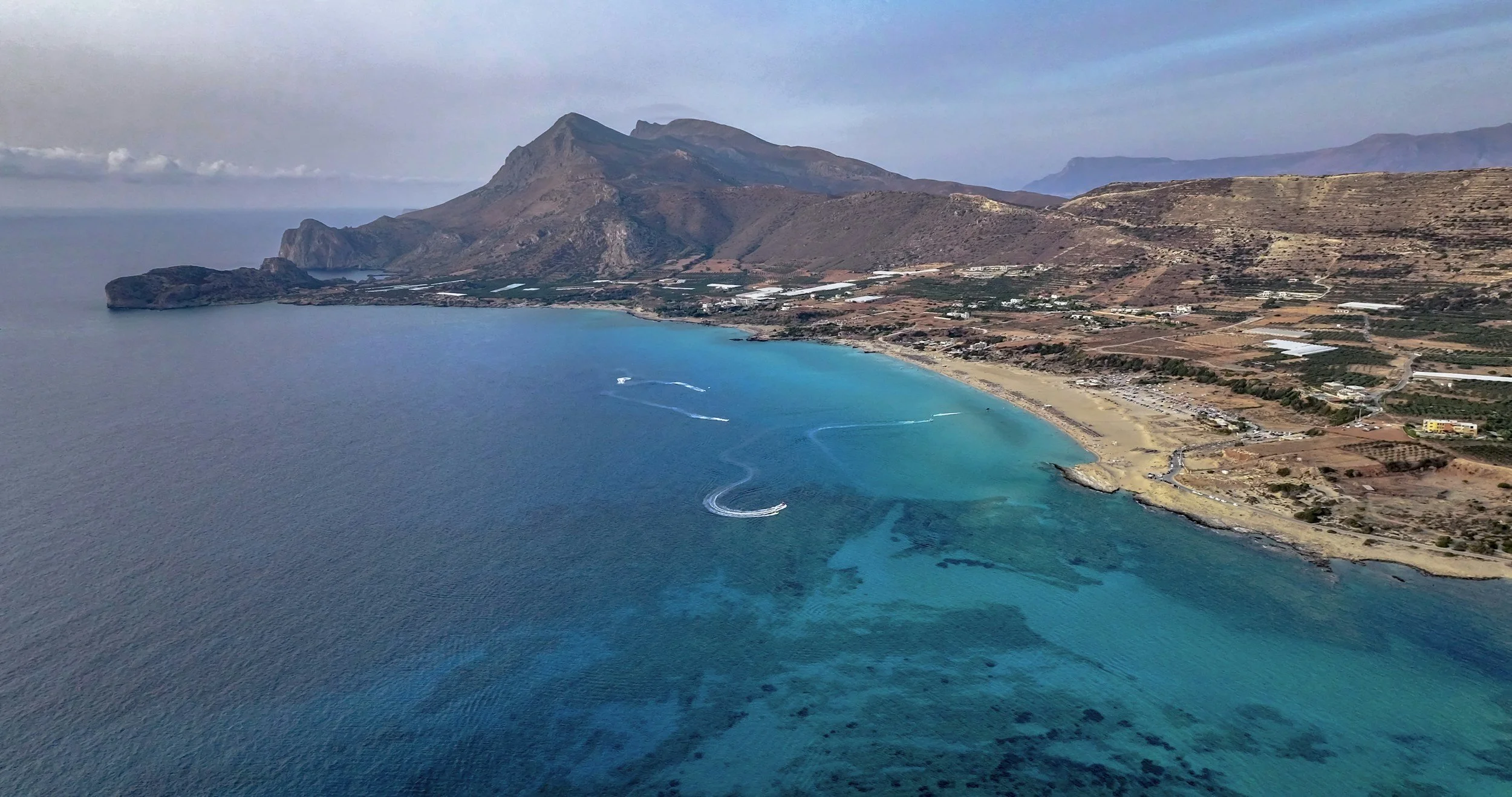
Overlooking Spinagola Island
Festivals and Holidays
Greek Orthodox Easter (March or April, depending on the year) is the most photographically rich event in Crete. The island celebrates with more intensity than most of mainland Greece. The candlelit midnight service on Holy Saturday, where thousands of people hold flames in the darkness before the lights come up, is one of the most visually powerful events I have witnessed in Greece. The feasts, processions, and street celebrations on Easter Sunday continue the photographic opportunities into the following day. Approach with respect: this is a deeply held religious observance, not a performance.
Rethymno Renaissance Festival (July and August) celebrates the island's Venetian cultural heritage with music, theater, dance, and art performances across the city. The Fortezza serves as the main venue for evening performances, which are photographed beautifully against the lit stone walls. The combination of Venetian architecture, warm summer nights, and cultural programming creates a strong backdrop for people and event photography.
Chania Film Festival (October) brings local and international films to Chania, with screenings in outdoor venues around the Old Town. The mix of audiences, outdoor projection, and the harbor setting creates interesting photography opportunities outside the screenings themselves.
Cretan Wine Festival (August, Rethymno) is a multi-day celebration of the island's wine production with tastings, music, and food. Less known to international visitors, but it is worth attending for the authentic local atmosphere it creates.
Frequently Asked Questions About Visiting Crete
Is a car necessary in Crete?
Yes, not optional. Elafonissi, Balos, Seitan Limania, Falassarna, and the Samaria Gorge trailhead are all only reachable by car. Book your rental well in advance, especially in summer.
Is Crete safe?
Yes, it's one of the safer Greek destinations to explore, including remote coastal drives and mountain villages. Normal travel awareness applies, particularly on unpaved roads like the one to Balos.
How many days do you need in Crete?
Seven days minimum. Five is possible but rushed, ten lets you properly add a second base in Elounda and explore the eastern half of the island, including Spinalonga and Knossos.
What are the best photo spots in Crete?
Chania's Venetian harbor at blue hour, Balos Lagoon's clifftop viewpoint at sunrise, and Spinalonga Island on the morning ferry are three that consistently deliver. The full list with Pro Tips is above.
Can you fly a drone in Crete?
Register with the Hellenic Civil Aviation Authority before flying. Drones are restricted or prohibited at archaeological sites like Knossos, within the Samaria Gorge national park, and near airports. Check current HCAA rules before your trip.
What surprised you most about Crete?
Waking up at the Blue Palace on my first morning, walking down before breakfast, and finding octopus hung out to dry on a clothesline in the small village next door. That image, the salt smell, the completely unhurried pace, told me everything about this island before I'd even had my coffee.
Is Crete worth combining with Athens?
Yes, it's the natural companion. Fly into Athens, spend three days photographing the Acropolis and the ancient sites, then take the overnight ferry to Chania. Together they tell the full story of Greece.
Is Crete worth combining with Cyprus?
Yes, it's a short flight away and offers a genuinely different eastern Mediterranean experience, sea cliffs, ancient mosaics, and a cultural identity distinct from mainland Greece or Crete itself.
Final Thoughts
Crete is the kind of island that changes size depending on how you spend your time.
Move fast, check the famous beaches off a list, take your photos, and leave, and Crete feels like a very beautiful destination you passed through. Slow down, stay an extra day, eat the same taverna twice, drive the mountain roads without a destination, accept the raki, and Crete becomes something else. It becomes a place you carry around for years.
For photographers, the lesson is the same one the island teaches everyone: arrive early and stay late. The harbor at blue hour. The pink sand before the crowds. The gorge in morning light. The fortress at golden hour. Crete is a place where the difference between a mediocre image and a great one is almost entirely about timing. Chase the light here, and it will find you.
For travelers, give it more time than you think you need. The west of the island, with Chania and its harbor, Elafonissi and Balos, the Samaria Gorge and the mountains, is where most people base themselves, and it earns that reputation. But if you have ten days or more, make the drive east to Elounda, Spinalonga, and the palm beach at Vai. The island keeps revealing itself.
Crete is not like anywhere else in Greece. It has its own pride, its own food, its own music, its own relationship with its history. You feel that within a day. You appreciate it more every day after.
Want to improve your photography while exploring some incredible destinations? Join me on one of my photography workshops! You can find all the details, including upcoming destinations and dates, through the links below.
Let's Stay Connected!
My Photography & Travel Guide to Athens, Greece: The perfect companion to a Crete trip. Fly into Athens, spend three days photographing the Acropolis, Plaka, and the ancient sites, then take the overnight ferry to Chania. The two together tell the full story of Greece.
My Photography & Travel Guide to Cyprus: A short flight from Crete and one of the most rewarding photography destinations in the eastern Mediterranean. Sea cliffs, ancient mosaics, and a cultural identity unlike anywhere else in the region.
My Photography & Travel Guide to Venice, Italy, and Crete shares a history; the Venetians built the harbor at Chania and ruled the island for centuries. Venice is the logical next chapter for anyone who falls in love with Cretan architecture.
Are you carrying too much camera equipment, but still coming home disappointed with your travel photographs?
You are not alone. Many photographers fall into the packing trap. They bring too much, plan too little, and spend their trip scrambling to capture photographs instead of enjoying the experience.
Capture the World offers a better approach.
In this practical guide, travel photographer Vito L. Tanzi shares the five step system he uses to plan photography trips, pack with purpose, work with the best light, and return home with stronger images.
Inside, you will learn how to:
• Travel lighter without sacrificing image quality
• Choose destinations that match your photography goals
• Visit at the right time for weather, light, wildlife, festivals, or seasonal conditions
• Build a photography itinerary around sunrise, sunset, blue hour, and changing weather
• Select the equipment you will actually use
• Find promising locations before you arrive
• Avoid the stress and exhaustion that can ruin a photography trip
• Stay flexible when weather, crowds, or travel plans change
This guide includes practical planning advice, useful photography tools, real travel examples, and a complete system you can use again and again.
Whether you are preparing for your first international photography trip or planning a weekend closer to home, Capture the World will help you travel with greater purpose, photograph with more intention, and spend less time worrying about what is inside your camera bag.
Because the best photography trip is not the one where you carry everything.
It is the one where you are ready when the right moment appears.
📸 Format: PDF download
Instant Download
Finally—a beginner-friendly photography guide that makes sense.
If you've ever picked up a camera and thought, "Now what?" this is the book for you.
Photography Made Simple is written for adults who are just starting out and want a clear, encouraging, real-world approach to learning photography. Whether you're using a DSLR, mirrorless, or just your smartphone, this guide walks you through the basics—without the jargon or tech overwhelm.
Inside, you'll learn:
The only camera settings you really need to know to get started
How to shoot sharper, more intentional photos using light and composition
Simple tips for portraits, landscapes, travel, and everyday life
What gear you do (and don’t) need
How to create better photos without upgrading your camera
You’ll also get practical exercises, cheat sheets, and tips for organizing and editing your images—plus the confidence to shoot off Auto Mode for good.
This is not a textbook. It’s a friendly guide to seeing the world with fresh eyes—and finally capturing what you see the way you imagine it.
📸 Format: PDF download
Pages: 100+
Perfect for: Beginners, hobbyists, and anyone ready to take better photos without the stress