Madrid Photography & Travel Guide: Retiro Park, Plaza Mayor, and the Best Photo Spots
My first morning in Madrid, I woke up before the city did.
I was in Retiro Park by 6:30 am, when the light was still low and orange, and the park was empty except for a few joggers and an old man feeding pigeons near the Palacio de Cristal. I photographed the iron-and-glass conservatory reflected in the still pond in front of it, with the trees just beginning to catch the early light. The whole city felt quiet and mine for about an hour.
Then Madrid woke up. And it woke up with an energy that I did not entirely expect.
This is not a city that eases into its day. By 9 am, the café terraces are full. By 10 am, the museums are open, and the queues are forming. By midnight, the restaurants are still turning tables. Madrid runs on a schedule that is completely its own, and once you adjust to it — eating lunch at 2 pm, dinner at 10 pm, staying out until the city finally goes quiet around 2 or 3 am — it makes complete sense. The Spanish invented this rhythm for a reason.
For photographers, Madrid is one of the most rewarding cities in Europe. The light here is extraordinary: the Spanish sun at golden hour turns the limestone facades of Gran Vía amber and catches the fountain jets at Cibeles in a way that feels almost theatrical. The subjects range from world-class Baroque palaces and Neoclassical monuments to medieval market streets, Egyptian temples, and a Sunday flea market that fills entire city blocks with the kind of authentic, unposed humanity that photographers dream about.
The art alone is worth the trip. The Golden Triangle of Art — the Prado, the Reina Sofía, and the Thyssen-Bornemisza — forms one of the greatest concentrations of masterworks in the world, all within a ten-minute walk of each other. For photographers who respond to art as a subject and as inspiration, spending a morning in the Prado alone can change the way you look at light.
In this guide, I will show you exactly where to go, what to shoot, where to stay, and where to eat. Whether you are here for three days or a week, this is everything you need.

The Metropole Hotel
Where to Stay
For photographers and travelers, the best bases in Madrid are the Centro neighborhood (walkable to almost everything in the historical center, including Plaza Mayor, Puerta del Sol, and the Golden Triangle of Art), the Salamanca district (Madrid's most elegant residential neighborhood, close to Retiro Park and the best mid-morning light on the wide, tree-lined streets), and La Latina (the most characterful and photogenic neighborhood in the city, best for evening street photography and Sunday El Rastro access).
Here is where I would stay.
LUXURY
Four Seasons Hotel Madrid Sevilla 3, Centro — named to Travel + Leisure's T+L 500 for 2025 and 2026
Seven historic buildings in the very heart of Madrid were transformed into one dynamic destination, and the result is the finest hotel currently operating in the Spanish capital. The spa alone covers more than 1,400 square meters over four levels, with a 14-meter pool beneath a skylight that floods the space with natural light, a steam bath, sauna, solarium, and eight treatment rooms. The fitness facilities and pool terrace are exceptional.
The dining is the headline. The rooftop features Dani Brasserie, helmed by Spanish celebrity chef Dani García, one of the most decorated culinary figures in Spain, serving contemporary Andalusian cuisine with panoramic city views. The in-house restaurant Isa offers Asian-Mediterranean fusion that is among the best in Madrid, regardless of where you are staying.
For photographers, the central location is difficult to improve upon. The Prado is fifteen minutes on foot. The Retiro is twelve. Puerta del Sol is five. You can be shooting Plaza Mayor at blue hour and be back at the hotel in time for a late dinner.
Rosewood Villa Magna Paseo de la Castellana 22, Salamanca
On Paseo de la Castellana in the heart of the Salamanca district, the Villa Magna has been one of Madrid's landmark hotels since 1972. The Rosewood renovation in 2021 transformed it into a contemporary manor house oasis — 154 rooms and suites with white walls, bespoke furniture, and subtle art-deco accents, surrounded by remarkable gardens designed by landscape architect Gregorio Marañón.
The signature restaurant Amós is led by Michelin-starred chef Jesús Sánchez and specializes in the lesser-known Northern Spanish cuisine and wines of the Cantabrian region. The Tarde.o bar and garden terrace is one of Madrid's most refined spots for an early evening drink, particularly during the long, warm summer evenings when the outdoor setting is at its best.
For photographers, the Salamanca position puts you steps from Calle de Serrano (great for street photography with money), a short walk from Retiro Park's eastern entrance, and central for afternoon light on the wide, tree-lined boulevards of this neighborhood.
Gran Meliá Palacio de los Duques Cuesta de Santo Domingo 5/7, near the Royal Palace
Housed in a restored 19th-century palace between the Royal Palace and the Opera House, the Gran Meliá Palacio de los Duques is one of Madrid's most atmospheric luxury options. The interior courtyard gardens are genuinely extraordinary, a rarity in central Madrid, and the rooftop terrace and pool offer some of the finest views of the Royal Palace and the Almudena Cathedral available from any hotel in the city.
The restaurant El Jardín de Ars holds a Michelin star and serves contemporary Spanish cuisine with impeccable local produce. For photographers, the proximity to the Royal Palace, the Temple of Debod (ten minutes on foot), and the medieval streets of La Latina make this the best-positioned hotel for the western photographic circuit.
The Principal Madrid Hotel Marqués de Valdeiglesias 1, near Gran Vía
A sophisticated boutique property tucked just off the Gran Vía in a beautifully restored Beaux-Arts building. The Principal's rooftop terrace is one of the finest in central Madrid — a front-row seat to the Gran Vía skyline and the Metropolis Building that photographers specifically come here for. With just 76 rooms, the service is genuinely personal, and the atmosphere is closer to a private residence than a hotel.
For photographers, the rooftop is the selling point. The view of the Metropolis Building's cupola at blue hour, lit against a deep blue sky, is one of the most photographed images of Madrid — and from this terrace, you are shooting it from directly above street level, not competing with traffic.
MID-RANGE
Iberostar Las Letras Gran Via Gran Vía 11, Centro
A chic, literary-themed hotel directly on the Gran Vía, with a rooftop bar that is consistently rated among the best in the city for views of the skyline. The rooms are stylish, and the location for photographing Gran Vía's architectural sweep is hard to beat.
Room Mate Oscar Plaza Vázquez de Mella 12, Chueca
Colorful, design-forward, and unapologetically fun, with a rooftop pool and bar that overlooks the Chueca neighborhood. A strong choice for travelers who want to be in the heart of Madrid's most vibrant quarter with a social hotel atmosphere.
Petit Palace Triball Corredera Baja de San Pablo 75, Malasaña
Housed in a historic building in the Malasaña neighborhood, this well-run hotel puts you in the middle of Madrid's most interesting street art and street photography territory, within walking distance of the Gran Vía and the major museums.
How Long Should I Stay?
For a comprehensive photography and travel experience, 3 to 5 days in Madrid is ideal. This duration allows you to explore major landmarks, walk into local neighborhoods, and capture the city's essence during different times of the day. It is not a very large city, so it’s quite easy to reach most locations on foot.

El Retiro Park
Best Time to Visit
The spring months (April to June) and autumn (September to October) are perfect for photographers. During these periods, Madrid enjoys pleasant temperatures, fewer tourists, and soft natural lighting—ideal for capturing the city's beauty. Additionally, events like the San Isidro Festival in May offer vibrant cultural scenes to photograph

Getting Around the City
Madrid's public transportation system is efficient and easy to use, with an extensive network of buses, metro lines, and trains. Uber and Bolt are also available, offering convenient options for getting around. For a more scenic and active experience, consider renting a bike to explore the city's parks and neighborhoods. I loved walking all over the city.

Where to Eat
Madrid does not make eating complicated. It makes it unavoidable. The city runs on a food culture so deeply embedded in daily life that you will find yourself eating more meals than you planned, staying at tables longer than you intended, and accepting the small glass of raki — in Madrid, the caña of beer, and the tapa — as the natural rhythm of an afternoon.

A few things to understand before you start: lunch happens at 2pm and is the main meal of the day. Dinner does not start until 9pm at the earliest, and locals sit down closer to 10:30. The menú del día — a two or three-course lunch with bread and a drink — is one of the great food values in Europe, available at almost every restaurant for €12–€18. Order it.

Restaurants
Here is where I eat.
Sobrino de Botín
Cuchilleros 17, near Plaza Mayor
The Guinness World Record holder for the oldest continuously operating restaurant in the world, open since 1725. The wood-fired oven in the basement, which has been burning almost without interruption for three centuries, cooks the cochinillo asado — roast suckling pig — that has been on the menu since the restaurant's founding. Hemingway ate here and wrote about it in The Sun Also Rises. The rustic Castilian dining rooms, with their low ceilings, terra cotta floors, and ochre walls, look almost exactly as they did when he visited.
Order the cochinillo. Also, the sopa castellana, a garlic and bread soup with a poached egg, which is one of the most honest and warming things you will eat anywhere in Spain. Reserve ahead — this is one of the busiest restaurants in Madrid.
Casa Lucio
Calle de la Cava Baja 35, La Latina
Casa Lucio is the meal that locals take out-of-town visitors to when they want to show them what Madrid actually tastes like. The restaurant has been in this same space on Calle de la Cava Baja since 1974, and the huevos rotos — fried eggs cracked over a pile of crispy potatoes, sometimes with jamón or chorizo — is the dish that defines it. Simple, precisely executed, deeply satisfying.
The dining room is warm and slightly boisterous in the best possible way. The jamón ibérico at the bar before you sit down is worth ordering immediately. The wine list leans heavily into Spanish regions most visitors never encounter. Stay for dessert.
Taberna La Bola
Bola 5, near the Royal Palace
La Bola has been serving cocido madrileño — Madrid's great chickpea, vegetable, and slow-cooked meat stew — since 1870, and it still arrives at the table in the traditional clay pot it has always been served in. This is Madrid's soul food: rich, generous, and exactly what you want after a morning of photographing the Royal Palace and the surrounding streets. The bright red exterior is a local landmark. The interior, with its tiled walls and wood-framed mirrors, has not changed much in a century.
Cocido is a lunch dish. Come at 1:30 pm, order the full service (it comes in three courses: the broth first, then the chickpeas and vegetables, then the meats), and plan on not being hungry again until the following morning.
DiverXO
NH Eurobuilding Hotel, Calle de Padre Damián 23, Chamartín
Madrid's only three-Michelin-star restaurant, and the one that requires the most planning. Chef David Muñoz's tasting menu fuses Spanish, Japanese, and Southeast Asian influences in theatrical, multi-course presentations that challenge the diner's expectations at every turn. Reservations open months in advance and sell out within hours of release — monitor the restaurant's social media for opening dates and book the moment they go live.
This is an occasion restaurant. It is expensive, it is long, and it is one of the most memorable meals you will have anywhere in Europe if you approach it in the right spirit.
Calle de Cava Baja y La Latina Tapas
The best tapas in Madrid are not in a single restaurant. They are on a single street. Calle de Cava Baja in La Latina is where locals go on Sunday evenings after El Rastro market closes, moving from bar to bar with a caña and a free tapa at each stop. The street runs about 400 meters and is lined end to end with tabernas that have been serving the same dishes for decades: patatas bravas, croquetas de jamón, boquerones en vinagre, tortilla española.
Start at one end and work your way down. Do not sit at a table — stand at the bar. Order the house vermouth with your first tapa. This is how Madrid eats on a Sunday, and it is worth organizing your entire trip around.

Coffee Shops
Madrid coffee culture runs on café con leche and croissants at metal bar counters. Here are three worth knowing:
Toma Café — Madrid's most respected specialty coffee roaster. Clean, focused, and excellent.
HanSo Café — Specialty coffee with excellent pastries, Malasaña neighborhood.
Café de la Luz — Vintage decor, relaxed atmosphere, Malasaña. Good before a morning walk through the neighborhood.

Photography Gear to Bring
Camera Models: Sony A7V, Canon EOS R5, Nikon Z6 II, Leica Q3
Lenses:
Wide-angle lens (16-35mm) for capturing architecture and street scenes.
Standard zoom lens (24-70mm) for versatile shooting across different settings.
Telephoto lens (70-200mm) for distant subjects and candid street photography.
Prime lens (50mm) for portraits and low-light conditions.
Tripod: Essential for night photography and long exposure shots.
Extra Batteries and Memory Cards: Always be prepared for extended shooting sessions.

El Retiro Park
Photography Locations in Madrid
El Retiro Park and Palacio de Cristal
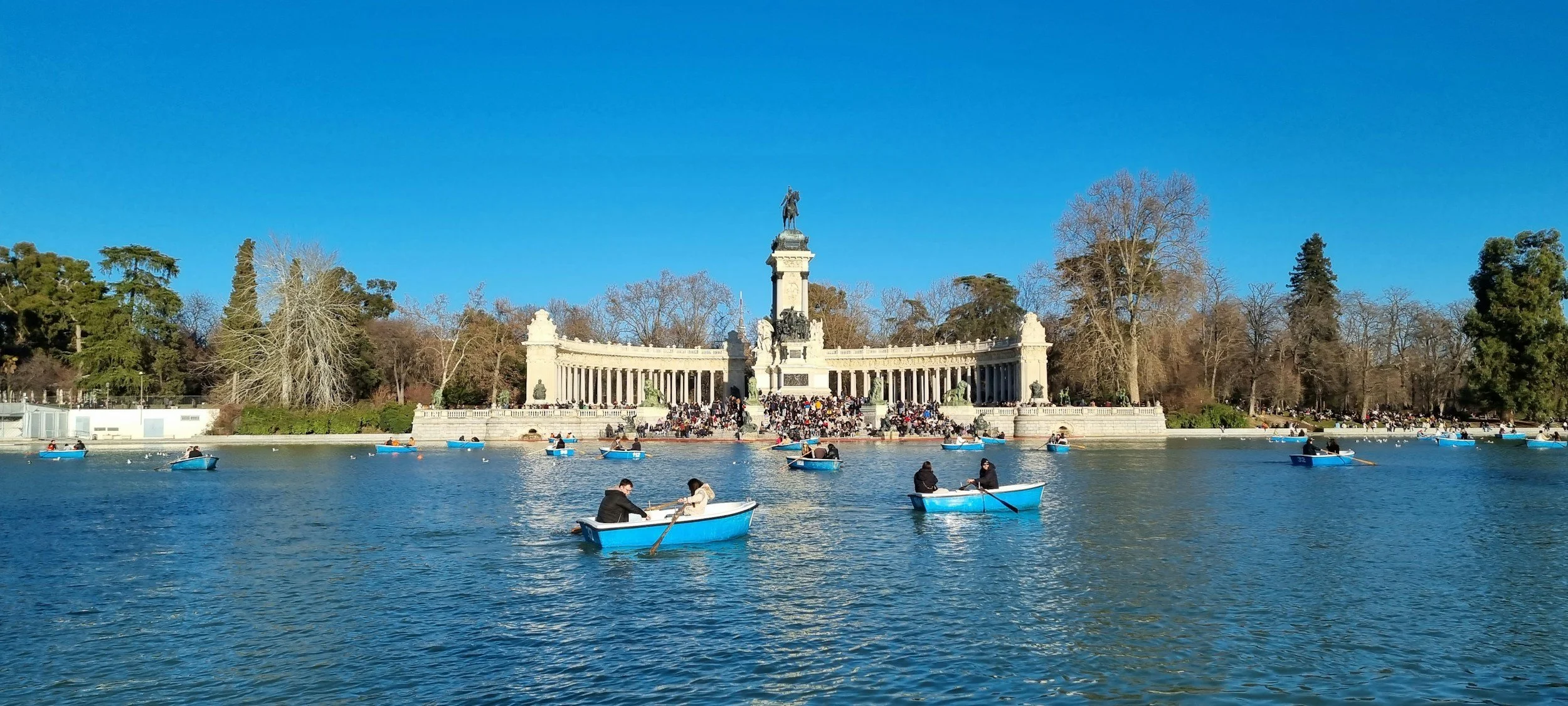
Retiro is Madrid's great park — 350 acres of formal gardens, tree-lined promenades, a rowing lake, and more statues per square meter than almost anywhere in Europe. But the photography centerpiece is the Palacio de Cristal, an iron-and-glass Victorian conservatory built in 1887 and modeled loosely on London's Crystal Palace. It stands at the edge of a small pond that reflects its structure with mirror precision on still mornings, creating one of the most compositionally satisfying images in the city.
📷 Pro Tip: Arrive at Retiro before 7am on a weekday and you will have the Palacio de Cristal and its reflection entirely to yourself. The morning light comes from the east and falls perfectly on the glass facade from about 7:30am onward in spring and summer. Shoot with a wide angle (16–24mm) for the full reflection composition, using the pond edge as a foreground anchor. The interior of the Palacio is used for temporary art exhibitions — check current programming, as the inside is often as photographically interesting as the exterior. Also look for the Monument to Alfonso XII on the east side of the lake, a curved colonnade that makes a strong architectural frame at golden hour.
Best time: Sunrise to 9am. Late afternoon in autumn for warm light on the park's turning leaves.
Temple of Debod
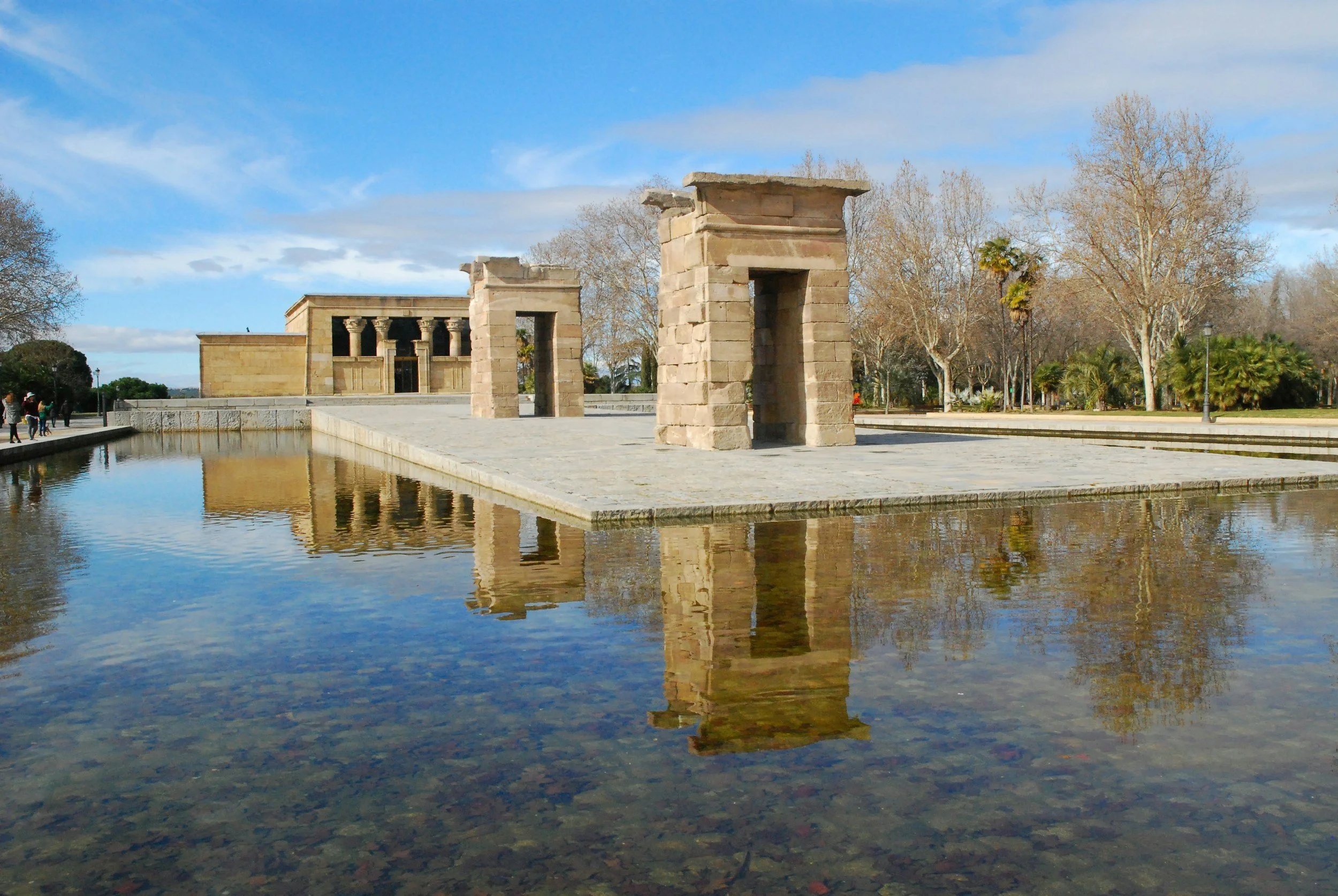
The most unexpected photography location in Madrid is a 2,200-year-old Egyptian temple sitting on an elevated park above the city. The Temple of Debod was gifted to Spain by Egypt in 1968 in gratitude for Spain's help preserving Abu Simbel from the Aswan Dam flooding. It was dismantled, shipped to Madrid, and reassembled in Parque del Oeste, where it has stood since 1972 with the entire western skyline of Madrid behind it.
At sunset, the temple turns golden and reflects in the shallow pools surrounding it. The sky beyond it — the Casa de Campo hills and the full sweep of the western horizon — gives you one of the most dramatic backgrounds in the city. It is the most popular sunset viewpoint in Madrid for good reason.
📷 Pro Tip: Arrive 30–45 minutes before sunset to find the perfect angle. The western side of the pool offers the most stunning reflections. Bring a tripod for the long-exposure transition from golden to blue hour when the temple begins to illuminate against the darkening sky. A 24–70mm handles both the full temple-and-reflection composition and tighter shots of the carved hieroglyphic details on the stonework. ND filters are useful for smoothing the water surface if there is any wind. Come on a weekday outside of summer for more manageable crowds.
Best time: One hour before sunset through blue hour. Free entry to the exterior; small fee for interior when open.
Plaza Mayor
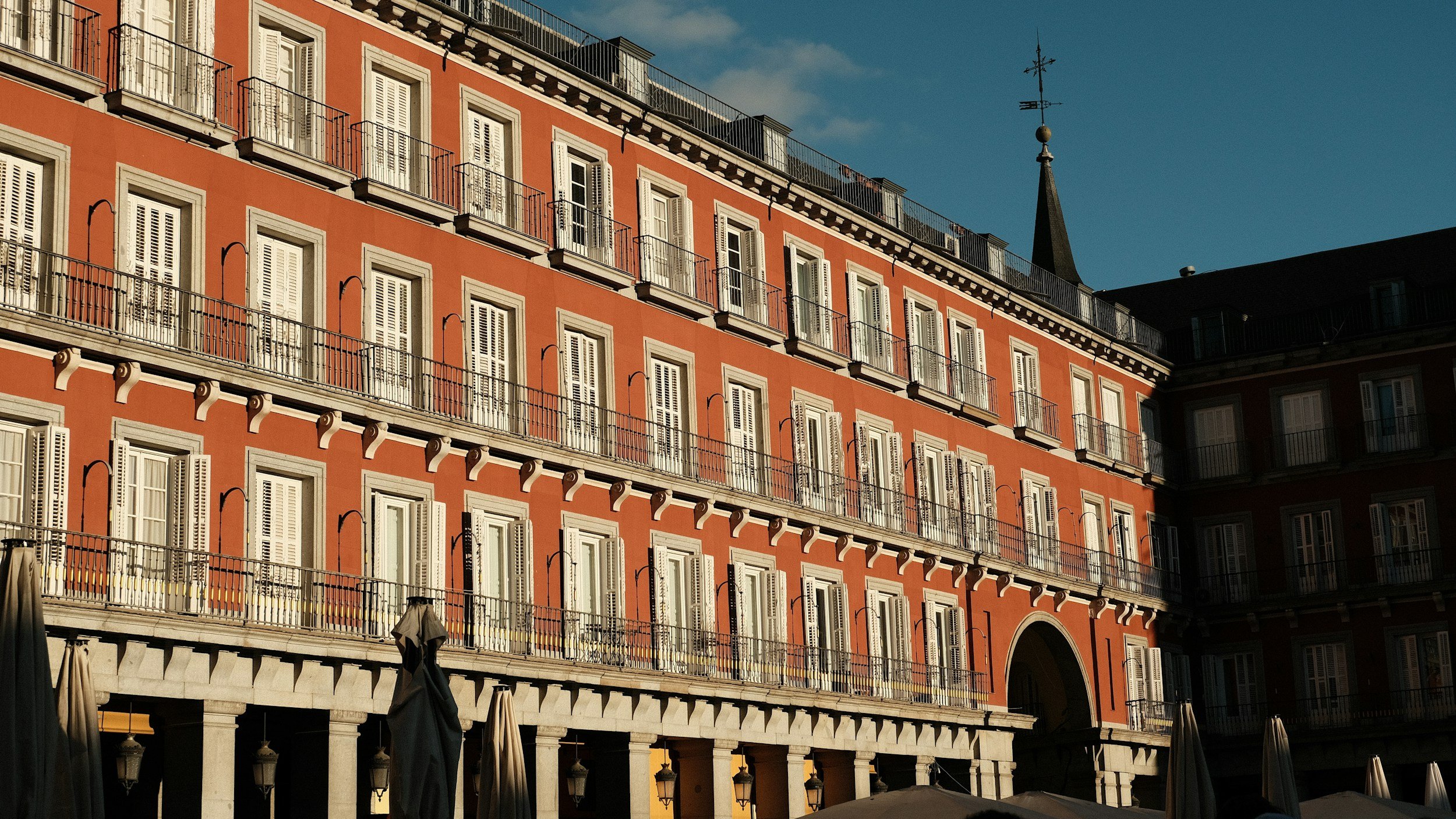
Madrid's great central square is one of the most architecturally satisfying spaces in Spain. Built between 1617 and 1619 under Philip III, it is a perfectly symmetrical rectangle of uniform red facades, painted archways, and spired towers, all enclosing a cobblestone plaza large enough to once host bullfights, royal coronations, and Inquisition trials. The equestrian statue of Philip III at the center, cast in 1616, predates the square itself.
📷 Pro Tip: The most photographed angle is from the corner arches, looking diagonally across the plaza with the painted facades receding in perspective. Come before 8am for the best light and empty cobblestones. In late afternoon, the western facades catch warm golden light and the contrast between the brick and the blue sky is exceptional. At night, the square is beautifully illuminated and makes a strong long-exposure subject with the surrounding restaurants adding warm ambient light. A 24–50mm handles both the wide compositional view and tighter architectural details.
Best time: Early morning for empty plaza. Late afternoon for the best light direction. Night for illuminated long exposures.
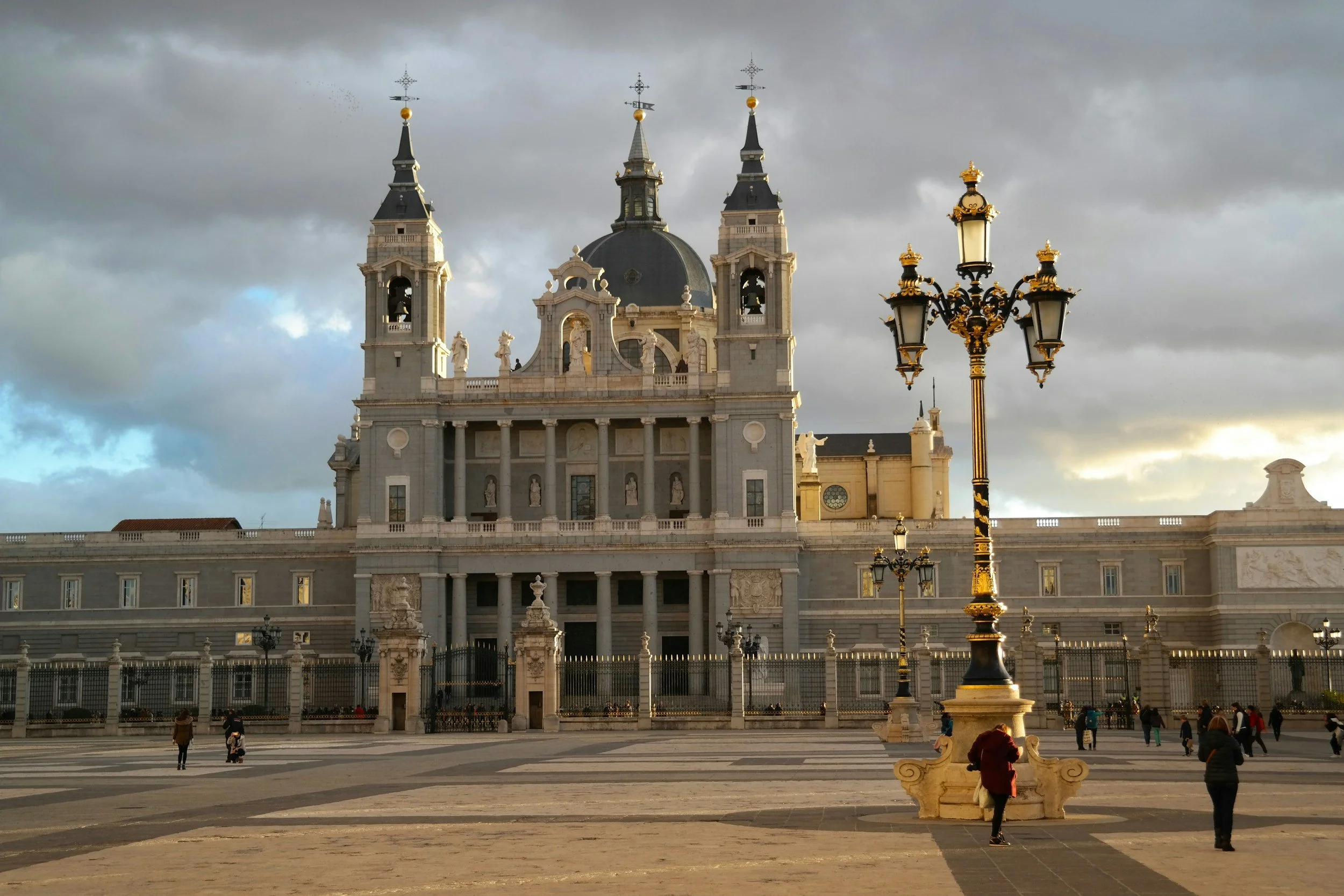
Royal Palace of Madrid and Almudena Cathedral
The Royal Palace is the largest royal palace in Western Europe by floor area, an 18th-century Baroque and Neoclassical structure with a facade that extends 135 meters on each side. Photography is not permitted inside, but the exterior and the surrounding gardens provide exceptional subject matter from every angle.
The Almudena Cathedral, directly east of the palace across a wide plaza, was completed only in 1993 despite construction beginning in 1879, making it one of the most recently built Gothic cathedrals in the world. The juxtaposition of palace and cathedral facing each other across Plaza de la Armería makes a distinctive dual architectural composition.
📷 Pro Tip: The view from the Sabatini Gardens, on the north side of the palace, gives you the full Baroque facade with formal garden hedgerows in the foreground — one of the best architectural compositions in Madrid. Early morning light from the east catches the stone facade from behind you. The view from the Viaducto de Segovia, a bridge directly south of the palace, frames the entire palace above the Manzanares valley. At night, the palace and cathedral are both illuminated and make a strong blue-hour pair composition from the plaza between them.
Best time: Morning for the Sabatini Gardens shot. Blue hour for illuminated facades.
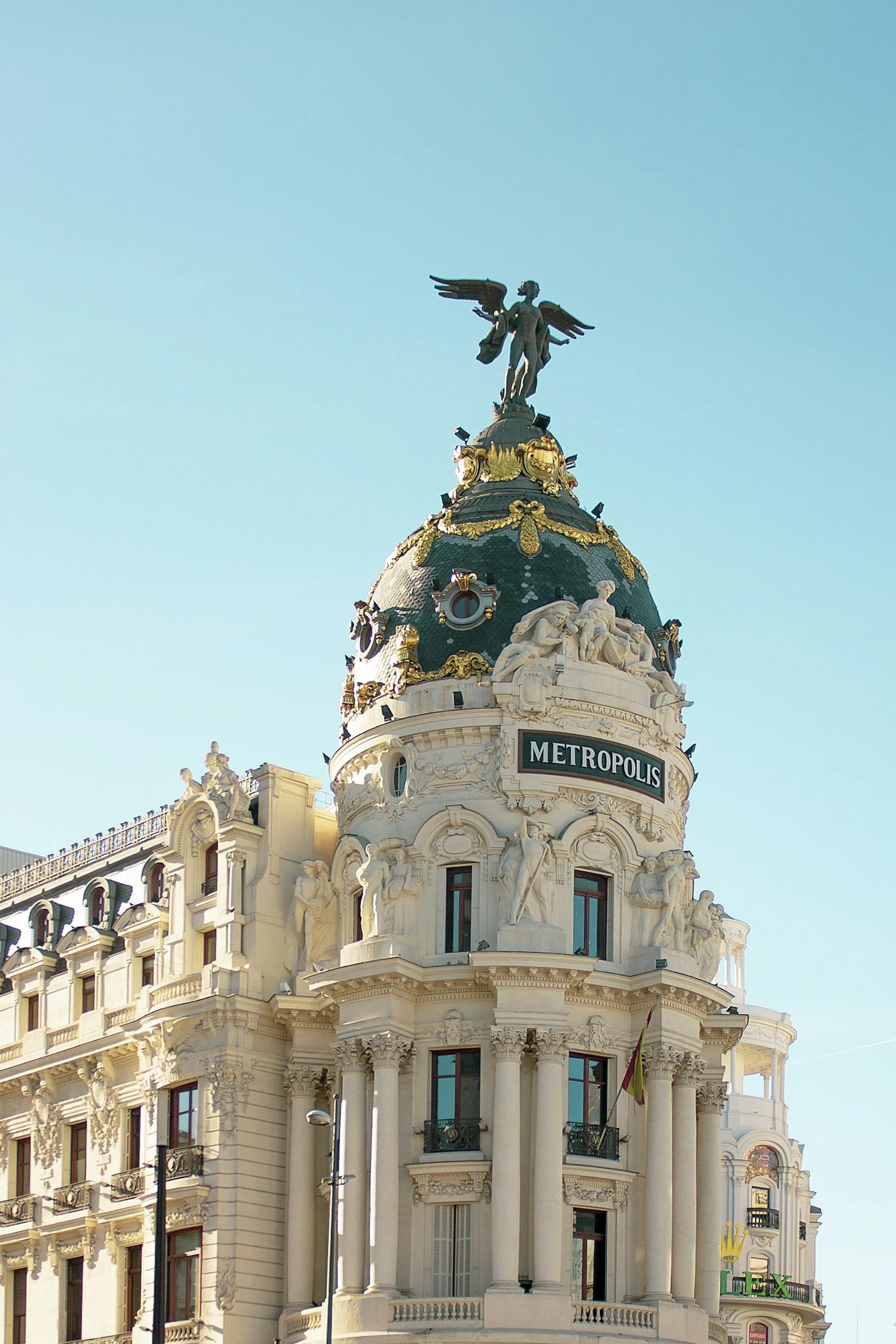
Gran Vía and the Metropolis Building
Gran Vía, Madrid's great boulevard, runs from the Cibeles fountain northwest through the heart of the city for 1.3 kilometers, lined with Art Deco and Beaux-Arts buildings, theaters, hotels, and the most concentrated display of early 20th-century architecture in Spain. At the southeastern end of Gran Vía where it meets Calle de Alcalá, the Metropolis Building (completed 1911) anchors the corner with its zinc cupola and allegorical sculptures — one of the most photographed buildings in Madrid.
📷 Pro Tip: The Metropolis Building photographs best from the corner of Calle de Alcalá, shooting up and west along Gran Vía with the cupola centered above the street. Blue hour gives you the building illuminated against a deep blue sky with the tram tracks and headlights below adding light trails. For the full Gran Vía architectural sweep, shoot from the Callao end looking southeast — the canyon of Beaux-Arts facades converging toward the Metropolis dome is one of the defining street photography compositions in Europe. A 35–50mm works well here; avoid too wide or the buildings lose their drama.
Best time: Blue hour. Long exposure with tripod for light trails from the traffic.
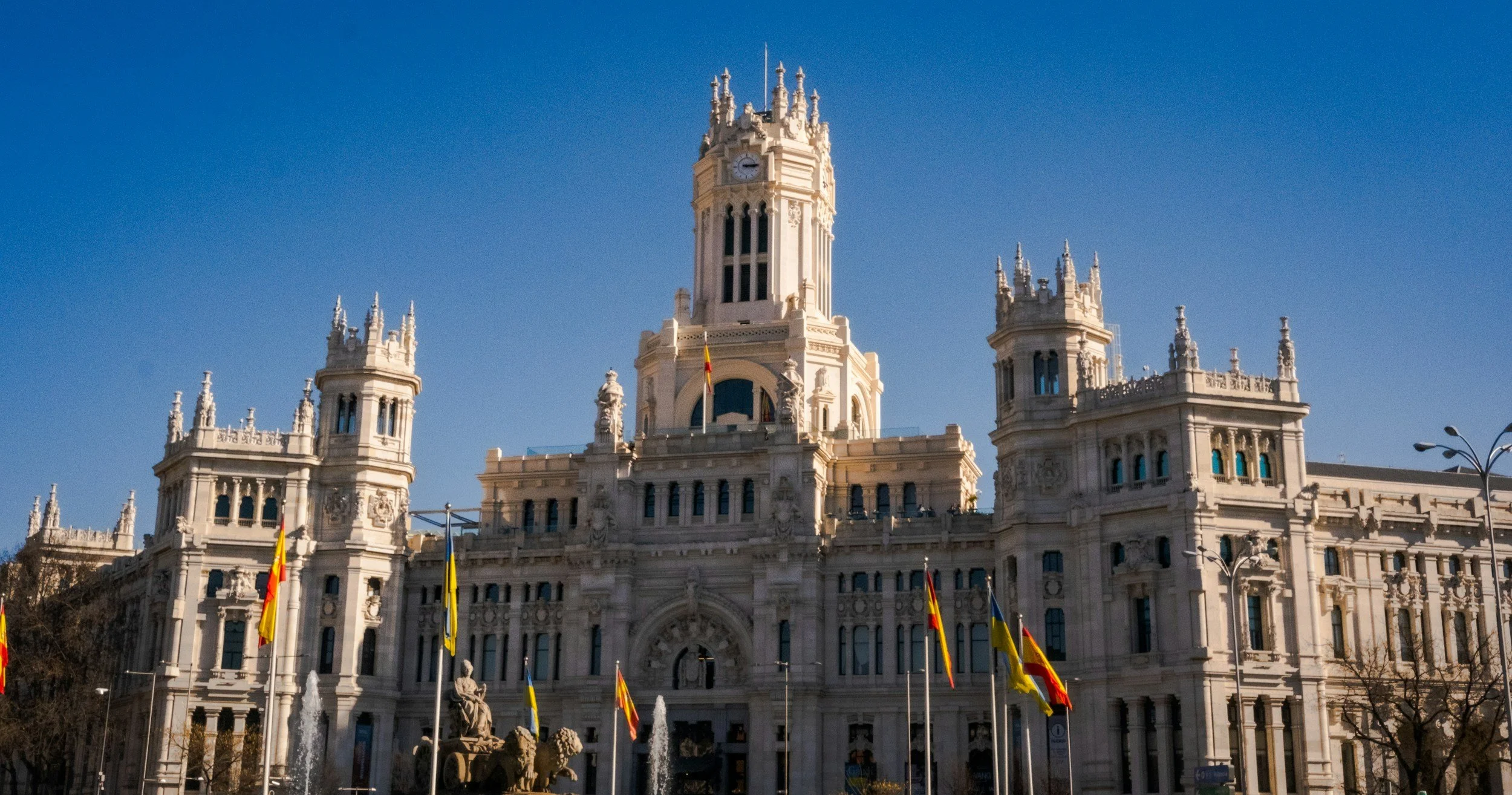
Plaza de Cibeles and the Palacio de Cibeles
The Cibeles Fountain, built in 1782 in honor of the goddess Cybele, sits at the intersection of Paseo del Prado and Calle de Alcalá in what is probably the most dramatic urban intersection in Madrid. Real Madrid fans celebrate championships here by the thousands. The Palacio de Cibeles (formerly the Central Post Office), an extraordinary example of Plateresque Neo-Gothic architecture completed in 1919, rises immediately behind the fountain.
📷 Pro Tip: The fountain-and-palace combination photographs beautifully from the southeast corner of the intersection, with the Palacio rising behind the lit fountain at blue hour. The Mirador del Palacio de Cibeles on the sixth floor of the building is one of the best elevated viewpoints in central Madrid, with a 360-degree panorama that includes Gran Vía, the Retiro treeline, and the Prado. Open to the public at a small charge. Shoot the interior atrium of the Palacio as well — it has exceptional structural photography potential with a wide angle.
Best time: Blue hour for the exterior. Any time for the Mirador viewpoint.
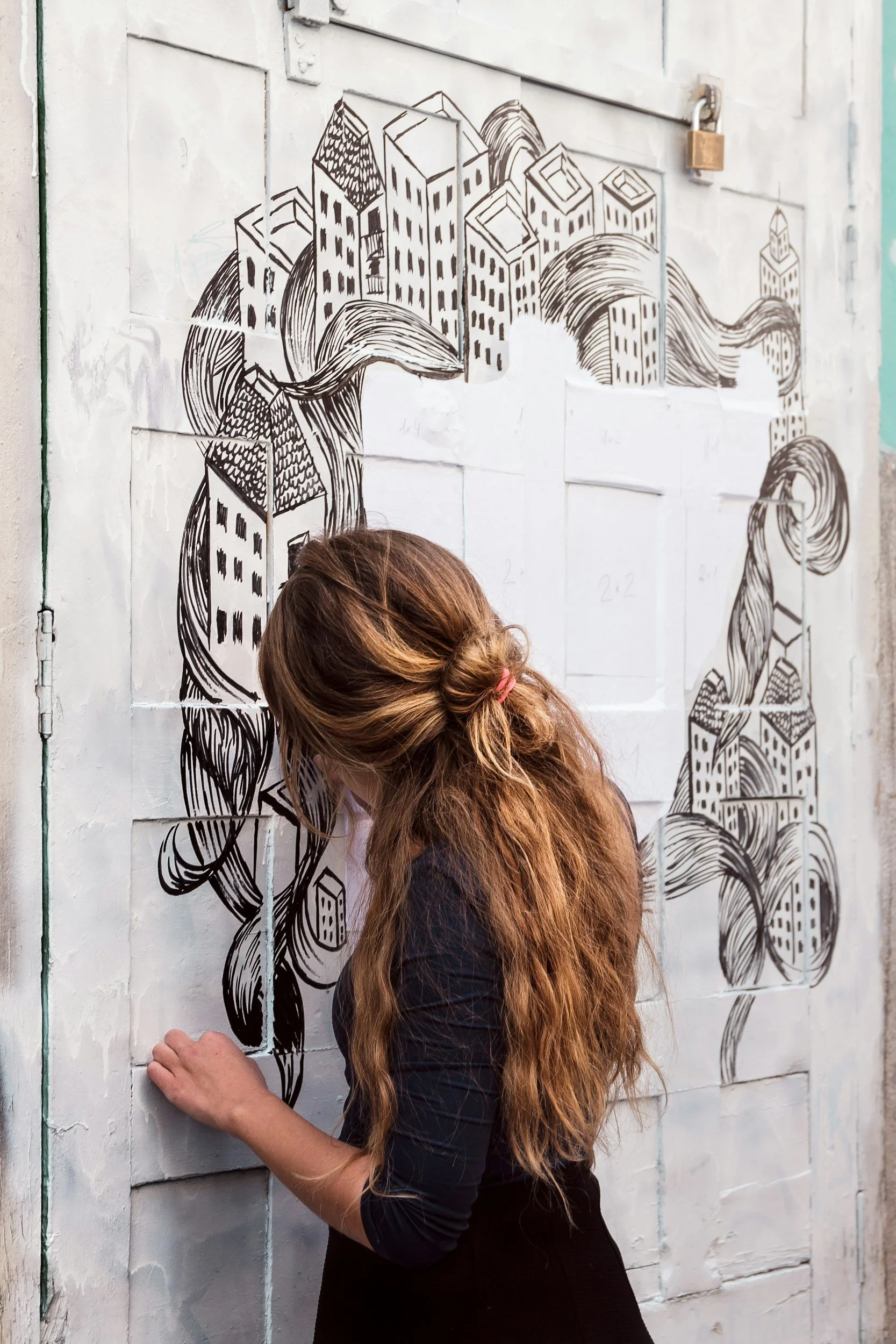
Malasaña and Chueca (Street Photography and Street Art)
Malasaña is the neighborhood that gave Madrid its countercultural reputation during the Movida Madrileña in the late 1970s and early 1980s, and it has never entirely left that spirit behind. The streets around Plaza del Dos de Mayo are lined with independent cafés, record shops, vintage stores, and gallery walls covered in murals. It is the best area in Madrid for street photography and urban texture.
Chueca, immediately east of Malasaña, is Madrid's LGBTQ+ neighborhood and one of the most vibrant urban villages in the city — colorful facades, lively terraces, and a community energy that is unlike anywhere else in the center.
📷 Pro Tip: Come to Malasaña on a weekend morning when the local residents are out and the tourist crowds have not yet arrived. A 35mm is the right focal length for this neighborhood — compact, unobtrusive, and wide enough to capture both the street level and the buildings above. For murals, bring a wide angle and position yourself to capture the full scale of the painted walls with people passing in the foreground for scale.
Best time: Weekend mornings for street life. Evenings for the illuminated bar and café scene.
El Rastro Flea Market
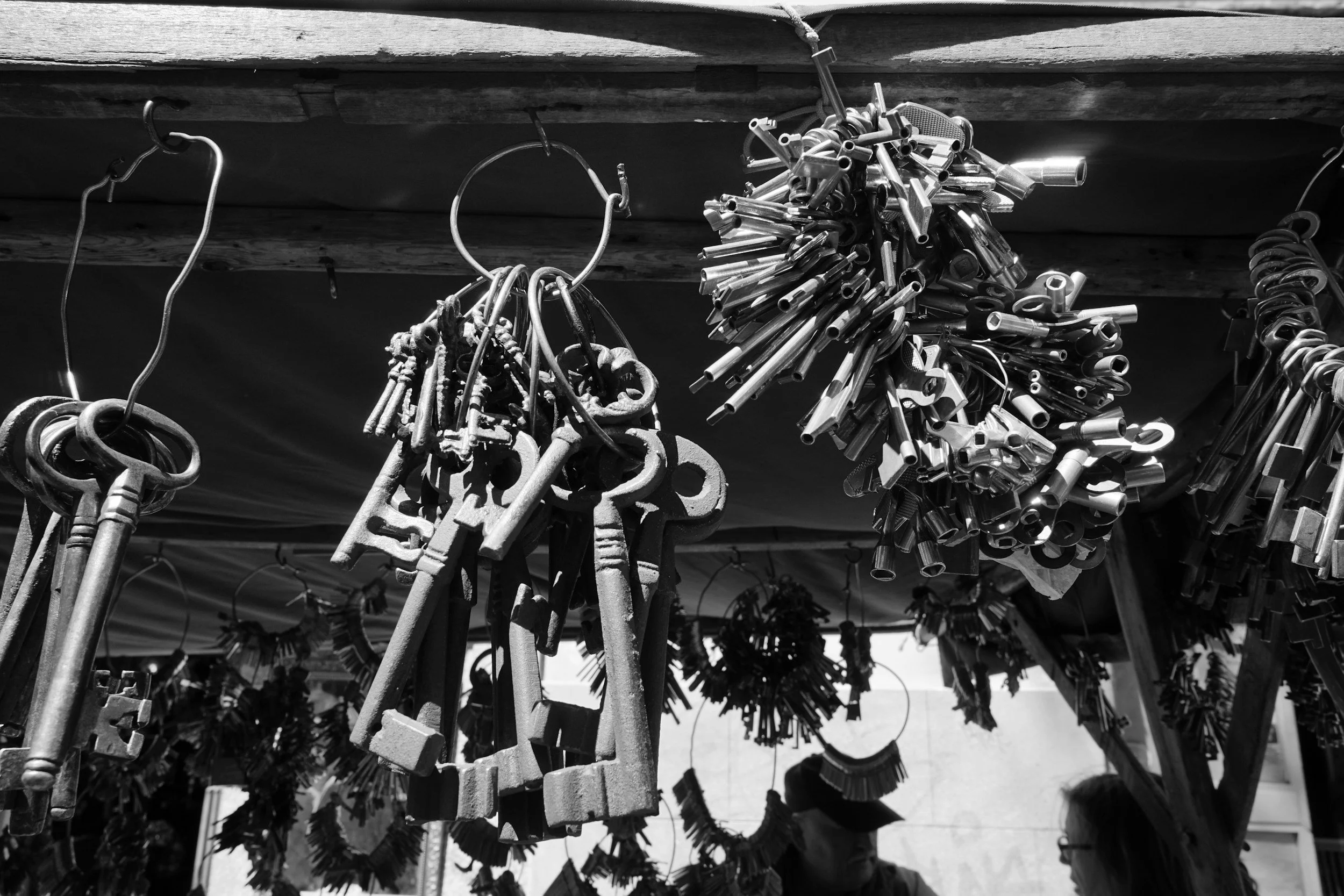
On Sunday mornings, several hundred market stalls fill the steep streets of La Latina between Plaza de Cascorro and the Ribera de Curtidores, selling antiques, vintage clothing, vinyl records, tools, art, and the kind of accumulated miscellany that makes a market genuinely worth photographing. El Rastro is the largest and oldest flea market in Madrid, operating on this site since the 15th century, and it is one of the best street photography environments in the city.
📷 Pro Tip: Arrive by 9am before the densest crowds, when vendors are still arranging their stalls and the light is low and directional from the east. A 35–50mm prime keeps you mobile and unobtrusive for candid vendor and crowd photography. After the market closes (usually by 3pm), the entire La Latina neighborhood moves to Calle de Cava Baja for tapas and afternoon drinks — follow them.
Best time: Sunday mornings, 9 am–1 pm. Free entry.
Puerta del Sol
The symbolic center of Spain — the point from which all road distances in the country are measured, marked by a stone plaque in the pavement — is less a photography location than an orientation point and a subject of continuous urban energy. The Bear and the Strawberry Tree statue (the symbol of Madrid) at the corner of Calle del Carmen is the most-photographed single object in the square.
📷 Pro Tip: Puerta del Sol is challenging to photograph well because it is almost always crowded and the sightlines are compromised by the constant pedestrian flow. The best compositions are early morning (before 7 am) when the square is quiet, and the equestrian statue in the center is visible, or at night when the illuminated facades and the moving crowd create strong long-exposure opportunities. Frame the Bear and the Strawberry Tree with a 50mm lens and wait for a clear moment.
Best time: Early morning for empty compositions. Blue hour for illuminated facades.

Royal Palace of Madrid
Special Festivals and Holidays
San Isidro Festival (May): Madrid's biggest festival, honoring the city's patron saint with parades, concerts, and traditional events.
Madrid Pride (June/July): One of the largest LGBTQ+ celebrations in Europe, featuring vibrant parades and parties.
Christmas Markets (December): Experience the festive spirit with beautiful lights, markets, and holiday events.

Final Thoughts
Madrid is a city that does not reveal itself immediately. Give it three days and you will find it pleasant. Give it five and something else happens. You start to understand the rhythm. You stop rushing between locations and start lingering. You have a second coffee. You stay at the lunch table until 4pm. You come back to the Temple of Debod on a different evening because the light was better than you expected the first time.
For photographers, Madrid rewards return. Come back to the same location at different times of day. Photograph Plaza Mayor before the cafés open and then again when they are full. Shoot El Retiro at sunrise and the same pond at golden hour. The city changes entirely depending on when you point your camera at it.
For travelers, Madrid is the city that asks you to slow down to its pace rather than demanding you speed up to the tourist standard. Eat late. Walk instead of taking the metro when you can. Sit at the bar instead of the table.
The art, the food, the light, the noise, the silence at 6am in the Retiro — Madrid stays with you because it gives you all of it at once, without apology, and expects you to keep up.
If you are in Madrid, Spain has more to offer within easy reach. Here is where I would go next.
My Photography & Travel Guide to Toledo, Spain One hour south of Madrid by high-speed train or car. The "City of Three Cultures" sits above the Tagus River in a setting that has barely changed since El Greco painted it. The Mirador del Valle panorama at golden hour is one of the most dramatic views in Spain, and the narrow medieval streets reward the photographer who stays past the day-trip crowd.
Best Photography Locations in the World My complete bucket list of the world's best photography destinations, with links to every guide.
Follow along on Instagram and subscribe to my newsletter below for photography and travel guides from 75+ countries. Find my photography workshops here.
Are you carrying too much camera gear… but still coming home with disappointing travel photos?
You’re not alone. Most travel photographers fall into “The Packing Trap” — overpacking, under-planning, and constantly scrambling to capture the shot… while missing the moment.
This powerful, step-by-step eBook is your shortcut to a better way.
The 5-Step Photographer’s Guide to Planning the Perfect Travel Adventure is a field-tested blueprint that helps you:
Travel light without sacrificing image quality
Plan smarter trips that lead to better, more intentional photos
Find breathtaking destinations at the perfect time
Create a shoot-ready itinerary that works with your creative style
Avoid the stress, fatigue, and overwhelm that kills your best work
Written by travel photographer Vito L Tanzi, it’s the system I personally use to craft stress-free photo trips that result in his best images.
Whether you're heading off on your first international shoot or leveling up your local weekend getaways, this guide will help you make the most of every trip.
📸 Format: PDF download